On this page
If you are studying for the JEE or NEET, your day likely moves from one class straight into the next. You might close a physics textbook and immediately open chemistry, or sit through a 90-minute lecture and then jump straight into another. When you study like this, the first few minutes of the new class often feel like a blur.
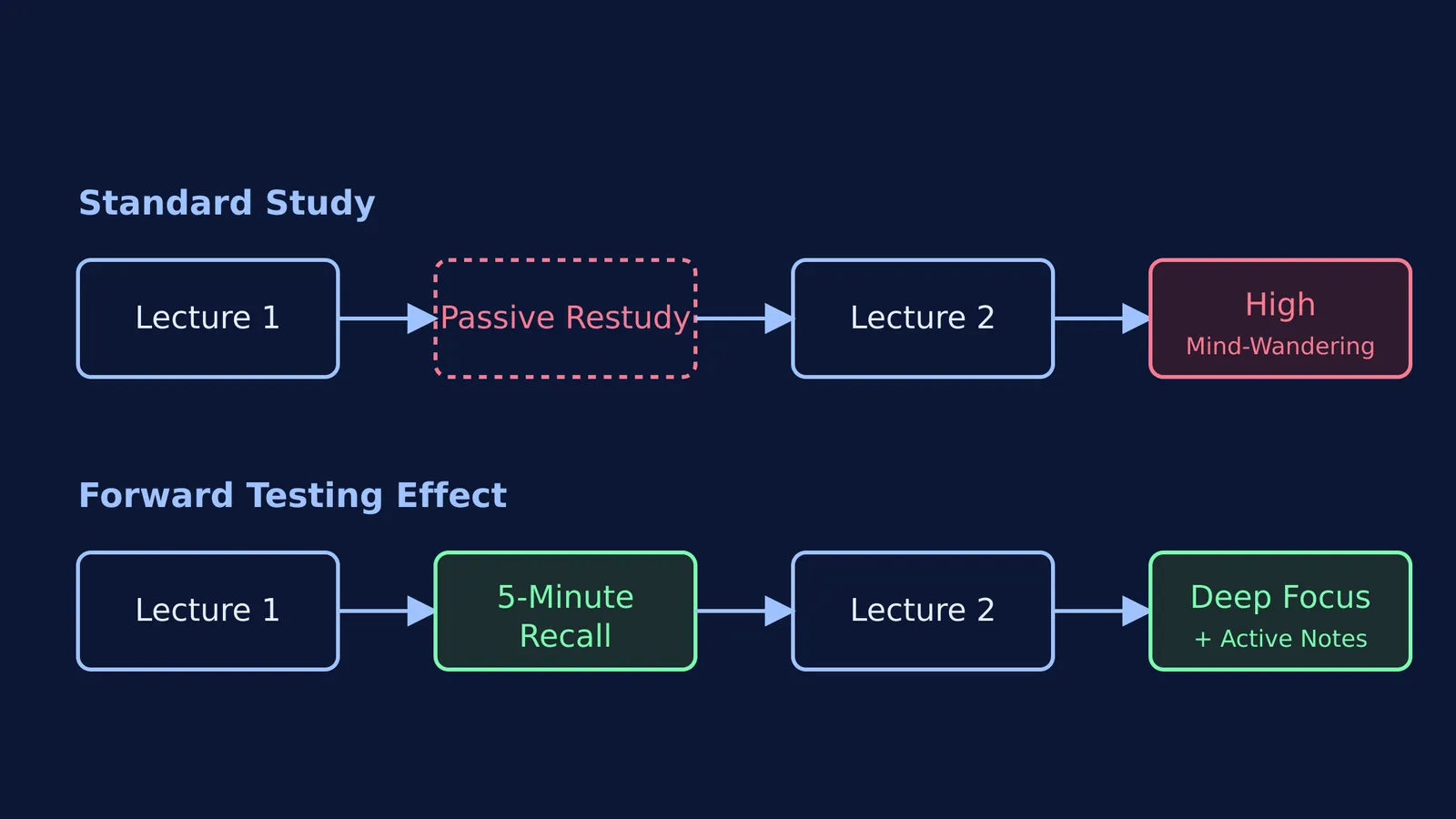
The simplest way to break this blur is a five-minute recall: trying to remember what you learned in the last session before the new one begins. Doing this without looking at your notes clears your head and makes the new material easier to follow.
Why do we lose focus in back-to-back classes?
Psychologists have long known that practice tests help you remember the material you just reviewed. But it turns out that testing also prepares your brain for the *next* piece of information. This is called the "forward testing effect."
When your brain processes a long block of information without a break, it eventually hits a limit on what it can hold in working memory. If you watch a video on kinematics and immediately switch to a lecture on thermodynamics, the equations from the first subject can bleed into the second. This mental clutter is what makes back-to-back classes so draining.
When you try to recall what you just learned, you create a clear boundary between the old topic and the new one. This stops old facts from interfering with new ones, a problem researchers call proactive interference. It also acts as a mental reset button, snapping your attention back to the present.
What is the forward testing effect?
A 2013 study published in the *Proceedings of the National Academy of Sciences* tested this idea on 80 students who watched a 21-minute online statistics lecture (Szpunar et al., 2013). The lecture was split into four segments. One group of students was given a brief recall test after each of the first three segments, while another group simply restudied the material or did unrelated maths problems.
The results were striking. The students who took the brief tests reported significantly less mind-wandering and took more than twice as many notes during the lecture than those who did not. They also performed better on a final test covering the entire lecture and reported feeling less anxious about the exam.
By frequently checking what they knew, the tested group naturally stayed in an active state of learning. They spent less time daydreaming because they expected they would need to use the information soon.
How to revise the previous class before the next class?
You do not need a formal quiz to get these benefits. You just need to actively retrieve information. Here is a simple routine you can use in the five minutes before your next class begins:
The blank page dump: Close all your books and take out a blank sheet of paper. Spend two minutes writing down everything you can remember from the last class on this subject. List the formulas, the main concepts, and any sticking points you encountered.
The "what is next" guess: Spend one minute predicting what the teacher will cover today. Look at the chapter heading if you need to, but try to guess how it connects to what you just wrote down.
The quick check: Open your notes from the last class and spend two minutes comparing them to your blank page. Fix any mistakes and fill in the biggest gaps.
If you are taking an online course, resist the urge to let the next video auto-play immediately. Pause the playback, look away from the screen, and run through the blank page dump. Even if you only have two minutes between live classes, use that time to mentally list three key takeaways from the session that just ended. This routine requires no special equipment, but it forces you to confront what you actually know. It is a highly effective way to learn from video lectures or live classes and keeps you engaged.
What if you cannot remember anything?
Sometimes, you will sit down to do a recall and draw a blank. This is completely normal, and it is actually a useful signal. Failing to retrieve a fact creates a knowledge gap. This gap primes your brain to actively look for the missing information when the teacher begins speaking. Instead of passively receiving facts, you are suddenly on a mission to find the answer.
If you find yourself stuck, try sketching out a concept map with whatever fragments you do remember, or try to recall the very last problem you solved.
This is also where a smart study tool can step in. When you start a session with Fermi's AI tutor, it works out what you already know before introducing a new concept. It builds a plan for the session and teaches through it, checking your understanding as it goes rather than just delivering a lecture. This kind of active engagement is the opposite of passively watching a video, and it helps ensure that each new idea has a solid foundation to land on.
Making the five-minute recall a daily habit will change how you experience your classes. Instead of feeling overwhelmed by a flood of new information, you will arrive at each lesson primed, focused, and ready to learn.