
On this page
Put a resistor at the end of two rails and a sliding rod slows down and stops. Put a capacitor there and a rod pushed by a steady force speeds up at a constant rate. Put an ideal inductor there and something different happens: the rod swings back and forth like a mass on a spring, joining induction, inductance and oscillations in one line of algebra.
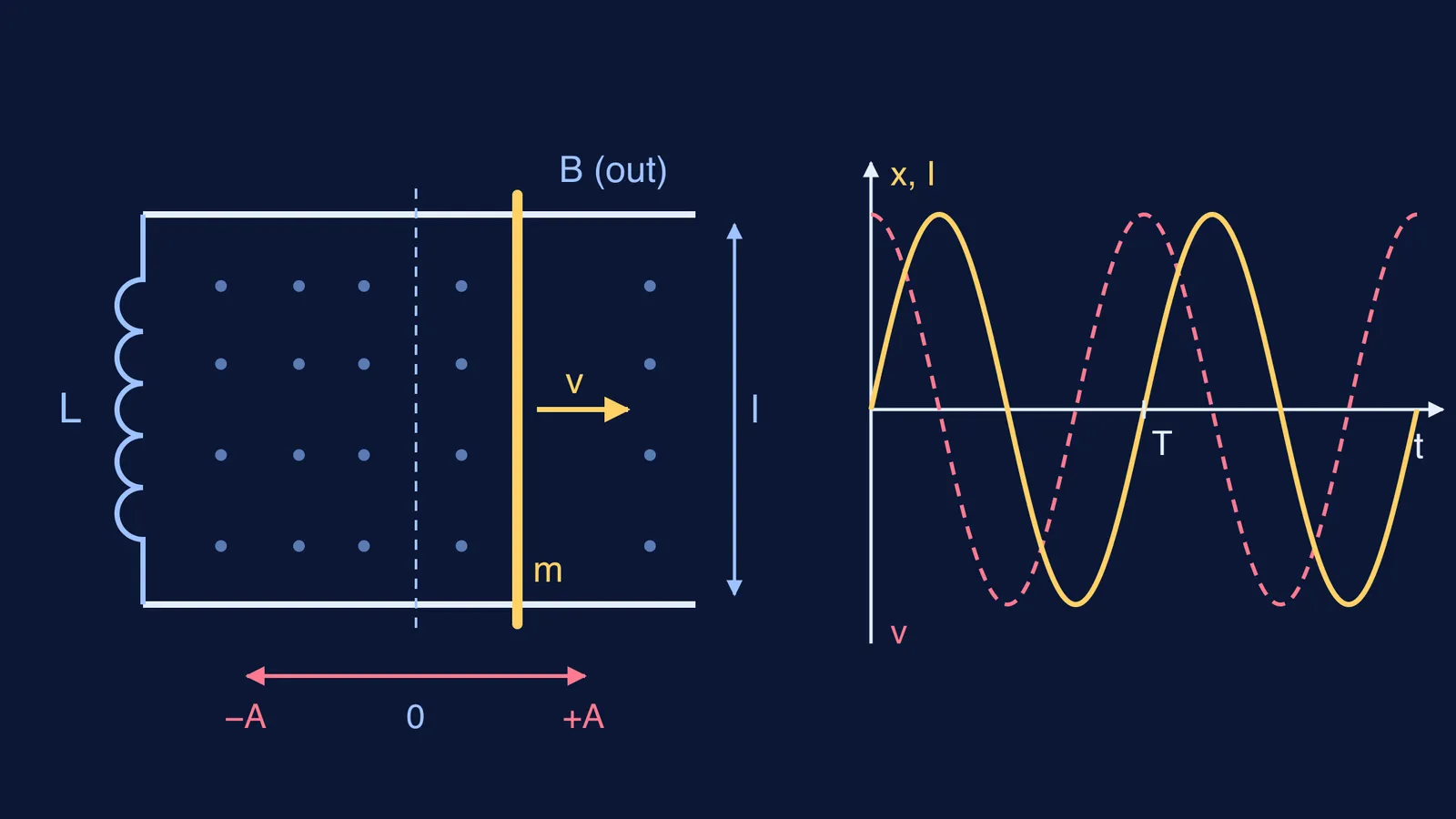
The set-up: frictionless rails a distance l apart lie in a uniform field B perpendicular to their plane, with a conducting rod of mass m across them. An ideal inductor L joins the rails, and nothing has resistance. At t = 0 the rod is at x = 0, the current is zero, and the rod is given a speed v0.
What are the three equations you need?
Motional EMF: a rod of length l moving at speed v through a field B has EMF ε = Blv (OpenStax, section 13.3).
Inductor EMF: an inductor opposes changes in its current with an EMF of size L dI/dt (OpenStax, section 14.2).
Magnetic force: a rod carrying current I in field B feels a force of size IlB (OpenStax, section 13.3).
The test for SHM is the one in OpenStax University Physics Volume 1: the net force must be proportional to the displacement and act opposite to it, and then ω = √(k/m).
How do you derive ω = Bl/√(mL) step by step?
Write Kirchhoff's loop rule. With zero resistance, the only two EMFs in the loop must balance: Blv = L dI/dt.
Replace v with dx/dt: Bl dx/dt = L dI/dt.
Integrate from the start, where x = 0 and I = 0. You get LI = Blx, so I = Blx/L. The current depends only on where the rod is, not its speed.
Find the force. The force on the rod is IlB in size and always points back towards x = 0, where the current is zero. So F = −IlB = −(B²l²/L)x.
Compare with F = −kx. The effective spring constant is k = B²l²/L.
Use ω = √(k/m) to get ω = √(B²l²/(mL)) = Bl/√(mL), and T = 2π√(mL)/(Bl).
The amplitude follows from the starting speed. In SHM the maximum speed is Aω, so A = v0/ω = v0√(mL)/(Bl). The peak current is BlA/L = v0√(m/L).
Check it with energy. An inductor stores U = ½LI² (OpenStax, section 14.3). At the turning point the rod is still, so ½mv0² = ½LI², giving I = v0√(m/L) again. With no resistor, nothing is lost and the motion never dies down.
Worked example: what are the period and amplitude?
Take B = 0.5 T, l = 0.4 m, m = 0.1 kg, L = 0.02 H and v0 = 2 m/s.
Bl = 0.2 T m and mL = 0.002 kg H, so √(mL) ≈ 0.0447.
ω = 0.2/0.0447 ≈ 4.47 rad/s.
T = 2π/4.47 ≈ 1.41 s.
A = v0/ω = 2/4.47 ≈ 0.447 m.
Peak current = 2 × √(0.1/0.02) = 2√5 ≈ 4.47 A.
So x = 0.447 sin(4.47t) metres, and I = Blx/L = 10x amperes, in step with the position.
What if the rod is pushed by a constant force instead?
If a steady force F pulls the rod from rest, m d²x/dt² = F − (B²l²/L)x. That is still SHM with the same ω, but the centre moves to x0 = FL/(B²l²). The rod oscillates between 0 and 2x0. With F = 0.5 N and the numbers above, x0 = 0.25 m, so it swings between 0 and 0.5 m.
How is this different from a resistor or capacitor on the rails?
Resistor: the force is proportional to v, so the rod decays to rest. See how far a rod on rails travels before it stops.
Capacitor: the force is proportional to the acceleration, which simply adds to the mass, so a steady push gives constant acceleration, as shown in rod on rails with a capacitor.
Inductor: the force is proportional to x, so you get SHM. It is the mechanical twin of LC oscillations: energy swaps between the rod's kinetic energy and the inductor's magnetic energy instead of between capacitor and inductor.
If the sign in step 4 still feels shaky, try more rails problems in the Fermi Problem Library, where the step-by-step solver explains the reasoning rather than printing an answer. If the motion is hard to picture, the Fermi Simulation Lab has interactive simulations for ideas easier to see than to read.
Next time you meet a rod on rails, ask one question first: is the force on it proportional to v, to a, or to x?