
On this page
On a curve, a train needs a sideways push towards the centre. Indian Railways gets that push by tilting the track. The Indian Railways Permanent Way Manual (2020) says the level of the inner rail is taken as the reference and "the super-elevation is provided by raising the outer rail" (para 402). Engineers call this raise cant or superelevation. Here is the formula, derived and then checked on a real broad-gauge curve.
Why is the outer rail raised on a curve?
A train of mass m going round a curve of radius r at speed v needs a centripetal force mv²/r. On flat track only the wheel flanges, pressing sideways on the outer rail, can supply it; that wears the rail and throws passengers outwards.
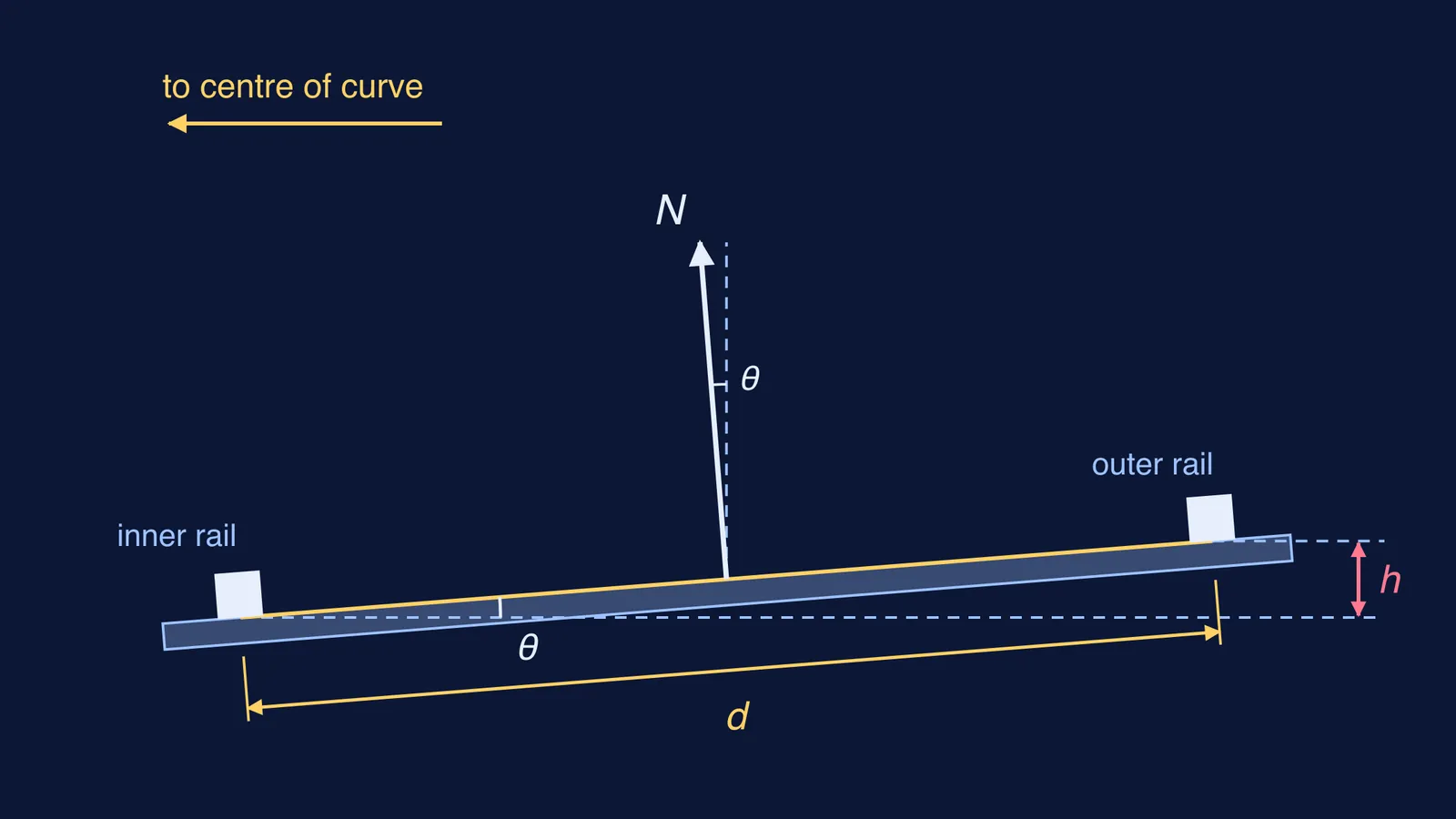
Tilt the track instead, and the normal reaction from the rails leans towards the centre. Its horizontal part now supplies the centripetal force. NCERT derives the same idea for a banked road: with no friction, the optimum speed is v₀ = (Rg tan θ)^½, and "at this speed, frictional force is not needed to provide the necessary centripetal force" (NCERT Class 11 Physics, Laws of Motion, Eq. 4.22). For a train, the flange force plays the part that friction plays for a car.
How do you derive h = d·v²/(rg)?
Take the train at its design speed, the frictionless case in the NCERT chapter, so no flange force is needed.
Two forces act: weight mg straight down, and the normal reaction N perpendicular to the tilted track.
Vertical balance: N cos θ = mg.
Horizontal, towards the centre: N sin θ = mv²/r.
Divide the two: tan θ = v²/(rg). The mass cancels, which is why the banking angle depends on speed, not vehicle mass.
Geometry: the rails are d apart along the tilted sleeper and the outer one sits h higher, so sin θ = h/d.
Railway banking angles are small, so sin θ ≈ tan θ. That gives h = d tan θ = d·v²/(rg).
How much is the outer rail raised on Indian broad gauge?
Indian broad gauge is 1676 mm; the Permanent Way Manual lists the "Schedule of Dimensions 1676 mm Gauge (BG)" among the rules an assistant divisional engineer must know (para 102). For curves, though, the manual's speed formulas assume a centre-to-centre distance between railheads of 1750 mm (para 403), and its cant formula uses G, the dynamic gauge: the nominal gauge plus the width of the railhead (para 404).
Worked example: d = 1.750 m, design speed 100 km/h, curve radius r = 1000 m, g = 9.81 m/s².
Convert speed: v = 100 ÷ 3.6 = 27.78 m/s, so v² = 771.6 m²/s².
Banking angle: tan θ = 771.6 ÷ (1000 × 9.81) = 0.0787, so θ ≈ 4.50°.
Small-angle height: h = 1.750 × 0.0787 = 0.1376 m, about 137.6 mm (137.2 mm with the exact sin θ).
Round as the railway does: the manual rounds calculated cant to a multiple of 5 mm (para 404), so the curve gets 140 mm.
If you plug in 1676 mm instead, you get about 131.8 mm, roughly 6 mm low.
There is a ceiling too. The manual caps design cant at 185 mm on Group A and B routes, 165 mm on other broad-gauge routes, and 140 mm on track with turnouts (para 404). At 165 mm, our 1000 m curve would be balanced for about 109 km/h.
Why does Indian Railways write it as C = GV²/127R?
It is the same formula in engineers' units. In the Permanent Way Manual, C and G are in mm, R in metres (para 404) and V in km/h (para 403). Since v = V/3.6, v²/g = V²/(3.6² × 9.81) = V²/127.1, and 127 is that number rounded. Check it: 1750 × 100² ÷ (127 × 1000) = 137.8 mm, the same answer as above.
On a shared line, a faster train runs with cant deficiency and a slower one with cant excess. The manual limits cant excess to 75 mm. It limits cant deficiency to 100 mm or 150 mm for nominated rolling stock and 75 mm for other stock (para 404).
What do students get wrong in cant problems?
Before the final answer, check:
Convert km/h to m/s before squaring.
Use the d the question gives; in railway practice that is the railhead centre distance, not the gauge.
Check the angle is small (h/d well under 0.1) before using sin θ ≈ tan θ.
Give h in mm and compare it with the cant limits above. An answer several times those limits usually means a unit slip.
If the question gives h and asks for speed, invert the formula: v = √(rgh/d).
If your number disagrees with the answer key, the Fermi Problem Library has worked problems with a step-by-step solver that explains the reasoning rather than printing an answer, so you can see which line went wrong.
Next, add friction with maximum safe speed on a banked road and then practise mixed circular motion banking problems.