
On this page
You are driving onto a curve that tilts inward. How fast can you go before the tyres slide outward? And can you go so slowly that the car slides down the slope? This standard Class 11 and JEE Main question needs one free-body diagram, drawn twice with friction reversed.
What is the maximum safe speed on a banked road with friction?
For a curve of radius r, banked at angle θ, with coefficient of static friction μ between tyres and road, the maximum safe speed is v_max = √[rg(μ + tan θ)/(1 − μ tan θ)], as derived in this LibreTexts chapter on banking_Circular_Motion/20.02:_Banking).
With no friction, only one speed works: tan θ = v²/(rg), the ideal banking condition in OpenStax University Physics. Friction widens that single speed into a range. In OpenStax's words, friction "allows you to take the curve at greater or lower speed than if the curve were frictionless."
How do you derive v² = rg(μ + tan θ)/(1 − μ tan θ)?
At top speed the car is about to skid up and out of the curve, so static friction acts down the slope, as the LibreTexts notes_Circular_Motion/20.02:_Banking) explain, and reaches its limit μN.
Three forces act: weight mg down, the normal reaction N perpendicular to the road, and friction μN downhill along it. The centripetal acceleration is horizontal, so resolve horizontally and vertically:
Horizontal (towards the centre): N sin θ + μN cos θ = mv²/r
Vertical: N cos θ − μN sin θ = mg
Divide the first by the second: v²/(rg) = (sin θ + μ cos θ)/(cos θ − μ sin θ)
Divide top and bottom by cos θ: v² = rg(μ + tan θ)/(1 − μ tan θ)
Both m and N cancel, so the answer does not depend on how heavy the car is.
Is there a minimum speed on a banked road?
Sometimes. If you go too slowly, the car tends to slide down the slope, so friction now points up the slope. Flip the sign of each friction term:
Horizontal: N sin θ − μN cos θ = mv²/r
Vertical: N cos θ + μN sin θ = mg
Result: v_min² = rg(tan θ − μ)/(1 + μ tan θ)
This matches the minimum-speed expression in the Wikipedia article on banked turns. If μ is at least tan θ, the top of the fraction is zero or negative, so there is no minimum. The car could even stand still on the slope without sliding.
Worked example: a 30 m curve banked at 15°
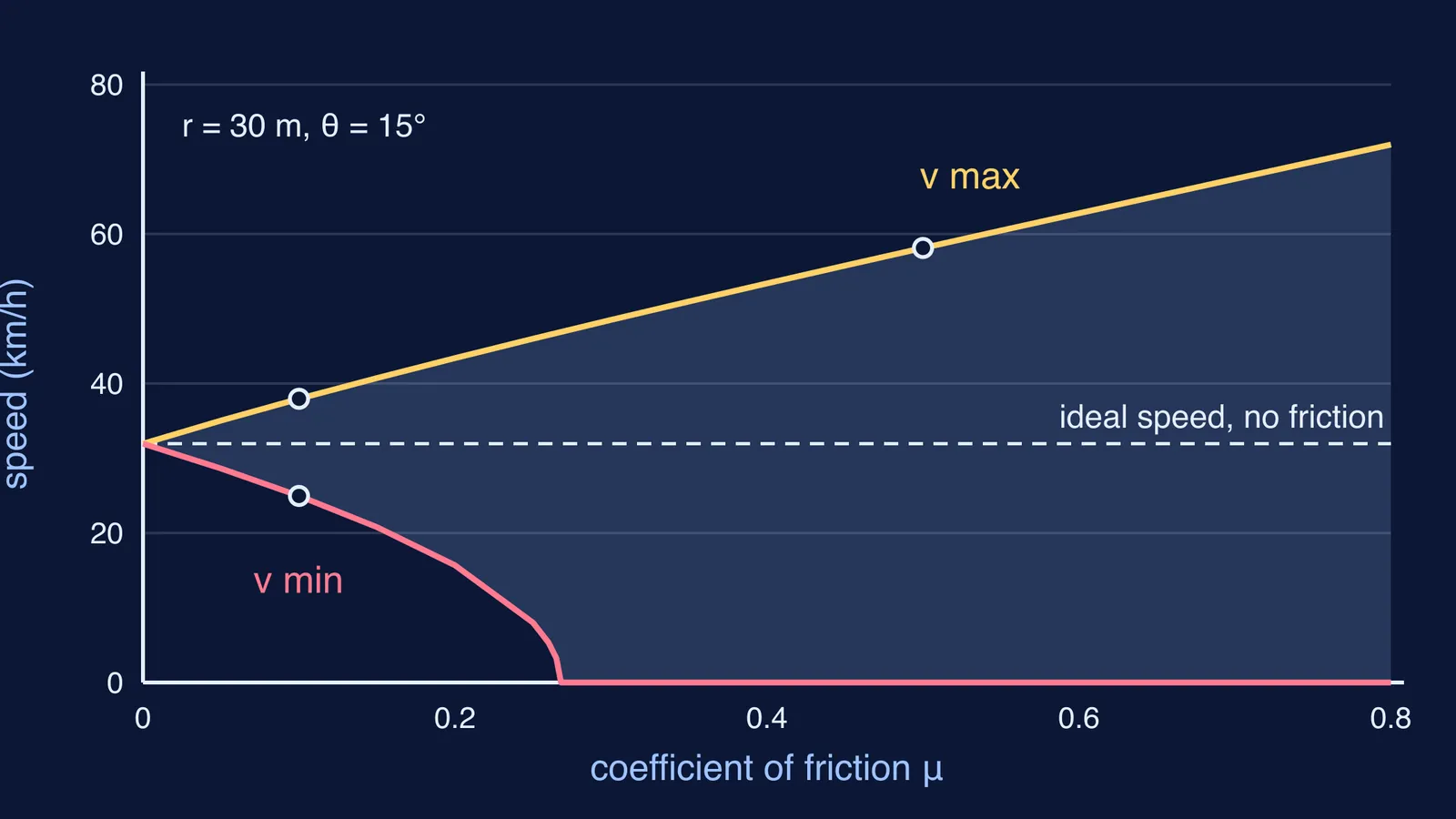
Take r = 30 m, θ = 15° (tan θ ≈ 0.268) and g = 9.8 m/s², so rg = 294 m²/s². For tyre grip, the OpenStax friction table gives static coefficients of 1.0 for rubber on dry concrete, 0.5 to 0.7 for rubber on wet concrete and 0.1 for ice on ice. We work out two cases: a wet road (μ = 0.5) and an icy one, using the ice-on-ice value μ = 0.1 as a rough stand-in for tyres on ice.
Case 1: wet road, μ = 0.5
Ideal speed (no friction): v₀² = 294 × 0.268 ≈ 78.8, so v₀ ≈ 8.9 m/s, about 32 km/h.
Maximum: v² = 294 × (0.5 + 0.268)/(1 − 0.134) = 294 × 0.887 ≈ 260.7, so v_max ≈ 16.1 m/s, about 58 km/h.
Minimum: μ is bigger than tan θ, so there is none. A parked car stays put.
Case 2: icy road, μ = 0.1
Maximum: v² = 294 × 0.368/0.973 ≈ 111.2, so v_max ≈ 10.5 m/s, about 38 km/h.
Minimum: v² = 294 × 0.168/1.027 ≈ 48.1, so v_min ≈ 6.9 m/s, about 25 km/h.
On ice, the safe range shrinks to roughly 25 to 38 km/h, centred near the 32 km/h ideal speed.
Which mistakes cost marks in banking problems?
Always drawing friction the same way. It points down the slope for v_max and up the slope for v_min.
Putting the whole of mv²/r along the slope. The centripetal acceleration is horizontal, so its component along the slope is (v²/r) cos θ.
Writing N = mg cos θ out of inclined-plane habit. On a curve, N comes out of the two equations and is generally different.
If friction direction keeps catching you out, the Fermi Problem Library has worked problems with a step-by-step solver that explains the reasoning rather than printing an answer. For ideas that are easier to see than to read, the Fermi Simulation Lab has interactive simulations.
For more practice, try these banked-road circular motion problems, read why the banking angle depends on speed, not mass, and work through what happens when a speeding car skids on a circular track.