

On this page
Fast curves on highways and racetracks tilt towards the inside. This is called banking. A common Class 11 and JEE doubt is why one tilt works for a light scooter and a loaded truck. Surely the heavier vehicle needs more help to turn?
It does need more force. But it also brings more force with it, and the algebra shows this in three lines.
Where does tan θ = v²/rg come from?
Take the ideal case: a car on a frictionless road banked at angle θ, going round a curve of radius r at speed v. Only two forces act on it, its weight mg straight down and the normal force N perpendicular to the road. The OpenStax University Physics section on centripetal force sets up exactly this case.
Vertically, nothing accelerates, so N cos θ = mg.
Horizontally, the car needs a centripetal force towards the centre, so N sin θ = mv²/r.
Divide the second equation by the first: tan θ = v²/(rg).
The m on the right of each equation cancels when you divide. OpenStax states the result directly: "Note that θ does not depend on the mass of the vehicle."
Why does a heavier vehicle not need a steeper bank?
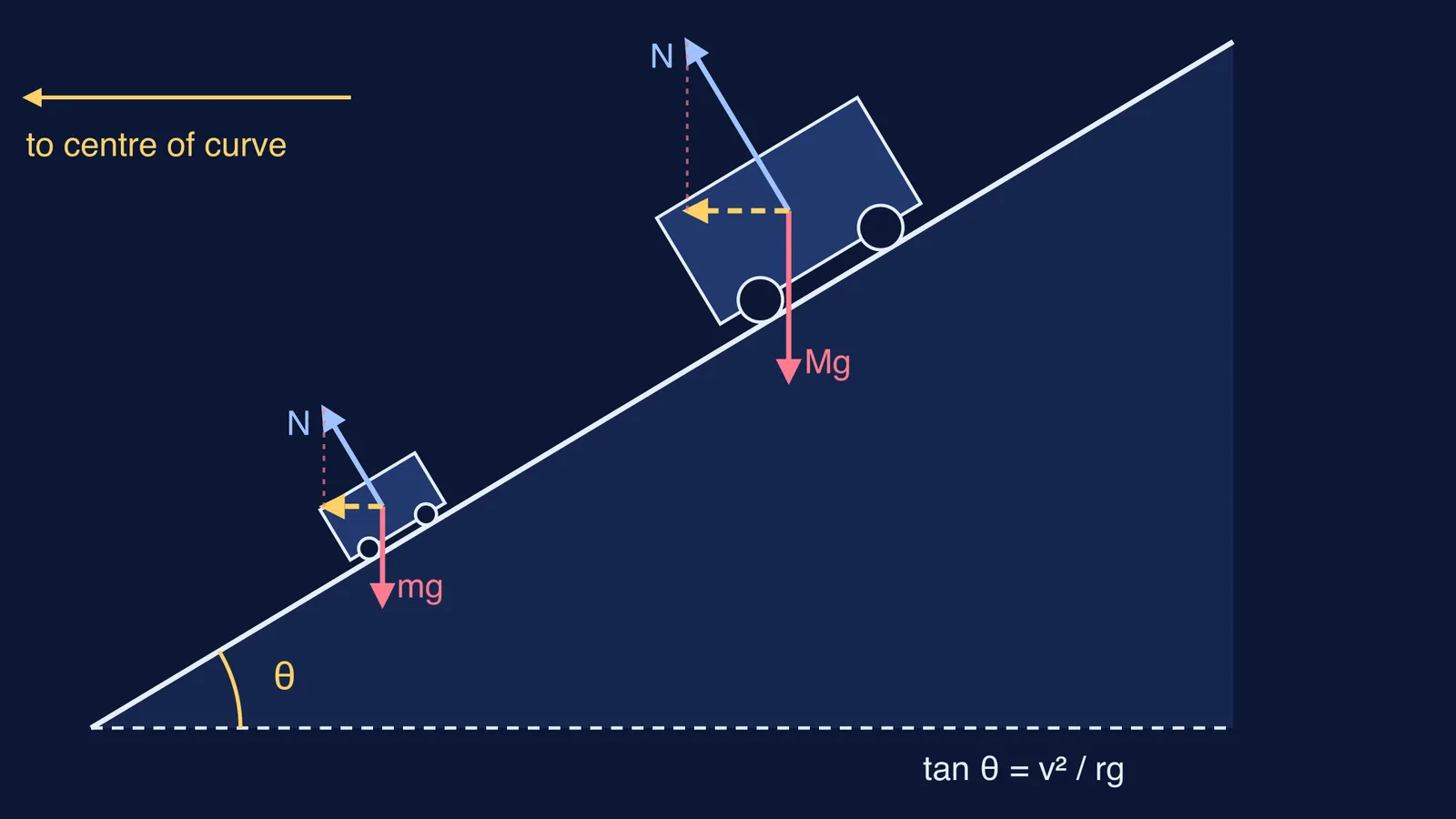
Think of the normal force as a tilted push. Its vertical part holds the vehicle up; its horizontal part turns it. On a given bank, the ratio of the two is fixed at tan θ. A heavier vehicle presses harder into the road, so the road pushes back harder, and both parts grow by the same factor.
The diagram above shows two vehicles on the same 31° bank. The heavier one has longer arrows, but the force triangles have the same shape, and both net forces point towards the centre of the curve.
What does change the banking angle?
Speed does, and strongly, because it enters the OpenStax banking equation as v². Here is a worked example you can check on a calculator, using g = 9.8 m/s².
A curve has radius 100 m and a design speed of 54 km/h, which is 15 m/s.
tan θ = 15² / (100 × 9.8) = 225 / 980 = 0.230, so θ is about 12.9°.
A 150 kg scooter needs a centripetal force of 150 × 225 / 100 = 337.5 N. On this bank, the horizontal part of its normal force is mg tan θ = 150 × 9.8 × 0.2296 = 337.5 N. It matches.
A 15,000 kg truck needs 33,750 N. Its normal force supplies 15,000 × 9.8 × 0.2296 = 33,750 N. It also matches.
Now double the speed to 30 m/s. tan θ = 900 / 980 = 0.918, so θ jumps to about 42.6°. Twice the speed needs far more than twice the angle.
Radius matters too: a tighter curve (smaller r) needs a steeper bank at the same speed. Mass never appears.
What happens above or below the design speed?
Real roads have friction, and that is what lets vehicles use a banked curve at speeds other than the ideal one. The NCERT Class 11 Physics chapter on laws of motion calls the ideal speed the optimum speed, v₀ = (Rg tan θ)^½, and notes that driving at this speed causes little wear and tear of the tyres because friction is not needed. NCERT adds that below v₀, friction acts up the slope; above v₀, it acts down the slope.
NCERT's Example 4.11 is worth doing yourself. A racetrack of radius 300 m is banked at 15°, with a coefficient of friction of 0.2 between tyres and road. The optimum speed works out to 28.1 m/s, and the maximum permissible speed before slipping is 38.1 m/s. The formula for that maximum speed contains R, g, θ and the friction coefficient, and still no mass.
How to check your own banking answers
Before you move on from a banked-road problem, check:
Did you draw only real forces: weight, normal force and (if given) friction? Centripetal force is the net result, not an extra arrow.
Did you resolve N vertically and horizontally, not along the slope? The acceleration is horizontal, towards the centre.
Did the mass cancel? If m is left in your final angle or speed, recheck your algebra.
Is your speed in m/s? Using km/h in v²/rg is the most common slip.
Does the answer make sense? Higher speed or a tighter curve should give a larger angle.
For more practice, work through our set of circular motion and banking problems. If you want to see the forces move as you change speed and angle, try the banked road circular motion simulation walkthrough, or open the Fermi Simulation Lab, which has interactive simulations for ideas that are easier to see than to read.
If your answers keep coming out with the wrong angle, the Fermi Problem Library has worked problems with a step-by-step solver that explains the reasoning rather than printing an answer, so you can see exactly which line went wrong.


