
On this page
On a banked curve the outer edge is higher than the inner edge, so the road itself pushes the car towards the centre. Here you drive a car round a banked curve in a simulation, predict the one speed at which it needs no friction, then predict which way friction points when you go faster or slower.
What is the safe speed on a banked curve without friction?
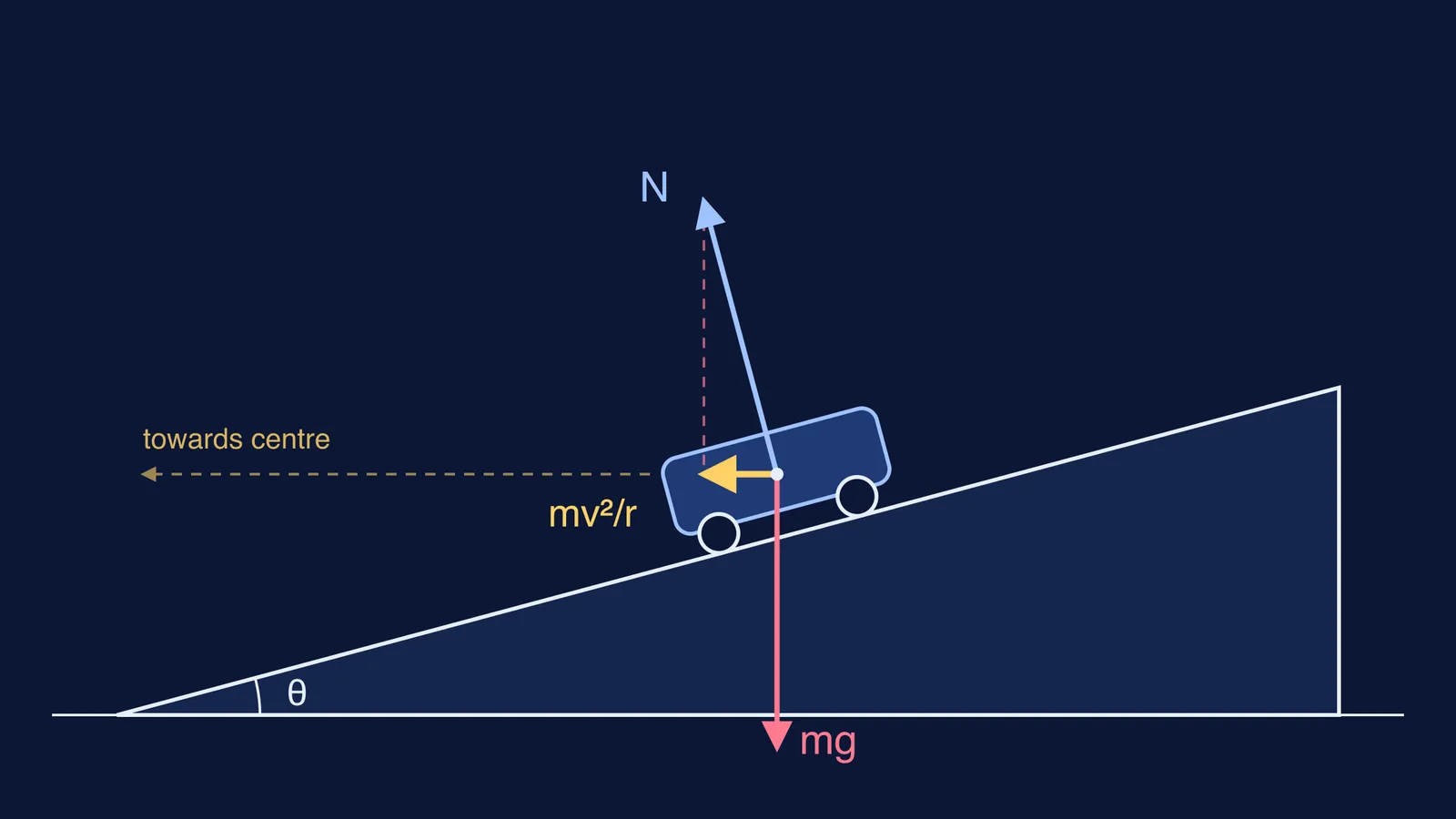
On a frictionless banked road only two forces act on the car: its weight mg, straight down, and the normal force N, perpendicular to the road. The vertical part of N balances the weight, N cos θ = mg. The horizontal part supplies the centripetal force, N sin θ = mv²/r. Divide one by the other and both N and m cancel.
On a banked road without friction, tan θ = v²/rg, so the friction-free speed is v₀ = √(rg tan θ). That speed is equation 4.22 in the NCERT Class 11 Physics textbook, Chapter 4 Laws of Motion, which notes that at this speed friction is not needed to provide the centripetal force, and driving at it causes little wear and tear of the tyres.
Mass has dropped out. A scooter and a loaded truck have the same friction-free speed on the same curve.
NCERT's Example 4.11 puts numbers in: a racetrack of radius 300 m banked at 15° has an optimum speed of 28.1 m/s, about 101 km/h, with g = 9.8 m/s² (NCERT, Chapter 4).
Which way does friction act if you go faster or slower than v₀?
Faster than v₀: the car needs more centripetal force than N alone gives, so it tends to slide up and out. Static friction acts down the slope, adding an inward push.
Slower than v₀: the horizontal part of N is too big, so the car tends to slide down and in. Static friction acts up the slope. NCERT states this case directly: for v < v₀, friction is up the slope, and a car can be parked on the bank only if tan θ ≤ μs (NCERT, Chapter 4).
Exactly v₀: friction is zero.
This is static friction, as our post on why the friction in a turning car is static, not kinetic explains.
With friction, the safe speeds form a window. The same NCERT example, with μs = 0.2, gives a maximum of 38.1 m/s, about 137 km/h (NCERT, Chapter 4). Flip the direction of friction in its formula and the minimum is v_min = √(rg (tan θ − μs)/(1 + μs tan θ)), about 13.8 m/s (50 km/h) for that track.
How do you test tan θ = v²/rg in a simulation?
Use any simulation where you can set bank angle, radius, speed and friction, and start from the track in NCERT Example 4.11.
Set friction to zero, r = 300 m, θ = 15°. Predict v₀, then run at it and check the car holds its lane.
Keep friction at zero and drive a little faster, then a little slower. Predict which way the car drifts each time.
Turn friction on with μs = 0.2. Drive at 20 m/s and at 35 m/s. Before each run, draw the free-body diagram with friction pointing the way you expect.
Double the car's mass. Predict v₀ again. It should not change.
Halve the radius. Since v₀ grows as √r, it should fall by a factor of √2.
Worked example: a 1,000 kg car on the NCERT track
Use the track from NCERT Example 4.11: r = 300 m, θ = 15°, g = 9.8 m/s², μs = 0.2. Taking down the slope as positive, friction is f = m(v²/r × cos θ − g sin θ).
At 20 m/s (72 km/h), below v₀: f = 1000 × (1.288 − 2.536) ≈ −1,249 N. The minus sign means friction acts up the slope.
At 35 m/s (126 km/h), above v₀: f = 1000 × (3.944 − 2.536) ≈ +1,408 N, down the slope.
The normal force is N = m(g cos θ + v²/r × sin θ), about 9,810 N at 20 m/s and 10,520 N at 35 m/s. The ratio f/N is about 0.13 both times, under μs = 0.2, so the car holds the curve.
Where do students go wrong with banked curves?
Writing N = mg cos θ, as on an inclined plane. The car accelerates horizontally, so at v₀ N = mg/cos θ, which is more than mg.
Fixing friction's direction before comparing the speed with v₀.
Using kinetic friction for a car that is not skidding.
For a car speeding up on a flat track, read when an accelerating car skids on a circular track. For loops instead of turns, try the vertical circular motion simulation.
The Fermi Simulation Lab has interactive simulations for the ideas that are easier to see than to read. If friction's arrow still feels backwards, Fermi's AI tutor can draw the figure, run the simulation and check your understanding as it goes.