
On this page
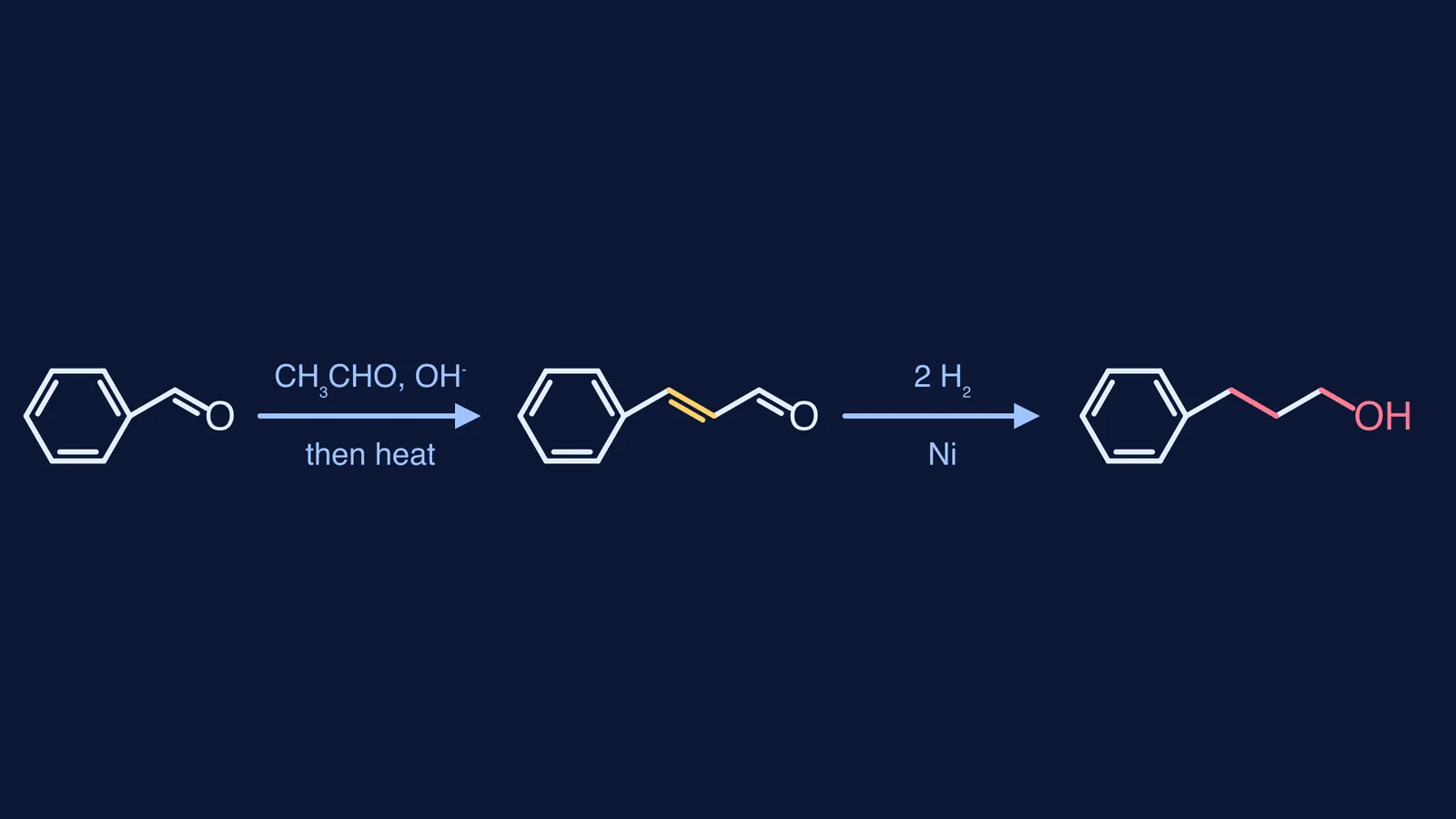
Benzaldehyde has seven carbons; 3-phenylpropan-1-ol has nine. So any route has to add two carbons and finish with a saturated chain ending in CH2OH. The standard textbook route takes two steps: a cross aldol condensation with ethanal, then catalytic hydrogenation. Here is why each step works, how to write it in an exam, and the slips that cost marks.
What does converting benzaldehyde to 3-phenylpropan-1-ol actually change?
Start by comparing formulas, because they give you the plan.
Cinnamaldehyde, the intermediate, is (E)-3-phenylprop-2-enal, C9H8O, with a molar mass of 132.16 g/mol (PubChem, cinnamaldehyde).
The target, 3-phenylpropan-1-ol, is C9H12O, with a molar mass of 136.19 g/mol (PubChem, 3-phenylpropan-1-ol).
Benzaldehyde (C6H5CHO) supplies the ring and one carbon. Ethanal (CH3CHO) supplies the other two. Then four hydrogen atoms, which is two molecules of H2, turn C9H8O into C9H12O.
Why does benzaldehyde give a clean cross aldol with ethanal?
NCERT defines the aldol reaction this way: aldehydes and ketones with at least one α-hydrogen react in dilute alkali to give β-hydroxy aldehydes or ketones, which lose water on heating to give α,β-unsaturated carbonyl compounds (NCERT Class 12 Chemistry Part II, Unit 8). The same chapter warns that a cross aldol between two partners that both have α-hydrogens gives a mixture of four products.
Benzaldehyde avoids that mess because it has no α-hydrogen. That is also why NCERT uses it as an example of the Cannizzaro reaction, which only aldehydes without an α-hydrogen undergo. So only ethanal can form an enolate. That enolate attacks the benzaldehyde carbonyl to give 3-hydroxy-3-phenylpropanal, and heating removes water to give cinnamaldehyde, C6H5CH=CHCHO. The new C=C is conjugated with both the ring and the C=O.
The main competing reaction is ethanal reacting with itself, which NCERT shows gives but-2-enal. For the full arrow-pushing, see our walk-through of the aldol condensation mechanism, step by step, and our explainer on why α-hydrogens next to a carbonyl are acidic for where the enolate comes from.
This is not only a textbook trick. An early synthesis of cinnamaldehyde, the compound that gives cinnamon its flavour, was the aldol condensation of benzaldehyde and acetaldehyde (Wikipedia, Cinnamaldehyde).
Which reagent reduces both the C=C and the CHO?
NCERT says aldehydes are reduced to primary alcohols by sodium borohydride, lithium aluminium hydride or catalytic hydrogenation (NCERT Class 12 Chemistry Part II, Unit 8). Catalytic hydrogenation is the one to write here, because H2 over a metal also adds across the C=C.
Double hydrogenation of cinnamaldehyde gives 3-phenylpropanol, while hydrogenation directed only at the alkene gives hydrocinnamaldehyde (Wikipedia, Cinnamaldehyde). A US patent describes this same conversion of cinnamaldehyde to 3-phenylpropan-1-ol by catalytic hydrogenation in the presence of a nickel catalyst (US11739036B2).
Much catalysis research aims the other way, at stopping halfway. A 2020 review in ACS Catalysis surveys supported metal catalysts for the selective hydrogenation of cinnamaldehyde, whose main products, cinnamyl alcohol and hydrocinnamaldehyde, are used for pharmaceutical intermediates, perfumes and fragrances (Wang and colleagues, ACS Catalysis). For this conversion you want neither, so H2 with a nickel catalyst, taken all the way, is the answer. Notice the ring survives: the product is C9H12O, not a cyclohexyl compound.
How do you write the full conversion in an exam?
C6H5CHO + CH3CHO, dilute NaOH: C6H5CH(OH)CH2CHO (3-hydroxy-3-phenylpropanal).
Heat, loss of H2O: C6H5CH=CHCHO (cinnamaldehyde).
H2 (2 mol), Ni: C6H5CH2CH2CH2OH (3-phenylpropan-1-ol).
Then check it the way an examiner would. Carbons: 7 + 2 = 9. Step 1 and 2 together: C7H6O + C2H4O gives C9H8O + H2O, which balances. Step 3: the PubChem molar masses differ by 136.19 − 132.16 = 4.03 g/mol, which is two H2 (PubChem, cinnamaldehyde; PubChem, 3-phenylpropan-1-ol).
Where do students lose marks on this conversion?
Using propanal instead of ethanal. You get 2-methyl-3-phenylprop-2-enal, and after hydrogenation 2-methyl-3-phenylpropan-1-ol: one carbon too many.
Forgetting the heat. Hydrogenating the aldol itself gives 1-phenylpropane-1,3-diol, with an extra OH.
Writing Clemmensen or Wolff-Kishner. NCERT shows both turn C=O into CH2, so you lose the oxygen you need (NCERT Class 12 Chemistry Part II, Unit 8).
Writing concentrated alkali. That sends benzaldehyde towards Cannizzaro; our post on the crossed Cannizzaro reaction with formaldehyde shows what happens to aldehydes without α-hydrogen there.
Writing only NaBH4. NCERT lists it for reducing the carbonyl group. It does not account for the C=C, so on paper you stop at cinnamyl alcohol.
To practise more two-step conversions like this one, the Fermi Problem Library has worked problems with a step-by-step solver that explains the reasoning rather than printing an answer. If the aldol step itself feels shaky, the Fermi Concept Library covers every concept in chemistry, each with its own lesson.