

On this page
When you mix two different aldehydes that lack α-hydrogens with a strong base, they undergo a disproportionation reaction called the crossed Cannizzaro reaction. A classic example is reacting benzaldehyde with formaldehyde in concentrated sodium hydroxide (NaOH).
In this specific pair, the result is completely predictable: formaldehyde is always oxidised to sodium formate, and benzaldehyde is always reduced to benzyl alcohol (Wikipedia).
But why does formaldehyde always act as the sacrificial reducing agent? To find out, we have to look at the reaction mechanism step by step. (If you ever get stuck memorising these, asking AI the 'why' behind named organic reactions is a much better way to learn than rote memorisation.)
Why does formaldehyde always get oxidised?
The crossed Cannizzaro reaction begins when a hydroxide ion (OH⁻) from the base acts as a nucleophile and attacks a carbonyl carbon. In a mixture of formaldehyde and benzaldehyde, the OH⁻ ion must "choose" which molecule to attack.
It preferentially attacks formaldehyde. This happens for two reasons:
It is more electrophilic: Formaldehyde (HCHO) has only two hydrogen atoms attached to its carbonyl carbon. Benzaldehyde, on the other hand, has a bulky phenyl ring. The phenyl ring donates electron density through resonance (+R effect), which decreases the partial positive charge on benzaldehyde's carbonyl carbon. Because formaldehyde's carbon is more positively charged (more electrophilic), it attracts the negative hydroxide ion much more strongly.
It has no steric hindrance: Formaldehyde is the smallest aldehyde. There are no large groups blocking the hydroxide ion from approaching the carbon.
When the OH⁻ ion attacks formaldehyde, it forms a tetrahedral intermediate, a hydroxy-alkoxide ion: H₂C(OH)O⁻.
How does the hydride transfer work?
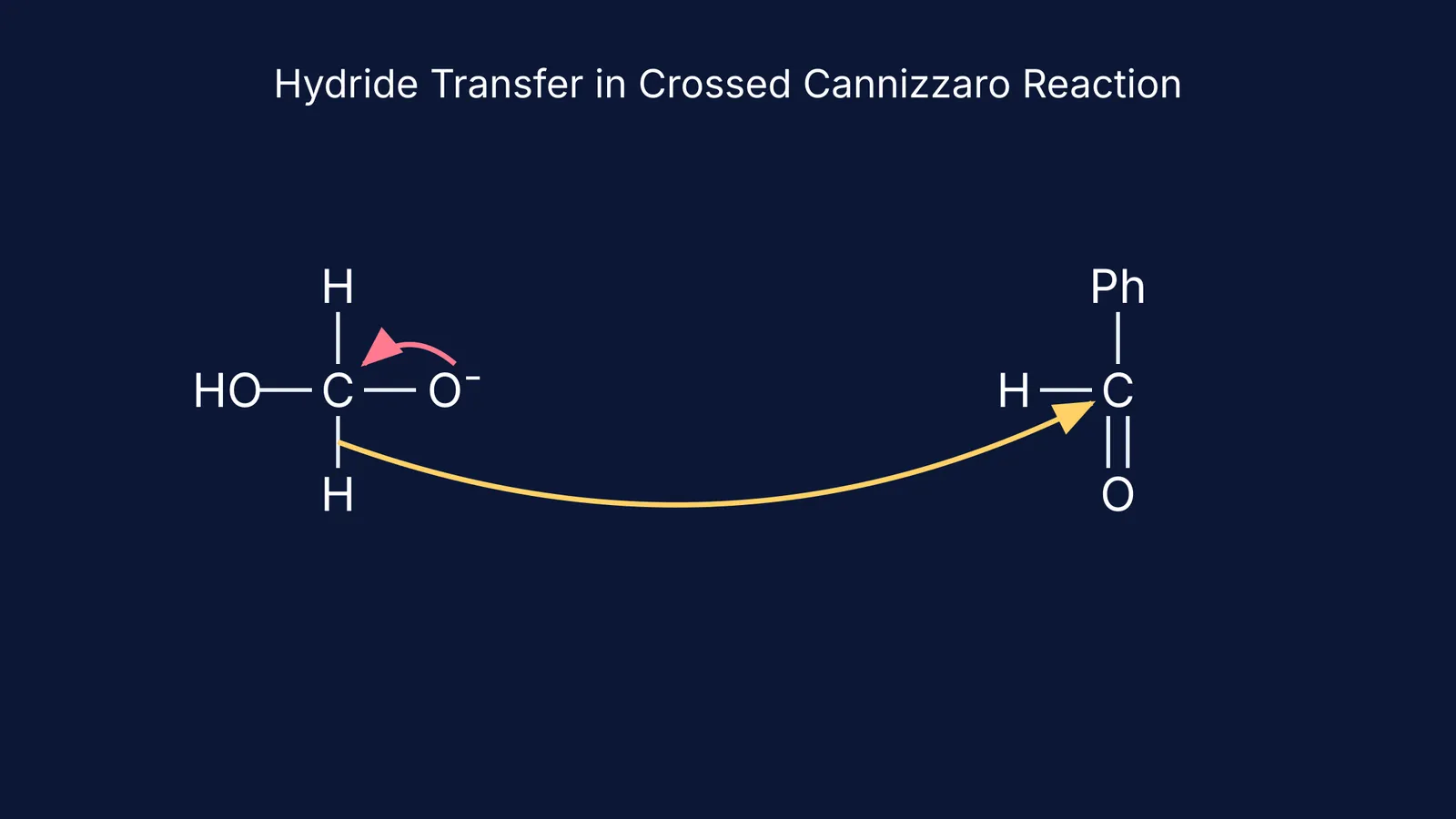
The formation of this intermediate sets up the most important part of the reaction: the hydride transfer. This is the rate-determining step.
The negative charge on the oxygen of the formaldehyde intermediate collapses back down to reform the carbon-oxygen double bond (C=O). To make room for this double bond, the carbon must let go of one of its other bonds. It forces out a hydrogen atom along with its electron pair—a hydride ion (H⁻). (If you want to understand why bonds break, reading about how to decide leaving group ability in organic chemistry will help clarify the general rules).
This hydride ion immediately attacks the carbonyl carbon of the waiting benzaldehyde molecule.
By losing the hydride ion, the formaldehyde intermediate becomes formic acid (which is an oxidation). By gaining the hydride ion, benzaldehyde becomes a benzyloxide ion (which is a reduction).
Finally, a rapid proton exchange happens. Formic acid is a stronger acid than the alcohol, so it gives a proton (H⁺) to the benzyloxide ion. You are left with a formate salt (like sodium formate) and benzyl alcohol.
Why must both aldehydes lack alpha-hydrogens?
The Cannizzaro reaction only works if neither aldehyde has α-hydrogens (hydrogens attached to the carbon directly next to the carbonyl group).
If either molecule had an α-hydrogen, the strong base would simply pull that acidic proton off. This would form an enolate ion, leading to an aldol condensation instead of a Cannizzaro reaction. Because neither formaldehyde nor benzaldehyde has an α-hydrogen, the base is forced to attack the carbonyl carbon directly.
If you find it difficult to picture how electrons move and bonds break in organic chemistry, the Fermi Concept Library has a lesson for every concept in chemistry, so you can understand exactly where each nucleophile attacks and why.
What is the summary of the crossed Cannizzaro reaction?
The overall reaction between benzaldehyde and formaldehyde is:
C₆H₅CHO + HCHO → C₆H₅CH₂OH + HCOONa *(with concentrated NaOH)*
By using cheap formaldehyde to do all the oxidising work, chemists can ensure that almost 100% of their more valuable aldehyde (like benzaldehyde) is successfully reduced to an alcohol.


