
On this page
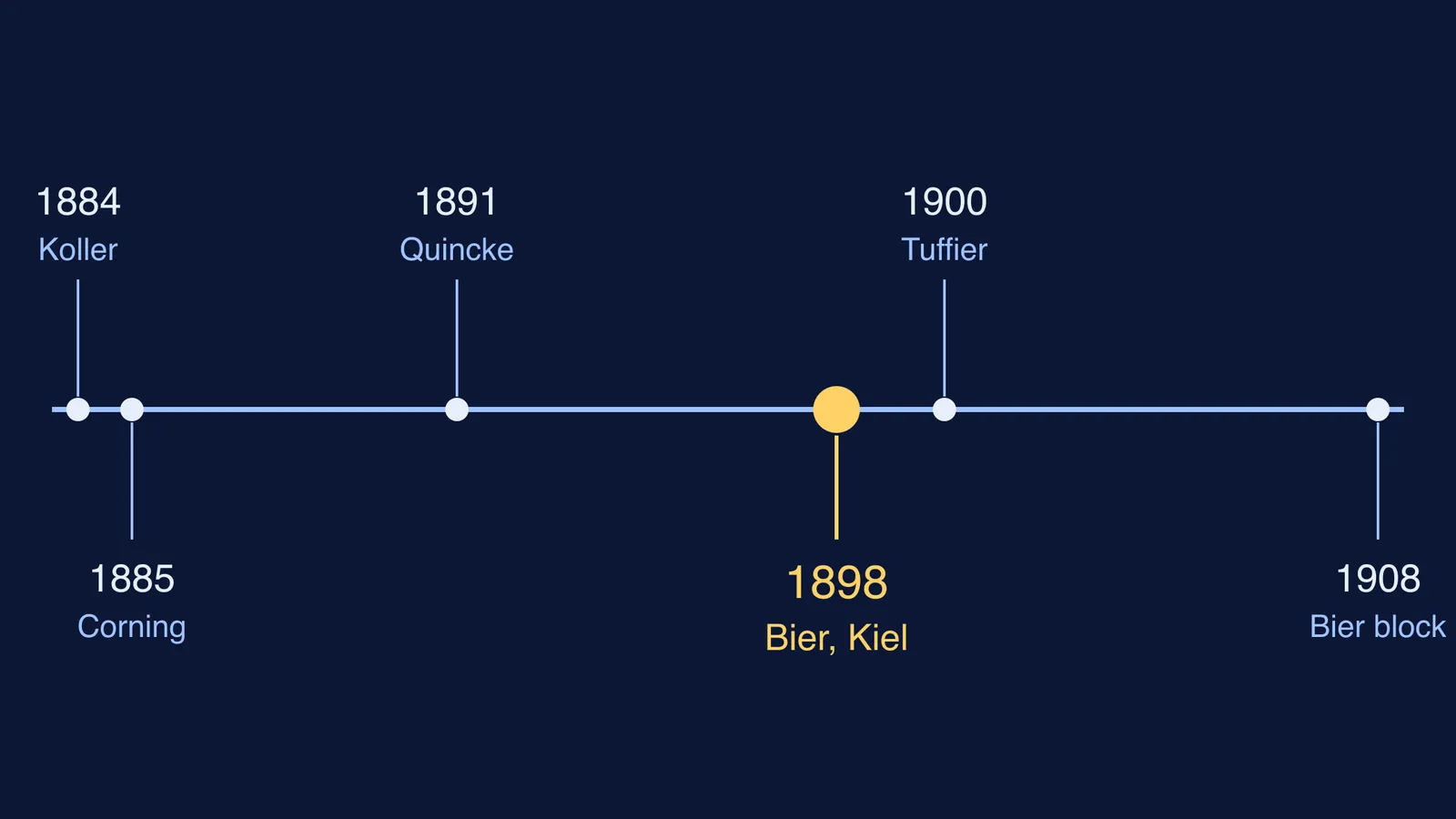
On 16 August 1898, at the Royal Surgical Hospital of the University of Kiel in Germany, surgeon August Bier injected cocaine into a patient's spinal fluid before an ankle operation (Wikipedia's account of Bier, which draws on Wulf's 1998 history in Anesthesiology). The patient stayed conscious and felt nothing in the lower half of his body (Embryo Project Encyclopedia, Arizona State University). It was the first operation under spinal anaesthesia.
What did August Bier do in 1898?
Surgeons already had general anaesthesia, which puts the patient to sleep (see how James Young Simpson brought chloroform into surgery). Bier joined two other ideas.
The first idea was cocaine as a local anaesthetic. Carl Koller's discovery that it numbs the eye was presented on his behalf on 15 September 1884 in Heidelberg (Association of Anaesthetists Heritage Centre); we tell that story in how Carl Koller found the first local anaesthetic for eye surgery.
The second was dural puncture: passing a needle through the membrane around the spinal cord into the fluid inside it, described by Heinrich Quincke in 1891 (NYSORA history of spinal anaesthesia). In 1885 the neurologist James Leonard Corning had injected cocaine near the spine, but his injection probably went into the epidural space rather than the spinal fluid.
The nerves from the legs pass through that fluid on their way to the cord. Bier's bet was that a local anaesthetic placed there would stop pain signals from the lower body while the patient stayed awake. According to NYSORA, he first used it on six patients having surgery on their legs. His first patient received 15 mg of cocaine and, two hours after the operation, had nausea, vomiting, a severe headache and pain in his back and ankle (Wikipedia).
Why did Bier test spinal anaesthesia on himself?
The six patients had varying outcomes; most had headaches afterwards and some vomited (Association of Anaesthetists). Bier wanted to feel the method himself. He asked his assistant, Dr Hildebrandt, to inject half a syringe of 1% cocaine solution into his spine.
It failed. The syringe did not fit the hub of the needle, so spinal fluid escaped, most of the cocaine was lost and the anaesthetic did not work (Wikipedia). Hildebrandt then volunteered, Bier injected him, and this time the block worked.
For about 40 minutes Bier tested how deep the numbness went: needle pricks in the thigh, a needle pushed towards the thigh bone, a burning cigar, a blow to the shin with an iron hammer, pulled pubic hair and pulling on the testicles (Association of Anaesthetists). Hildebrandt felt no significant pain, but afterwards had nausea, vomiting, headache, and bruising and pain in his legs (NYSORA).
What went wrong, and what came next?
Both men developed severe headaches, lasting almost a week by one account (Embryo Project Encyclopedia); Wikipedia says Bier was confined to bed for nine days (Wikipedia). NYSORA describes Bier's as a postdural puncture headache, the name still used for a headache after the membrane around the spinal fluid is pierced (NYSORA).
Bier published the results in 1899 in Deutsche Zeitschrift für Chirurgie as "Versuche über Cocainisirung des Rückenmarkes", experiments on cocainising the spinal cord (the paper's DOI record). Others refined the method: in 1900 the French surgeon Theodore Tuffier stressed that cocaine should not be injected until spinal fluid was seen (NYSORA). In 1908 Bier pioneered a different method, intravenous regional anaesthesia, still called a "Bier block" (Wikipedia).
How does spinal anaesthesia work today?
Regional anaesthesia means you are awake while the part of your body being treated is numbed (NHS). A spinal is one kind, and the principle is Bier's: block the nerve signal before it reaches the spinal cord, and the brain never registers the pain. The drugs, needles and safety checks have all changed since 1898.
For biology students, this is the nerve impulse chapter in action. If the difference between a nerve, a neuron and a nerve fibre still blurs, the Fermi Concept Library has a lesson for every concept in biology, each with its place in the map.
How do you judge a self-experiment like Bier's?
Ask what an experiment showed and what it could not. Five questions, tried on Bier and Hildebrandt (Wikipedia):
What was the question? Can a drug in the spinal fluid numb the lower body while the person stays awake?
What was measured? The response to stimuli of rising strength, from a pinprick to a hammer.
How many subjects? One successful self-test, after six patients. Enough to show it could work, not how often or how safely.
What did it cost? Nausea, vomiting, bruising and severe headaches, with Bier in bed for days.
Who agreed to the risk? Hildebrandt volunteered, but he was Bier's junior. Ask whether a junior could easily say no.
Then try the same five questions on Werner Forssmann's 1929 heart catheter self-experiment and compare.