On this page
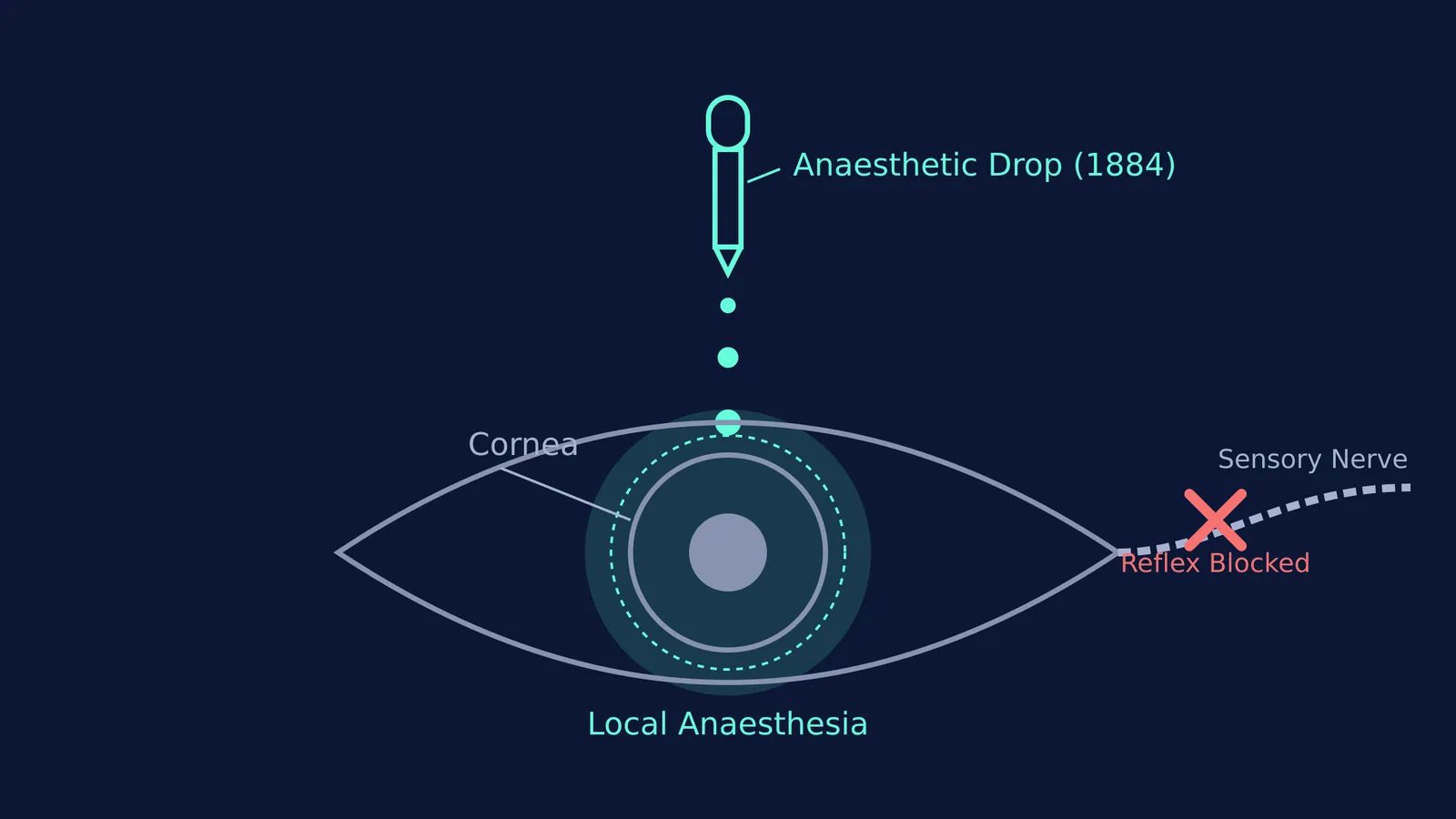
In short: In 1884, Carl Koller demonstrated that cocaine drops could numb the eye, preventing involuntary movement during surgery (source). This made it the first effective local anaesthetic in medicine.
Why was eye surgery so difficult before 1884?
Eye surgery used to be extremely difficult because the eye has involuntary reflex motions that respond to the slightest stimuli (source)). This made delicate surgical procedures risky and painful. Carl Koller, a young ophthalmologist at the Vienna General Hospital, wanted to find a way to numb the eye to stop these reflexes. Prior to his major breakthrough, he had tested solutions such as chloral hydrate and morphine as anaesthetics in the eyes of laboratory animals, but none of them were successful.
How did Carl Koller discover the anaesthetic?
At the time, Koller's colleague at the Vienna General Hospital was Sigmund Freud. Freud was fully aware of the pain-killing properties of cocaine and was studying its effects. While Freud focused on other uses, Koller recognised that cocaine's tissue-numbing capabilities could be the exact solution he needed for the eye. He placed a cocaine solution on the cornea and found that it produced complete insensibility, effectively blocking the reflexes. Freud reportedly nicknamed him "Coca Koller" because of this association.
In September 1884, Koller's findings were presented at the Heidelberg Ophthalmological Congress. Because he could not afford to travel to the congress himself, his paper was read by a colleague named Joseph Brettauer (source)). The news of his discovery spread throughout the world in less than a month, and the solution was quickly adopted in operating theatres everywhere (source).
What happened to Koller after his discovery?
While in Vienna, Koller faced antisemitism that affected his career. In January 1885, he won a duel against another medical student who had made an antisemitic remark about him. However, his career suffered in the aftermath, and he moved to the United States in 1888 to practice ophthalmology in New York. There, he received many distinctions, including the Lucien Howe Medal from the American Ophthalmological Society in 1922 for his outstanding achievements.
One of his later patients was a blind ten-year-old boy named Chauncey D. Leake (source)). Leake recovered his sight and, as an adult, discovered another anaesthetic, divinyl ether.
What replaced cocaine as a local anaesthetic?
This discovery marked the clinical invention of local anaesthesia. Before this, general anaesthetics were available, which eliminated all sensation in the entire body and caused unconsciousness. A local anaesthetic, by contrast, allows a specific body part to be numbed without a loss of consciousness (source). Following Koller's success, the use of cocaine rapidly expanded beyond ophthalmology into other medical fields, such as dentistry and peripheral nerve blocks.
Today, while the principle of local anaesthesia remains exactly the same, cocaine has been largely replaced in routine surgery. The search for less toxic and less addictive alternatives led to the development of synthetic aminoester and aminoamide local anaesthetics, such as procaine in 1904 and lidocaine in 1943. These synthetic derivatives have a much lower abuse potential, but they still end in the suffix "-caine" because cocaine was the original model for this class of medication.
From observation to clinical practice
Koller's breakthrough shows how medical research often relies on applying an existing observation to a specific problem. If you are a student hoping to enter medical research or surgery, understanding the physiological mechanisms of the body—such as Eye accommodation: how the lens changes shape for near vision—is a necessary first step. When you are exploring these biological systems, the Fermi Concept Library offers detailed lessons across chemistry and biology to help you build a solid foundation.
Koller's work also mirrors other medical milestones, such as How James Black designed cimetidine to cut stomach acid. Both scientists took a precise understanding of how tissues respond to chemicals and used it to safely solve a major clinical problem.