On this page
In 1964, at the Smith Kline & French laboratories in Welwyn Garden City, UK, pharmacologist James Black began a project with an unusual plan. Instead of testing random chemicals, his team would start from one molecule, histamine, and change it step by step until it blocked a receptor nobody had yet proved existed. The result, cimetidine (sold as Tagamet), went on sale in the UK in 1976 and the US in 1977, according to Chemical & Engineering News. It is a classic case of designing a drug from biology rather than finding it by luck.
Why couldn't ordinary antihistamines stop stomach acid?
Histamine is a signalling molecule with several jobs. In the stomach, histamine stimulates acid production by acting on the H2 receptors of parietal cells, the acid-making cells of the stomach lining (C&EN).
The antihistamines of the 1960s blocked some of histamine's effects, but not its push on stomach acid. The 1988 Nobel Prize press release explains Black's answer: by analogy with what was known about beta receptors, he proposed two types of histamine receptor. H1 receptors were blocked by the known antihistamines; H2 receptors had no blocker at all.
Black had used the same receptor logic before, on the heart. That story is told in how James Black designed beta blockers.
A note on words: a classic antacid is a base that neutralises acid already made. Cimetidine works one step earlier, blocking the signal that tells parietal cells to make acid.
How did James Black design cimetidine, step by step?
Two of the team's scientists, Parsons and Ganellin, set out the route in a history in the British Journal of Pharmacology:
Build the tests first. The team set up five bioassays: two where mepyramine-type antihistamines blocked histamine, and three where they did not (guinea-pig atrium, rat uterus and rat stomach acid secretion).
Start from the messenger itself. The chemical starting point was the structure of histamine, the molecule the receptor already recognises.
Find a foothold. N-alpha-guanylhistamine turned out to be a weak partial agonist. It still switched the receptor on a little, but it showed that a histamine look-alike could sit there.
Get a pure blocker. Burimamide was a highly specific competitive antagonist, but it was not active enough when swallowed.
Make it work by mouth. Metiamide worked by mouth and proved useful against duodenal ulcers, but a small number of patients had a reversible drop in white blood cells, which was blamed on its thiourea group.
Swap the problem group. Replacing the thiourea with a cyanoguanidine group gave cimetidine, which lacked metiamide's toxicity.
Between 1964 and 1972 the team synthesised and tested only 700 compounds, according to Parsons and Ganellin. With burimamide in hand, Black, Duncan, Durant, Ganellin and Parsons defined the H2 receptor in a 1972 paper in Nature.
What does an H2 blocker actually do in the stomach?
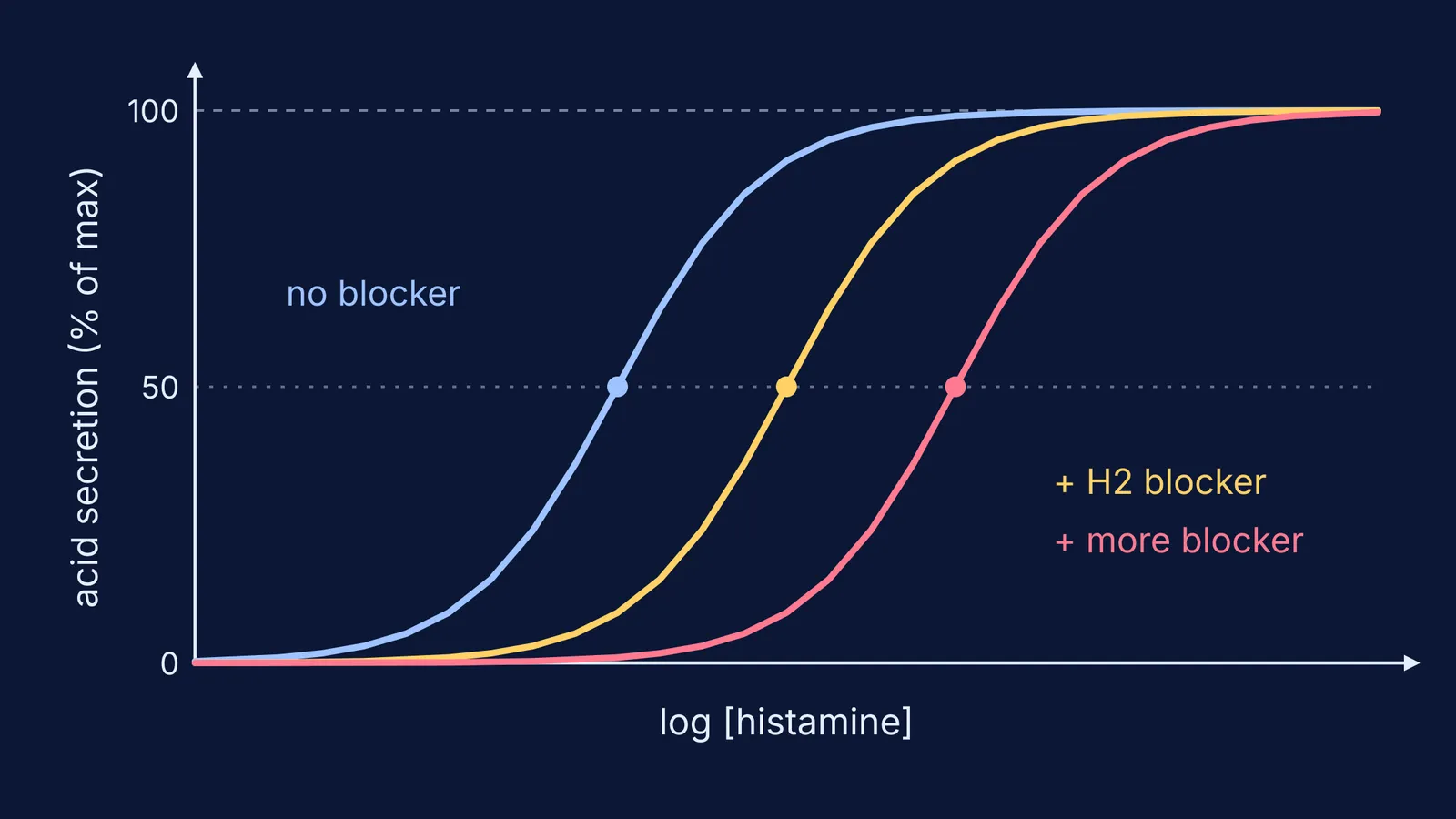
Cimetidine is a competitive antagonist (Parsons and Ganellin). It occupies the H2 receptor without switching it on, so histamine has to compete for the same site. The diagram at the top shows what that means: the curve of acid output against histamine dose shifts to the right, so far more histamine is needed for the same effect. The idea of a molecule shaped to fit a biological site goes back to Emil Fischer's lock-and-key model.
Before Tagamet, peptic ulcer care relied on bed rest, a bland diet, antacids and, if the ulcer came back, often surgery (C&EN). The Nobel press release says the need for ulcer surgery decreased significantly. In 1988 Black shared the Nobel Prize in Physiology or Medicine with Gertrude Elion and George Hitchings “for their discoveries of important principles for drug treatment”.
How we first learned that the stomach makes acid is its own story: William Beaumont's experiments on digestion.
How can you use the cimetidine story in an exam answer?
Question: Mepyramine blocks some effects of histamine but does not reduce stomach acid. Cimetidine does. Explain.
Model answer, in four steps:
Histamine acts on more than one type of receptor.
Classic antihistamines such as mepyramine block H1 receptors.
Histamine drives acid secretion from parietal cells through H2 receptors.
Cimetidine resembles histamine and competitively blocks H2 receptors, so acid output falls; H1 blockers leave this pathway untouched.
You can use the same five questions for any drug story in chemistry or biology:
What is the target, and how do we know it exists?
How was the effect measured?
What was the starting molecule, and why?
What was changed at each step, and why?
What went wrong, and how was it fixed?
If receptors or acid-base reactions still feel shaky, the Fermi Concept Library gives every concept in chemistry and biology its own lesson. For a longer revision session, Fermi's AI tutor works out what you already know, builds a plan for the session and checks your understanding as it goes.