On this page
In 1929 Werner Forssmann, a trainee surgeon in a small German town, reached the inside of a living human heart through a vein, and the heart was his own. He was criticised so hard that he dropped the idea. Twelve years later, two New York doctors picked it up and turned it into a working research method.
What did Werner Forssmann do in 1929?
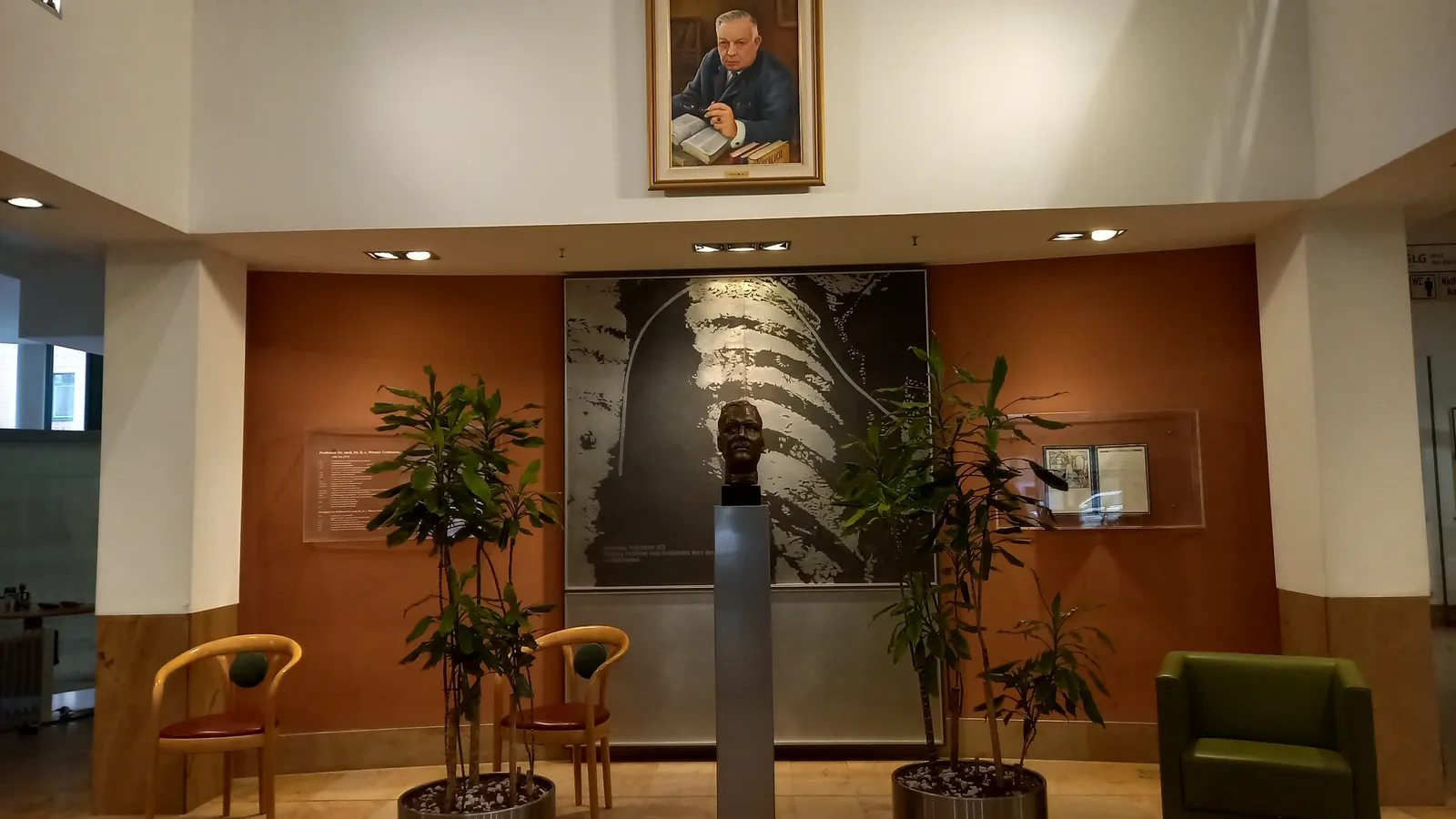
Forssmann was born in Berlin on 29 August 1904 and passed his State Examination in medicine in 1929, according to his official Nobel Prize biography. That year he went for surgical training to the August Victoria Home at Eberswalde, near Berlin.
The biography sums up the experiment: he put a cannula into his own antecubital vein (in the crease of the elbow), passed a catheter through it for 65 cm, then walked to the X-ray department, where a photograph showed the catheter lying in his right auricle, the old name for the right atrium.
A 2006 history in The Hospitalist adds the human detail. Forssmann asked Gerda Ditzen, a surgical nurse, for help, and she believed she would be the subject. Instead he worked on himself, cutting into his left elbow crease and threading in a 65 cm ureteral tube, a thin tube used in urology. Then they went, tube in place, to the X-ray room in the basement.
He published the result in November 1929 as "Die Sondierung des rechten Herzens" ("Probing the right heart") in Klinische Wochenschrift, volume 8, pages 2085 to 2087, per the Crossref record for the paper.
Why was a catheter in the heart such a big deal?
To judge a heart, doctors need the pressure inside its chambers and how much blood it pumps. The 1956 Nobel presentation speech explains that catheters could measure these in animals, but in people key values, such as the pressure in the right ventricle, could not be measured directly. As late as 1928, it notes, a textbook said that in humans one was "naturally" confined to indirect methods.
A year later Forssmann showed that a narrow catheter could travel from an arm vein into the right atrium, almost two-thirds of a metre, so the animal methods could in principle be used in people. He also experimented on himself with X-ray contrast medium injected through the catheter. To see those chamber pressures through one heartbeat, try our interactive cardiac cycle pressure graph; for an earlier pioneer, read Stephen Hales and the first blood pressure measurement.
Why was Forssmann criticised, and who made catheterisation work?
The Nobel speech is blunt. The method was taken up in a few places, Prague and Lisbon, but Forssmann faced criticism "of such exaggerated severity" that he lost any wish to continue, based on an unsubstantiated belief that it was dangerous. In New York, André Cournand and Dickinson Richards needed direct measurements from the right heart, and after years of preparation they published a report of cardiac catheterisation in people in 1941.
All three shared the 1956 Nobel Prize in Physiology or Medicine "for their discoveries concerning heart catheterization and pathological changes in the circulatory system", says the Nobel Prize summary. By then Forssmann was a urologist at Bad Kreuznach; he died on 1 June 1979. The Hospitalist notes that pacemaker insertion, angioplasty and valve repair build on his idea.
What path does a catheter take from the arm to the heart?
Here is one possible route, traced with the Texas Tech upper-limb vein table.
It enters a superficial vein at the elbow crease, such as the basilic vein.
The basilic vein joins the brachial veins to form the axillary vein near the armpit.
The axillary vein continues as the subclavian vein, which unites with the internal jugular vein to form a brachiocephalic vein.
The left and right brachiocephalic veins unite to form the superior vena cava.
The superior vena cava empties into the right atrium.
If the names blur together, the Fermi Concept Library gives each biology concept its own lesson and its place in the map, so you can revise circulation one idea at a time.
Should students admire a self-experiment like this?
Admire the reasoning, not the risk. Forssmann had a clear question and checkable evidence, but he misled the nurse who helped him. Research on people in India today follows the ICMR National Ethical Guidelines for Biomedical and Health Research Involving Human Participants (2017), which set out ethical review by ethics committees and an informed consent process for participants.
A four-question check for any famous experiment:
What exactly was the question, and what result would have answered it?
What was the evidence, and could someone else check it?
Who could be harmed, and did they agree with full knowledge?
Why did others accept or reject it, and was that about the evidence or the person?
To see how X-rays like Forssmann's photograph pick out dense objects inside the body, read how an X-ray shows bones.