

On this page
Why is the constant-speed formula incomplete on a curve?
Most introductory physics textbooks introduce cornering through uniform circular motion. In the curriculum published by the NCERT (Class 11 Physics, Chapter 5), a car negotiating a flat circular road of radius r at a steady speed v requires centripetal acceleration a_r = v²/r. On an unbanked road, static friction supplies this force: m(v²/r) ≤ μ_s m g, giving the familiar limit v ≤ √(μ_s r g).
This formula assumes speed never changes. The moment a driver presses the accelerator or applies the brakes, the speed changes with time, adding a tangential acceleration a_t = dv/dt along the path. As explained in our guide to non-uniform circular motion, the car's net acceleration is no longer purely radial. Because tyre friction must provide both accelerations simultaneously, assuming a purely radial demand leads drivers and students to underestimate when slipping starts.
How do centripetal and tangential forces combine?
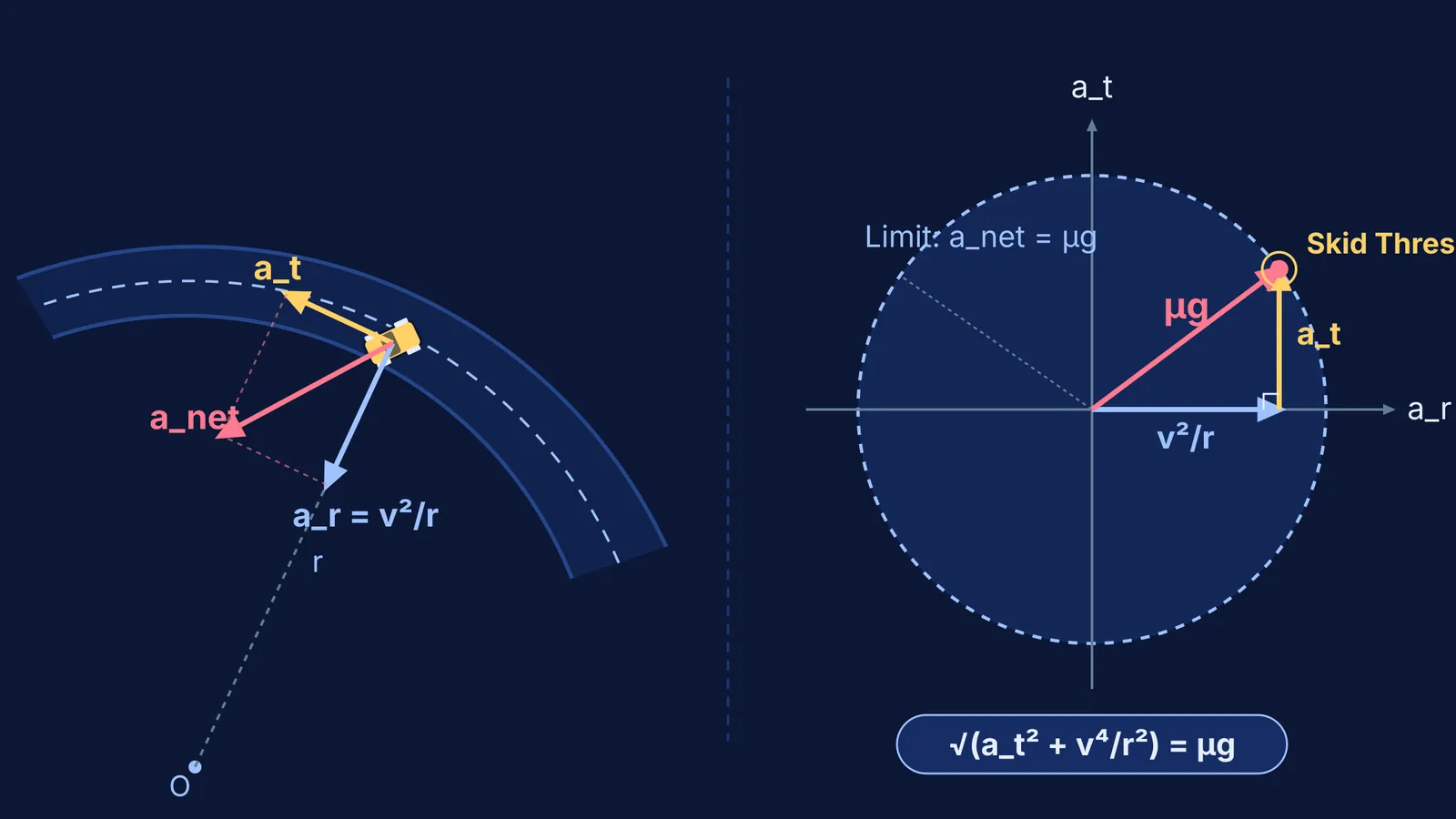
To evaluate skid risk, we resolve the car's motion into two perpendicular components on the road surface: the radial axis toward the centre and the tangential axis along the velocity vector.
Radial acceleration: a_r = v²/r
Tangential acceleration: a_t = dv/dt
Net acceleration: a_net = √(a_t² + a_r²) = √(a_t² + v⁴/r²)
On a level track, normal force is N = mg. By Newton's second law, total friction is f = m a_net = m √(a_t² + v⁴/r²).
This trade-off is the core of vehicle dynamics. In *Fundamentals of Vehicle Dynamics*, Thomas D. Gillespie models tyre grip as a friction circle where drive torque and steering compete for contact-patch friction (doi:10.4271/R-114). Any grip spent accelerating forward leaves less lateral grip to hold the turn.
When does a speeding car begin to skid?
Tyres maintain traction as long as the required friction does not exceed maximum static friction, f_max = μ_s N = μ_s m g:
m √(a_t² + v⁴/r²) ≤ μ_s m g
Cancelling mass m reveals that the skid threshold is independent of vehicle weight:
√(a_t² + v⁴/r²) = μ_s g
Squaring both sides and solving for the maximum instantaneous speed v_skid gives:
v⁴/r² = (μ_s g)² - a_t²
v_skid = [r² ((μ_s g)² - a_t²)]^(1/4)
When a_t = 0, this recovers the classic v_skid = √(μ_s r g). But when a_t approaches μ_s g, allowable cornering speed drops toward zero. Students exploring curvilinear motion can consult the Fermi Concept Library, which covers every concept in physics, chemistry, biology, mathematics and computing, each with its own lesson and its place in the map.
Worked example: how far can a car accelerate before skidding?
A classic demonstration appears in I. E. Irodov's *Problems in General Physics*, Problem 1.90 (Irodov 1988). Suppose a car starts from rest (v_0 = 0) on a horizontal track of radius r = 40 m with constant tangential acceleration a_t = 0.62 m/s² on a surface with friction coefficient μ_s = 0.20 (taking g = 9.8 m/s²). How far does it travel before skidding?
Find maximum frictional acceleration:
a_max = μ_s g = 0.20 × 9.8 m/s² = 1.96 m/s².
Express radial acceleration via distance s:
From kinematics, v² = 2 a_t s, so a_r = v²/r = 2 a_t s / r.
Solve the skid condition:
a_t² + (2 a_t s / r)² = (μ_s g)² (2 a_t s / r)² = (μ_s g)² - a_t² s = (r / (2 a_t)) √((μ_s g)² - a_t²)
Insert the numbers:
√((1.96)² - (0.62)²) = √(3.8416 - 0.3844) = √3.4572 ≈ 1.859 m/s² s = (40 / (2 × 0.62)) × 1.859 ≈ 32.26 × 1.859 ≈ 59.98 m ≈ 60 m
The car travels 60 m before skidding, reaching v ≈ 8.62 m/s (31.0 km/h). At constant speed, it could have turned safely at √(0.20 × 40 × 9.8) ≈ 8.85 m/s. Accelerating along the arc lowered that threshold. For related normal force problems, see how normal reaction varies as a car passes over a hump. When practising multi-step mechanics questions, students can turn to the Fermi Problem Library, which features worked problems with a step-by-step solver that explains the reasoning rather than printing an answer.
What does the friction circle teach drivers and engineers?
The friction circle guides real-world vehicle handling. Racing drivers practice trail braking, gradually easing off the brakes while turning in, and feeding in throttle only as the steering straightens. This keeps total acceleration within the friction perimeter.
Highway standards apply the same principle. The Indian Roads Congress standard IRC:73-1980 limits lateral friction factors on curves to 0.15 while reserving 0.35 to 0.40 longitudinally for braking. While dry tyres on clean pavement reach peak friction coefficients between 0.70 and 0.80 (Gillespie 1992), sudden acceleration consumes that safety margin. To explore how banked curves reduce frictional demand, see our guide to circular motion banking problems.


