
On this page
Look at clear blue sky a quarter-turn away from the sun through polarised sunglasses, tilt your head, and the sky darkens and brightens. That light is polarised. The reason fits in one picture: an air molecule driven by sunlight acts like a tiny antenna, and an antenna sends no wave along its own length.
Why is light scattered at 90 degrees plane polarised?
Light is a transverse wave. In sunlight travelling along x, the electric field vibrates only in the y-z plane, in random directions within it. That is what unpolarised means.
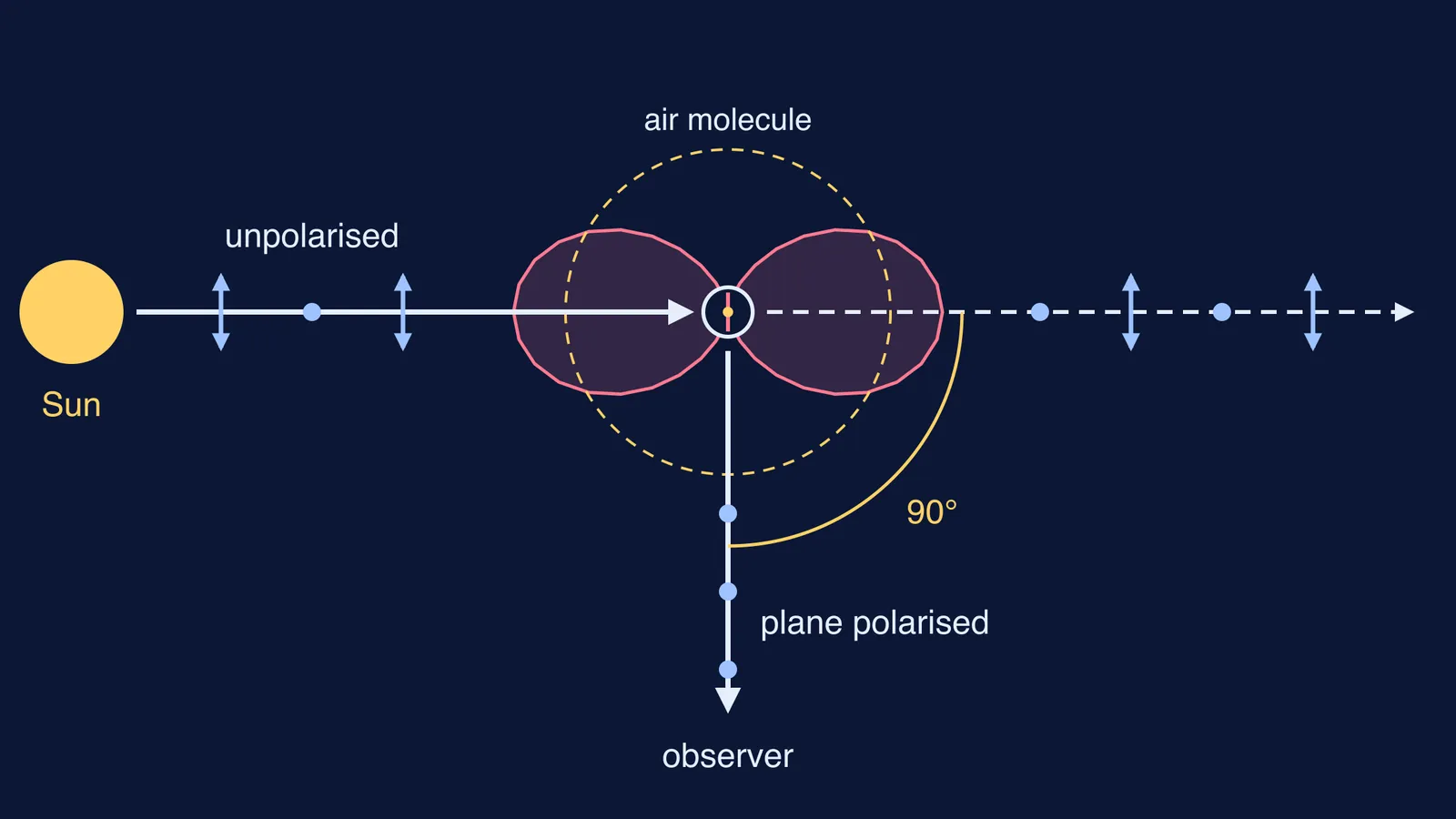
The field pushes the electrons of an air molecule back and forth along those same directions, so the molecule becomes an oscillating dipole along y and along z, never along x.
An oscillating dipole radiates with intensity proportional to sin²θ, where θ is measured from the dipole's axis, so it sends nothing along its own axis and the most at right angles to it (Richard Fitzpatrick's electromagnetism lecture notes, University of Texas).
Now stand to one side, so scattered light reaches you along y, at 90° to the sunbeam. The y-dipole points straight at you: sin²0 = 0, so it sends you nothing. Only the z-dipole is left, so the light reaching you vibrates in one direction, perpendicular to the plane that holds the sun, the molecule and you. That is plane polarised light. In the diagram above, the pink lobes are the y-dipole's sin²θ pattern, pinched to zero towards the observer.
At 90° away from the beam direction, light scattered by air molecules is linearly polarised (HyperPhysics, Georgia State University).
Look along the beam instead and both dipoles reach you equally, so the light stays unpolarised. In between, it is partly polarised.
How polarised is the sky at other angles?
Let γ be the angle between the sunbeam and your line of sight, both in the x-y plane. The z-dipole is always side-on to you, so it contributes 1. The y-dipole is at 90° minus γ from your line of sight, so it contributes sin²(90° minus γ), which is cos²γ. The degree of polarisation is the difference over the sum:
P = (1 - cos²γ) / (1 + cos²γ) = sin²γ / (1 + cos²γ)
This is the formula of the ideal single-scattering Rayleigh sky model. Worked through:
γ = 90°: P = 1 / 1 = 1, fully polarised.
γ = 60°: P = 0.75 / 1.25 = 0.60.
γ = 45°: P = 0.5 / 1.5 ≈ 0.33.
γ = 30°: P = 0.25 / 1.75 ≈ 0.14.
γ = 0°: P = 0, unpolarised.
So the strongest polarisation lies in a band 90° from the sun, and the band moves across the sky as the sun moves. For why the scattered light is blue in the first place, see our post on Rayleigh's 1/λ⁴ law and the blue sky.
Why is the real sky never fully polarised?
The ideal model gives 100% at 90°, but the real sky falls short. The Atmospheric Optics sky polarisation page gives three reasons: air molecules are not perfect dipole oscillators, dust, moisture and aerosols also scatter, and some light is scattered more than once.
Nathan Pust and Joseph Shaw of Montana State University write that the maximum polarisation of a cloud-free sky depends on wavelength, the sun's height, ground reflectance and aerosols. Citing earlier work, they note that multiple scattering of ground-reflected light greatly reduces it (Optics Express, 2012).
How can you check sky polarisation with a polaroid?
You need a polaroid sheet or one lens of polarised sunglasses, a clear sky, and the sun low, in the morning or late afternoon.
Stand with the sun directly to your left or right. Looking straight ahead, you are now looking 90° from the sun.
Hold the polaroid in front of one eye and rotate it slowly through a full turn. The sky should dim and brighten twice per turn, as Malus' law predicts for polarised light; our post on three polaroids and Malus' law works through the cos² rule.
Now look at sky about 30° from the sun, not at it. The change on rotating should be much weaker, as the worked example predicts.
Look at a white cloud in the 90° band. The cloud stays bright while the sky behind it darkens, because cloud light is unpolarised (Atmospheric Optics). A polarising filter therefore makes clouds stand out.
Note what you saw. The sky never goes fully black, for the reasons above.
Reflection polarises light too, which is why polarised sunglasses cut glare.
How should you revise this topic?
Draw the diagram from memory: beam, molecule, two dipoles, observer at 90°, then cross out the dipole pointing at the observer. If transverse waves or dipole radiation feel shaky, the Fermi Concept Library gives each concept its own lesson and its place in the map of physics. To test whether you can explain it, Fermi's AI tutor can draw the figure with you and check your understanding as it goes.