

On this page
The blinding glare that bounces off a wet road or a lake on a sunny day is not just brighter light—it is physically different from the sunlight coming directly from the sky. If you have ever put on a pair of polarised sunglasses and watched the glare instantly vanish, you have experienced a wave optics principle called polarisation by reflection.
Understanding how these lenses act as a microscopic picket fence requires looking at what happens to light waves the moment they strike a horizontal surface.
Why do roads and water create such intense glare?
Natural sunlight is unpolarised, meaning its electromagnetic waves vibrate in all possible directions perpendicular to their path of travel. However, when this unpolarised light strikes a flat, non-metallic horizontal surface like asphalt or a pool of water, it undergoes a sorting process.
The surface absorbs and refracts most of the vertical vibrations (pushing them down into the water or road), while preferentially reflecting the horizontal vibrations (OpenStax, University Physics Volume 3). This creates a concentrated "sheet" of horizontally vibrating light. This reflected horizontal light is what we experience as glare, and it is far more intense than the ambient scattered light around you.
If you are reviewing light properties like those seen when tracing a ray through a glass slab in Class 10, the shift to wave optics in Class 12 reveals that light does not just bend—its plane of vibration can be restricted entirely.
What happens to light at Brewster's angle?
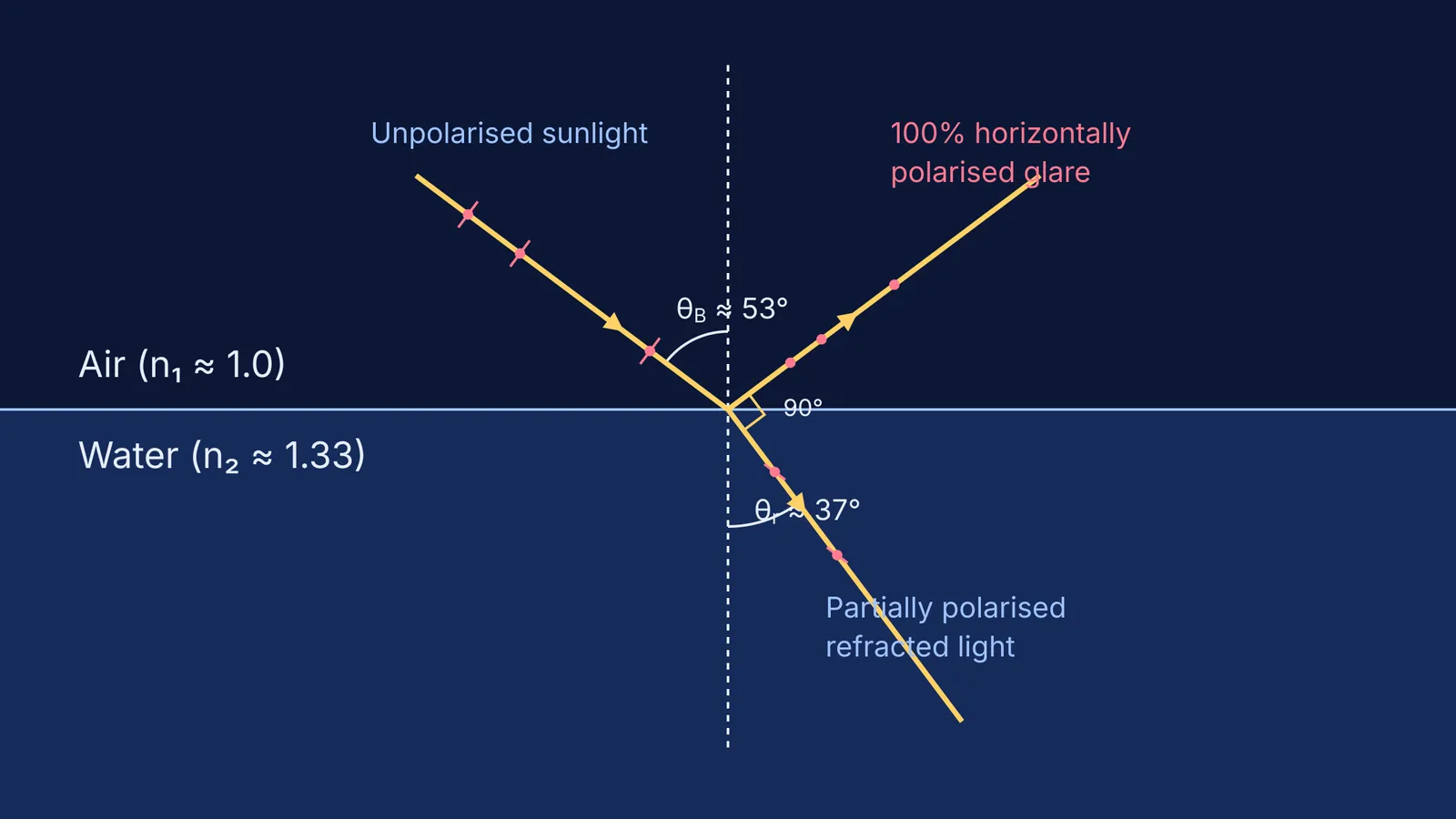
The degree to which the reflected light becomes horizontally polarised depends entirely on the angle at which the sunlight hits the surface. There is one specific angle of incidence, known as Brewster's angle, where the reflected glare becomes 100% horizontally polarised (OpenStax).
At Brewster's angle, the reflected ray and the refracted ray travelling into the water are separated by exactly 90 degrees (OpenStax). You can calculate this angle using Brewster's Law, which states that the tangent of the angle of incidence equals the refractive index of the surface. For water, which has a refractive index of about 1.33, Brewster's angle is approximately 53.1° (OpenStax). For ordinary glass, Brewster's angle is about 56.7° (OpenStax).
Visualising how the reflected and refracted rays lock into that 90-degree relationship is much easier when you can drag a slider and watch the electric field vectors change. You can interact with this exact setup in the Fermi Simulation Lab, which provides interactive simulations for the ideas that are easier to see than to read.
How do polarised sunglasses block this glare?
Since the blinding glare from the road is almost entirely horizontal, manufacturers can design a filter to block it. Polarised lenses contain a chemical film with molecules aligned in a strict vertical direction.
They act like a microscopic picket fence. The vertical "slats" of the filter allow vertically vibrating light to pass through, which carries all the useful information about the colour and texture of your surroundings. However, when the horizontally polarised glare hits the vertical fence, it cannot fit through and is entirely absorbed (OpenStax). This drastically reduces eye strain and allows you to see straight through the surface of water, just like photographers do with polarising camera filters.
For a broader look at how light interacts with different media, you can explore the dispersion of white light by a glass prism. But when it comes to everyday optical engineering, the simple geometry of Brewster's angle is what keeps your vision clear on a bright afternoon drive.
Why don't regular sunglasses cut the glare?
Standard tinted sunglasses simply dim all incoming light equally. If a regular pair of sunglasses blocks most of the light, it blocks the same fraction of the ambient light and the intense glare. Because the glare from a wet road or lake is significantly more concentrated than the surrounding light, the remaining glare is still blindingly bright compared to everything else in your field of vision.
Polarised lenses, however, are selective. By targeting the horizontal plane of vibration specifically, they can eliminate nearly all of the blinding glare without darkening the rest of your vision too much. This targeted filtering is why drivers and fishermen rely on them.
Can polarised sunglasses cause problems with screens?
While blocking horizontal light is brilliant for reducing road glare, it can sometimes interfere with modern technology. Many digital displays, including your smartphone, ATM screens, and car dashboard displays, emit light that is already polarised.
If the screen's emitted light happens to be polarised at an angle that your sunglasses block, the screen will appear entirely black when you look at it. This is why airline pilots are often advised against wearing polarised sunglasses; they need to quickly and reliably read digital instruments without having to tilt their heads to let the light through. If you ever look at your phone with polarised glasses and see a strange dark rainbow pattern or a black screen, just tilt your device sideways to realign the polarisation axes.


