
On this page
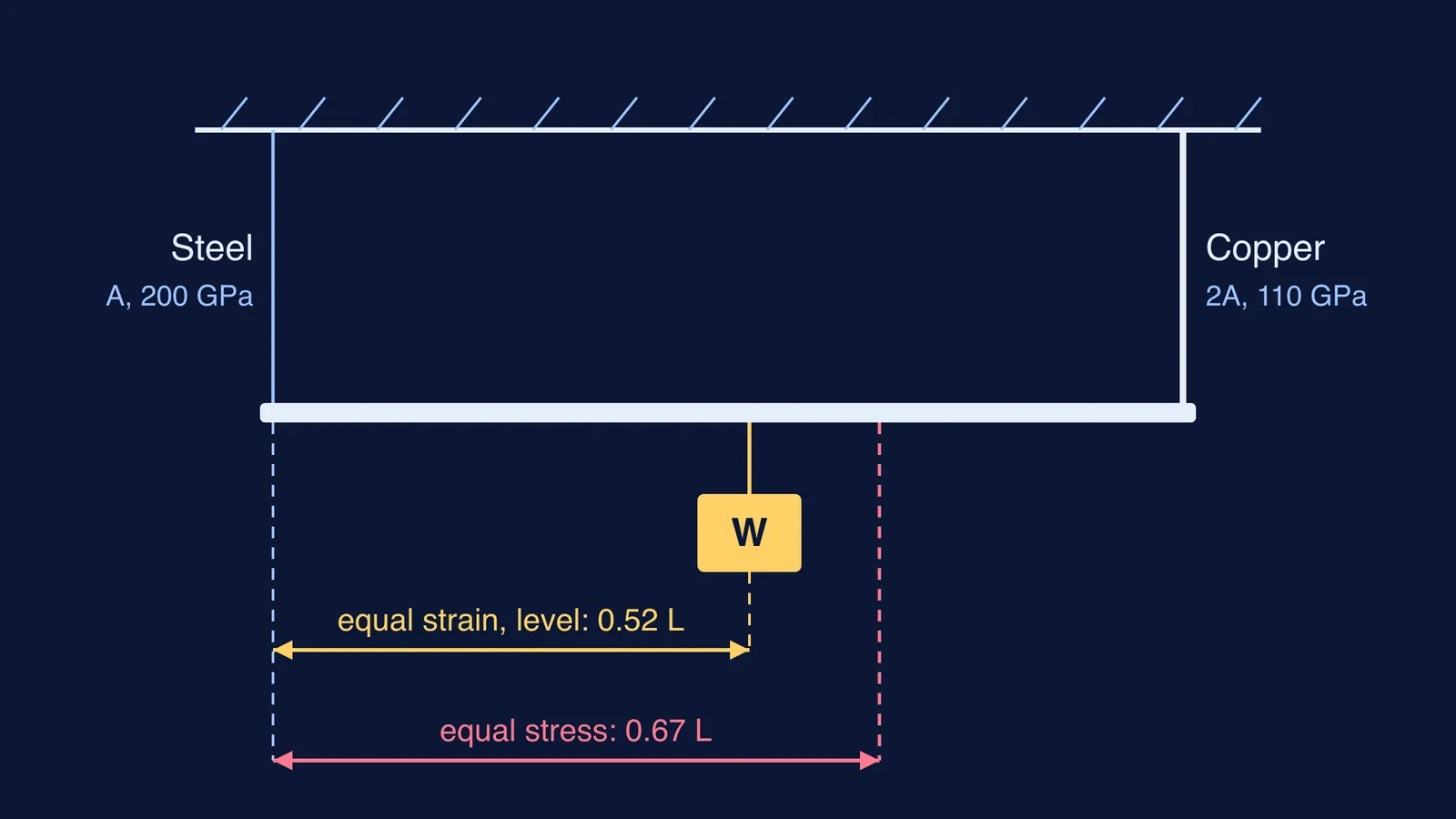
A light rod hangs from a steel wire at one end and a thicker copper wire at the other. Where should the load go for equal stress, or equal strain? Those are two different points, and only one keeps the rod level.
What do stress, strain and Young's modulus mean here?
Stress is the restoring force per unit area, F/A, measured in N m⁻² or pascal, as defined in NCERT Class 11 Physics, Chapter 8: Mechanical Properties of Solids.
Longitudinal strain is the change in length divided by the original length, ΔL/L, and has no unit (same NCERT chapter).
Young's modulus Y is stress divided by longitudinal strain, so a wire with tension T, area A and modulus Y has a strain of T/(AY) (NCERT, Eq. 8.7).
Stress depends only on tension and area. Strain also depends on the material. That one difference is the whole problem.
How do you find the tension in each wire?
Call the rod's length L, with wire 1 at the left end, wire 2 at the right, and the load W at distance x from wire 1. The rod is light, so take torques about wire 1: T₂ × L = W × x. That gives T₂ = Wx/L and T₁ = W(L − x)/L. Wire 1's tension drops out because it passes through the axis; here is how to choose a torque axis that removes unknowns.
Where should the load hang for equal stress?
Equal stress means T₁/A₁ = T₂/A₂. Substitute the tensions and you get (L − x)/A₁ = x/A₂, so:
x = L·A₂/(A₁ + A₂), measured from wire 1.
Young's modulus does not appear at all. The load sits closer to the thicker wire, because a thicker wire needs more tension to reach the same stress.
Where should the load hang so the rod stays level?
The rod stays level when both wires stretch by the same amount. If the wires start at the same length, equal extension means equal strain: T₁/(A₁Y₁) = T₂/(A₂Y₂). That gives:
x = L·A₂Y₂/(A₁Y₁ + A₂Y₂), measured from wire 1.
If the wires have different lengths l₁ and l₂, match the extensions, ΔL = Tl/(AY), instead. Replace each AY with AY/l: x = L·(A₂Y₂/l₂)/(A₁Y₁/l₁ + A₂Y₂/l₂). AY/l is the wire's stiffness, the force per metre of stretch; our explainer on Young's modulus and elasticity covers where it comes from.
Worked example: steel and copper wires
Table 8.1 of the NCERT chapter gives Young's modulus as 200 × 10⁹ N m⁻² for steel and 110 × 10⁹ N m⁻² for copper. We use those values.
Setup: a light rod 1.0 m long, a steel wire of area 1.0 mm² at the left end, a copper wire of area 2.0 mm² at the right, both wires 1.5 m long, and a load W = 210 N.
Equal stress. x = 1.0 × 2/(1 + 2) = 0.667 m from the steel wire. Copper carries 140 N, steel 70 N, and each stress is 7.0 × 10⁷ N m⁻². But steel stretches (7.0 × 10⁷ / 2.0 × 10¹¹) × 1.5 m = 0.53 mm, while copper stretches (7.0 × 10⁷ / 1.1 × 10¹¹) × 1.5 m = 0.95 mm. Equal stresses, tilted rod.
Equal strain. For steel, AY = 1.0 × 10⁻⁶ × 2.0 × 10¹¹ = 2.0 × 10⁵ N; for copper, AY = 2.0 × 10⁻⁶ × 1.1 × 10¹¹ = 2.2 × 10⁵ N. So x = 2.2/(2.0 + 2.2) = 0.524 m from the steel wire. Copper carries 110 N and steel 100 N, giving a strain of 5.0 × 10⁻⁴ in both. Each wire stretches 0.75 mm and the rod stays level.
The largest stress, 1.0 × 10⁸ N m⁻² in steel, is below the yield strengths in the same NCERT table (250 × 10⁶ N m⁻² for steel, 200 × 10⁶ N m⁻² for copper), so the wires stay elastic.
What is the 3-step checklist?
Take torques about one wire: T₂ = Wx/L and T₁ = W − T₂.
Turn the condition into a ratio of tensions. Equal stress: T₁ : T₂ = A₁ : A₂. Equal strain: T₁ : T₂ = A₁Y₁ : A₂Y₂. Level rod with unequal wire lengths: T₁ : T₂ = A₁Y₁/l₁ : A₂Y₂/l₂.
Put the load at x = L × (wire 2's share)/(sum of shares) from wire 1. Check that it sits nearer the wire carrying more tension and that every stress is below the yield strength.
If the two wires are joined end to end instead, see how to find the extension of a composite wire made of two materials.
If you keep putting the load on the wrong side, the Fermi Problem Library has worked problems with a step-by-step solver that explains the reasoning rather than just printing an answer. If stress and strain still blur together, the Fermi Concept Library gives each concept in physics its own lesson.
Try it yourself: swap copper for aluminium and redo step 2 before you look anything up.