

On this page
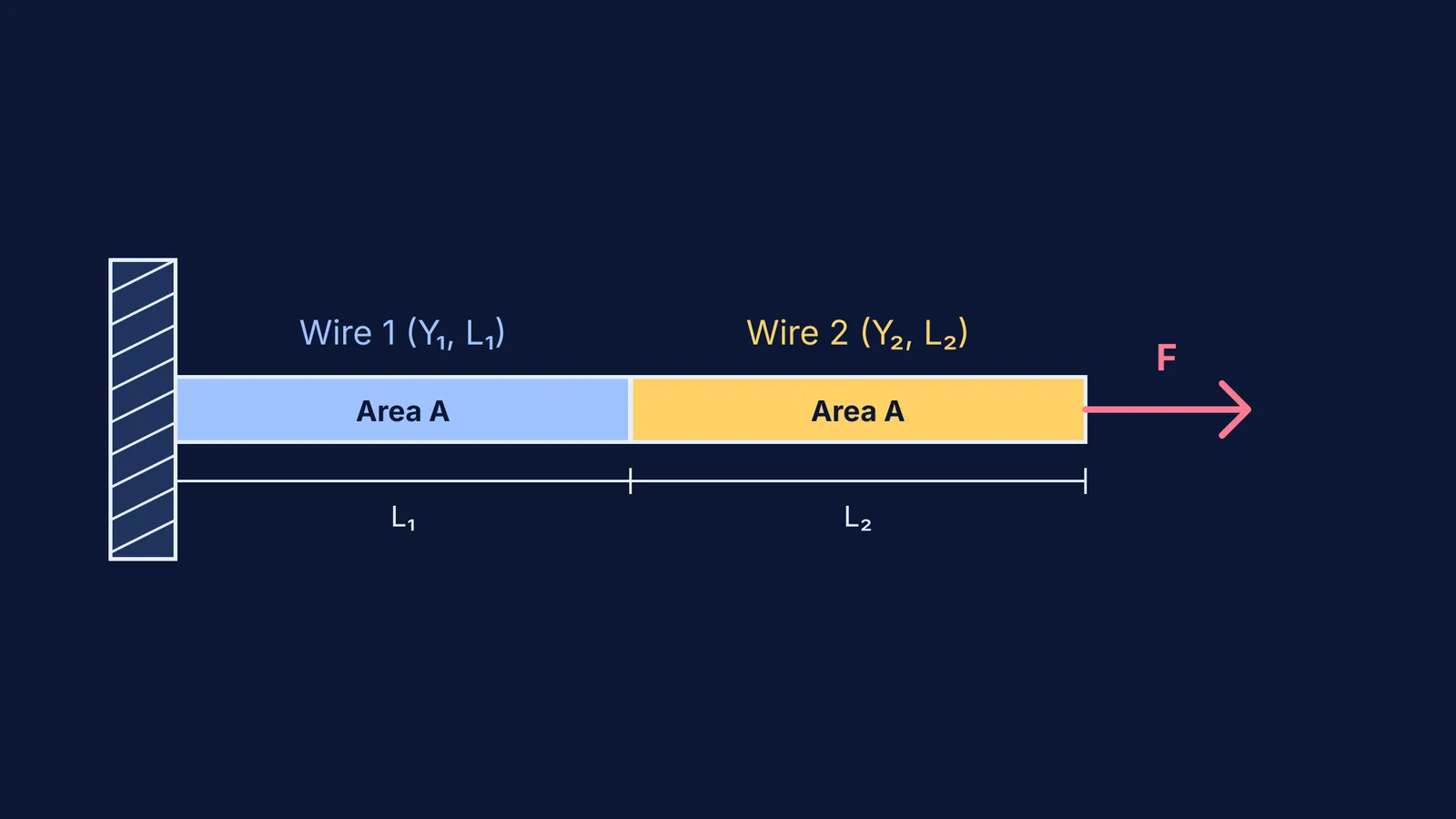
When you join two wires of different materials end to end and pull them, you create a composite wire. A classic problem involves pulling a copper wire attached to a steel wire. For example, steel has a Young's modulus of 200 GPa, making it more resistant to stretching than copper, which has a modulus of 110 GPa (NCERT). Because their elastic properties differ, they will not stretch by the same amount even though they are part of the same cable.
To solve for the total extension or to replace the two wires with a single equivalent wire, you have to look at the forces acting on the joint.
Why is the tension the same in both wires?
If you pull the free end of a composite wire with a force F, that force must be transmitted through every part of the system. Assuming the wires are light enough that we can ignore their weight, the tension is exactly F everywhere in both materials.
If you are dealing with a massive vertical cable instead, the tension would vary, and you would need to calculate how the rod stretches under its own weight. But for standard end-to-end composite wires, the tension F and the cross-sectional area A are constant across the boundary. This means the longitudinal stress (F/A) is identical for both materials.
How to calculate the total extension?
According to Hooke's law, the extension ΔL of any single wire is the pulling force multiplied by its length, divided by its area and its Young's modulus.
For the first material, the extension is ΔL₁ = F × L₁ / (A × Y₁). For the second material, the extension is ΔL₂ = F × L₂ / (A × Y₂).
Because the wires are joined in series, their individual stretches add up to give the total extension of the composite wire:
Total extension ΔL = ΔL₁ + ΔL₂ ΔL = (F / A) × [ (L₁ / Y₁) + (L₂ / Y₂) ]
To see how this works in practice, let's set up a worked example with a 2.0-metre steel wire joined to a 3.0-metre copper wire. Assume both wires have a cross-sectional area of 1.0 × 10⁻⁵ m² and a load of 500 N is applied to the end of the composite wire.
First, identify the constant terms. The force F is 500 N and the area A is 1.0 × 10⁻⁵ m². The stress (F/A) is therefore 50,000,000 Pa for both sections.
Next, calculate the individual extensions. For the steel wire (Y₁ = 200 × 10⁹ Pa, L₁ = 2.0 m): ΔL₁ = (50,000,000 × 2.0) / (200 × 10⁹) = 0.5 × 10⁻³ m, or 0.5 mm.
For the copper wire (Y₂ = 110 × 10⁹ Pa, L₂ = 3.0 m): ΔL₂ = (50,000,000 × 3.0) / (110 × 10⁹) = 1.36 × 10⁻³ m, or 1.36 mm.
The total extension is simply the sum: 0.5 mm + 1.36 mm = 1.86 mm. This step-by-step approach breaks a complex system down into single, manageable parts.
Composite wire problems test whether you know which variables stay constant and which ones add up. The Fermi Problem Library has worked problems with a step-by-step solver that explains the reasoning rather than printing an answer, helping you spot these physical constraints before you write down a formula.
What is the equivalent Young's modulus?
Exams often ask you to find the equivalent Young's modulus (Y_eq). This is the modulus of an imaginary single wire that has the same total length (L₁ + L₂), the same uniform area A, and stretches by the exact same total amount ΔL under the identical force F.
Engineers use equivalent moduli when designing cables made of multiple twisted materials. Instead of calculating the stress on every single fibre, they can model the entire cable as a uniform cylinder.
We can write the extension of this equivalent wire as: ΔL = F × (L₁ + L₂) / (A × Y_eq)
Since this must equal the total extension of our two original wires, we set the expressions equal: F × (L₁ + L₂) / (A × Y_eq) = (F / A) × [ (L₁ / Y₁) + (L₂ / Y₂) ]
The stress term (F / A) appears on both sides, so we can cancel it out to leave a general relationship: (L₁ + L₂) / Y_eq = (L₁ / Y₁) + (L₂ / Y₂)
What happens if the lengths are equal?
A common variation of this problem sets the original lengths of the two wires to be equal, so L₁ = L₂ = L.
When you substitute L into the general relationship, the length L factors out entirely: 2L / Y_eq = (L / Y₁) + (L / Y₂) 2 / Y_eq = (1 / Y₁) + (1 / Y₂)
Solving for Y_eq gives: Y_eq = 2 × Y₁ × Y₂ / (Y₁ + Y₂)
This formula shows that the equivalent Young's modulus of two wires of equal length joined end to end is the harmonic mean of their individual Young's moduli. Because it is a harmonic mean, the equivalent modulus is heavily influenced by the weaker, more stretchable material.
This is very different from joining two wires side by side (in parallel). If you hang a load from two parallel wires of equal length, they must both stretch by the same amount, but they share the tension. For parallel wires, the equivalent modulus is the arithmetic mean: Y_eq = (Y₁ + Y₂) / 2.
Whether your materials are in series or in parallel, remember that changing their dimensions by stretching will also change their electrical properties, just like how a single wire's resistance changes with length.


