On this page
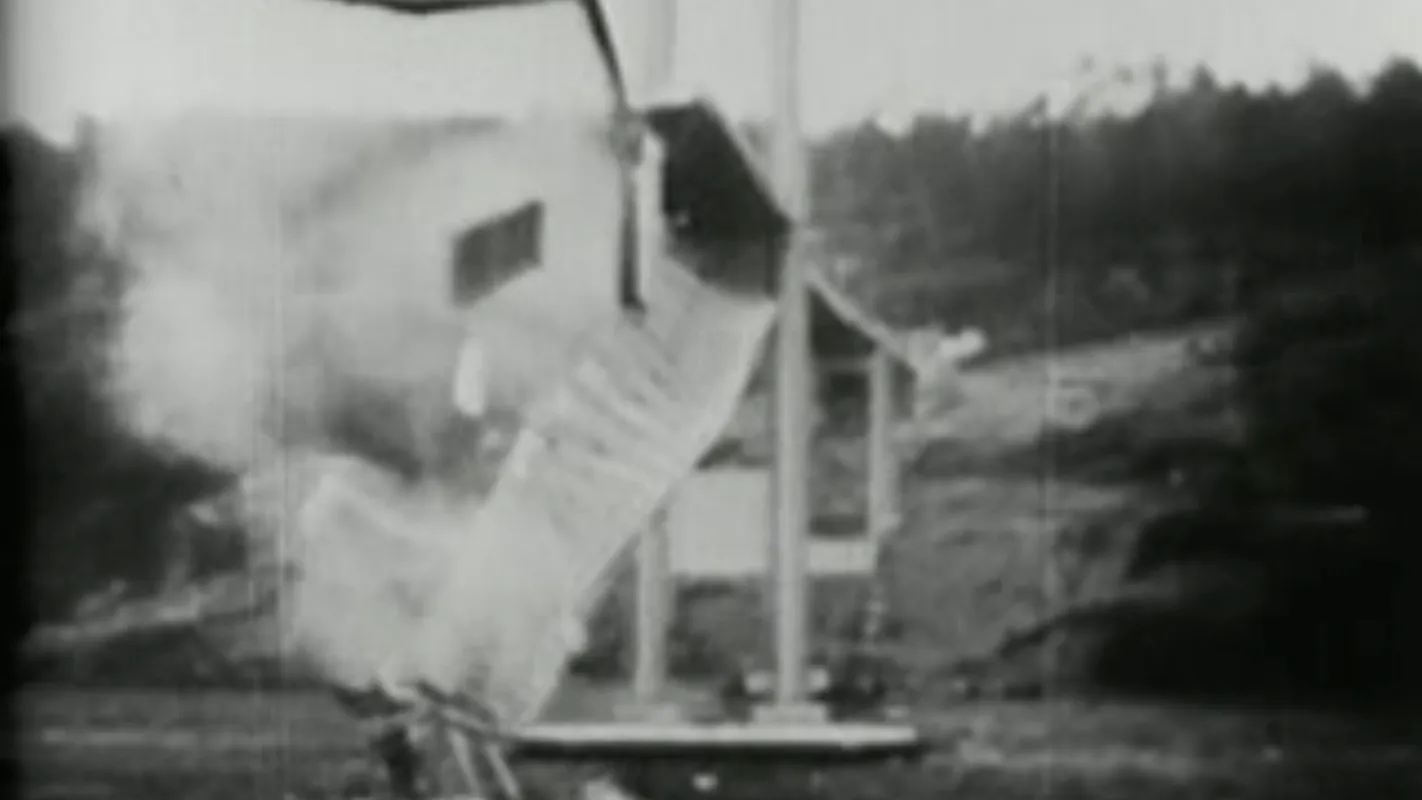
The first Tacoma Narrows bridge in Washington State, USA, opened on 1 July 1940 and fell on 7 November 1940, according to the Washington State Department of Transportation's history of the bridge. The film of its deck twisting like a ribbon turns up in many physics classes. The explanation that often comes with it, resonance, is the part engineers dispute.
What happened on 7 November 1940?
The bridge had a centre span of 2,800 feet, stiffened by two solid plate girders only 8 feet deep, according to WSDOT's page on the 1940 bridge. It was so flexible that it earned the nickname Galloping Gertie: from its first months the deck rode up and down in waves of 1 to 5 feet, the WSDOT timeline records.
On 7 November the wind measured 42 miles per hour at 9:30 a.m. Just after 10 a.m. the motion changed: instead of rising and falling, the deck began to twist, tilting up to 28 feet on one side and then the other, at angles up to 45 degrees. The last section of roadway fell at 11:08 a.m., per the same timeline. The only victim was Tubby, a dog in reporter Leonard Coatsworth's car, WSDOT notes.
A federal board that included Othmar Ammann and Theodore von Kármán reported in March 1941 that the bridge was excessively flexible and that its girder and deck acted like an aerofoil, WSDOT's "Lessons from failure" page explains. The page links the switch to twisting with a cable band slipping at mid-span and calls torsional flutter the primary explanation, though the details are still debated.
Why wasn't it simple resonance?
Resonance needs an outside push that repeats at its own fixed rhythm and matches the structure's natural frequency. Soldiers marching in step on a bridge are the classic case, which we explain in why soldiers break step on a bridge.
In 1991 K. Yusuf Billah of Princeton University and Robert Scanlan of Johns Hopkins University pointed out in the American Journal of Physics that many undergraduate physics texts present Tacoma Narrows as forced resonance, an explanation they called oversimplified (Billah and Scanlan, 1991). They argued that the failure came from aerodynamic self-excitation, or "negative damping", in the twisting motion: the wind forces were strongly linked to the motion of the structure itself. As they put it, forced resonance and self-excitation are "fundamentally different phenomena".
In resonance the wind would be the metronome; in flutter the bridge is. Each twist tilts the deck, the air pushes the way the deck is already turning, and the next twist is bigger. The wind needs no rhythm of its own.
How can you tell resonance from flutter?
Treat the twist angle θ of the deck as a damped oscillator:
θ'' + 2ζωθ' + ω²θ = (outside torque) / I
Here ω is the natural angular frequency, I the moment of inertia and ζ the damping ratio.
Forced resonance. The outside torque is periodic and ζ is positive. Even at exact resonance the amplitude stops at a ceiling set by damping, T₀ / (2ζIω²). Stop the push and the motion dies away.
Flutter. There is no periodic torque. Above a critical wind speed the air adds a torque proportional to θ', which acts like negative damping. With ζ below zero, the amplitude grows like e^(−ζωt) until something breaks.
A worked example: take ζ = −0.01. In one cycle (ωt = 2π) the amplitude is multiplied by e^(2π × 0.01) = e^0.063, about 1.065. After 50 cycles the factor is e^3.14, roughly 23. A wobble becomes the swing on the film.
Ask three questions of any vibration problem:
Is there a push with its own fixed rhythm, such as marching feet or a motor? If yes, think resonance.
Does the amplitude settle, or keep growing? Settling means positive damping; growing without limit means negative damping.
Does the structure vibrate at its own frequency whatever the push does? Then it is self-excited.
For the steady-state side, read forced vibration vs resonance; for positive damping, see the pendulum damping practical. If the sign of a damping term is hard to picture, the Fermi Simulation Lab has interactive simulations for ideas that are easier to see than to read.
How did bridges change after Tacoma Narrows?
The replacement bridge opened on 14 October 1950 with 33-foot-deep steel Warren stiffening trusses, slots of open steel grating between its lanes and hydraulic shock absorbers, WSDOT records. F. B. Farquharson of the University of Washington tested the design in a wind tunnel, where the model showed virtually no torsional movement. In 1951 it rode out storms with sustained winds up to 75 miles per hour without vertical or torsional movement, the timeline says.
The lasting change was in method: according to WSDOT, bridges built with US federal funds must have their preliminary design tested in a wind tunnel with a three-dimensional model.
To work through the oscillator equation, Fermi's AI tutor works out what you already know, builds a plan for the session and checks understanding as it goes.