On this page
A tense is the form of a verb that tells you when something happens. Almost every sentence your child writes has one, and many tense mistakes in Classes 4 to 6 come from three slips: forgetting the -s, adding -ed where it does not belong, and putting the wrong verb form after a helper word like did or will. This guide covers the three simple tenses, the clue words that point to each, and a short daily practice for home.
What are the three simple tenses?
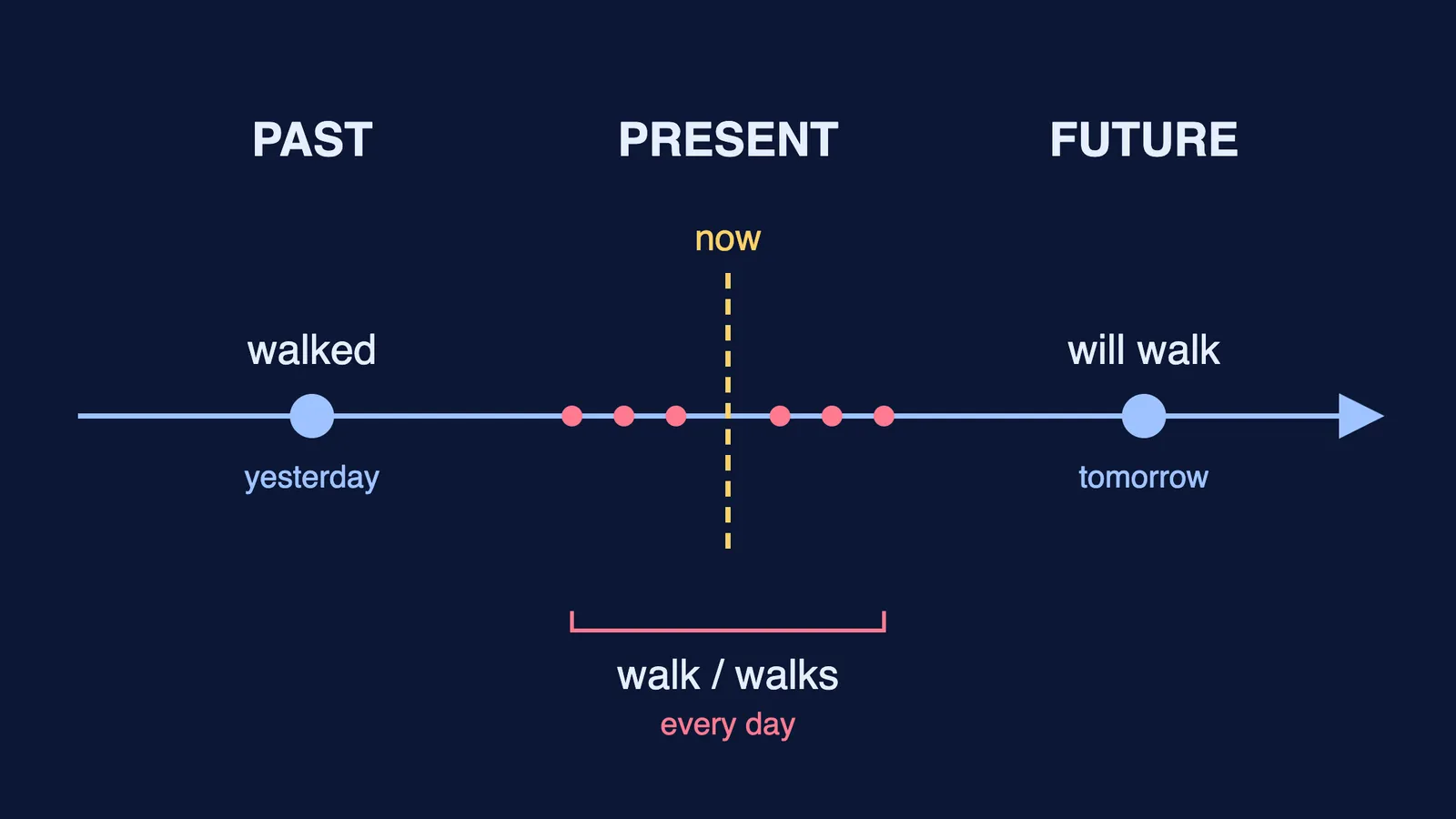
Picture a line. Everything to the left of “now” is the past, everything to the right is the future, and the simple present covers what is true now or happens again and again.
The British Council's grammar guide says we use the present simple “to talk about things we do regularly” and “for things which are generally true”. Riya walks to school. The sun rises in the east.
With he, she and it, the same present simple page says we add -s or -es, and sometimes change y to i: play becomes plays, watch becomes watches, carry becomes carries.
The past simple is for something that happened once or several times in the past, or was true for some time in the past. Most verbs add -ed (walk, walked), but English has many irregular past forms, such as go and went.
For the simple future, children learn will plus the verb: she will walk. The British Council lists the uses of will as beliefs about the present or future, what people want or are willing to do, and promises, offers and requests: “I'll give you a lift home after the party.”
How do you find the tense using signal words?
Signal words are time clues in the sentence. Teach your child to look for them first.
Simple present: every day, always, usually, often, on Sundays
Simple past: yesterday, last week, in 2020, ago
Simple future: tomorrow, next week, soon, later
The British Council notes that we often use expressions with ago with the past simple, as in “I met my wife a long time ago.” The next example is from its page on talking about the future.
What mistakes do Class 5 students make with tenses?
Watch for these six slips:
Dropping the -s: “He go to tuition” should be “He goes to tuition.”
Two past forms after did: “Did you went?” should be “Did you go?” The British Council uses did for questions and didn't for negatives, and its example “They didn't go to Spain this year” keeps the main verb plain.
Adding -ed to irregular verbs: “goed” and “buyed” should be went and bought.
Doubling the -s after does: “Does she likes mangoes?” should be “Does she like mangoes?” For questions, the present simple uses do or does, and the -s moves to does.
Changing the verb after will: “She will goes” should be “She will go.”
Switching tense in the middle of a story: “Yesterday I go to the market and bought bananas” should use went.
The pattern behind mistakes 2, 4 and 5 is one rule: after do, does, did or will, the main verb goes back to its plain form.
Worked example: one sentence in all three tenses
Start with the verb in brackets: Arjun (eat) idli for breakfast.
Every day: Arjun eats idli for breakfast.
Yesterday: Arjun ate idli for breakfast.
Tomorrow: Arjun will eat idli for breakfast.
Now the negatives: Arjun doesn't eat, didn't eat, won't eat. And the questions: Does Arjun eat? Did Arjun eat? Will Arjun eat?
When your child fills a blank, ask three questions out loud:
What is the time word? (every day, yesterday, tomorrow)
Where does it sit on the line: past, now and always, or future?
Is there a helper word (do, does, did, will)? If yes, keep the main verb plain.
How can parents practise tenses at home?
A short daily chat is easy to keep up. At dinner, ask three questions: What did you do today? What do you do every Monday? What will you do tomorrow? Gently repeat the answer in the right form instead of correcting it (“Oh, you went to the park!”).
While reading a story together, pause and ask which tense the writer used and why. Our guide to improving reading comprehension in Class 5 has a routine that fits this well. If English is not your strongest language, helping your child with English when you're not fluent shows how to support practice anyway, and our plan for Class 5 homework helps you decide when to sit with your child and when to step back.
The habit behind all of this, naming the rule and then checking the answer against it, is useful in maths and science too. In STEM subjects, Fermi's AI tutor works out what a student already knows, builds a plan for the session and checks understanding as it goes.
Tonight, try the three dinner questions and listen for one helper word followed by a plain verb.