On this page
Your child brings home ten words on Monday and a test on Friday. The rules below come from England's national curriculum spelling appendix (Department for Education, English Appendix 1: Spelling), which sets out spelling work year by year for primary school.
What are the main spelling rules for Class 4?
The appendix brings in doubling and dropping the e in its Year 2, the stress rule in Years 3 and 4, and i before e in Years 5 and 6.
Rule 1: i before e, except after c. The rule applies only to words where the letters make the long "ee" sound, according to the curriculum's spelling appendix. So you get believe, chief and field, and after c: receive, ceiling, deceive. The appendix lists the exceptions as protein, caffeine and seize (plus either and neither when said with an "ee" sound). Vein, weigh and eight, where ei sounds like "ay", sit outside the rule.
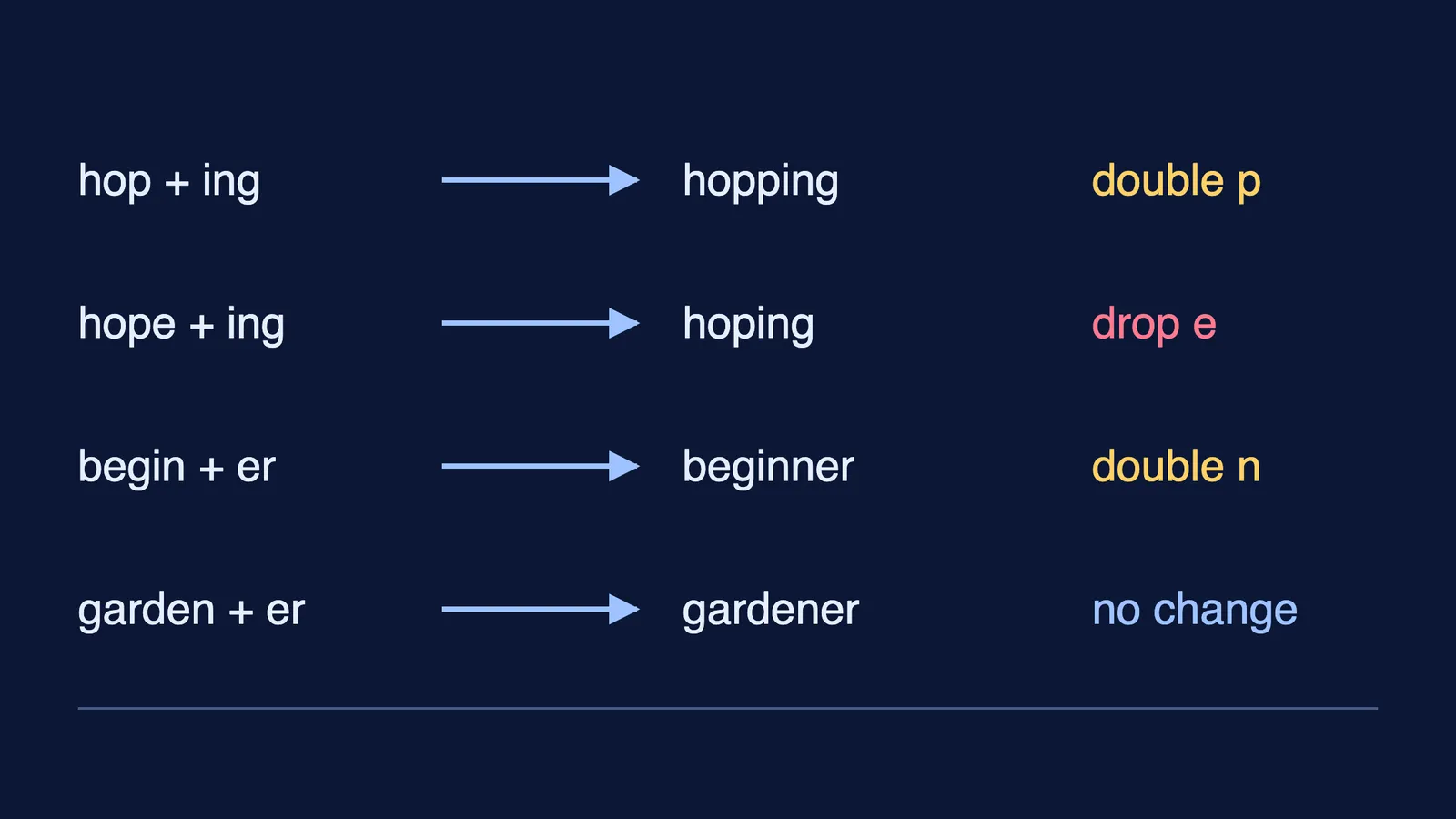
Rule 2: double the last letter to keep the vowel short. When a one-syllable word ends in one consonant after one vowel, double that consonant before adding -ing, -ed, -er, -est or -y. The appendix gives patting, hummed, saddest and runny, and explains that the doubled letter keeps the vowel short. Its one exception: x is never doubled, so mixing and boxer.
Rule 3: drop the silent e before a vowel suffix. If a word ends in e with a consonant before it, drop the e before -ing, -ed, -er, -est, -y or any other suffix that starts with a vowel: hike becomes hiking, nice becomes nicest, shine becomes shiny. The exception the appendix names is being.
Rule 4: in longer words, listen for the stress. For words of more than one syllable that end in one consonant after one vowel, the appendix says the final consonant is doubled only if the last syllable is stressed: forgetting, beginner, preferred. If the last syllable is unstressed, nothing doubles: gardening, limited. Ask your child to say the word and clap the beats; the louder beat decides.
How do you teach spelling rules without a lecture?
Use one worked example and let your child do the thinking. Write stop, hope, begin and visit, and ask them to add -ing to each and name the rule.
stop: one syllable, one vowel, one consonant, so double it: stopping.
hope: ends in e after a consonant, so drop the e: hoping.
begin: two syllables, stress on gin, so double the n: beginning.
visit: two syllables, stress on VIS, so no doubling: visiting.
If they get one wrong, don't give the answer. Ask: "Clap it for me. Which beat is louder?" or "Does it end in e?"
Not every word follows a rule. The curriculum's statutory list for its Years 3 and 4 has 100 words, including February, separate, peculiar and believe, and the appendix says some letter patterns in root words simply have to be learnt. It also suggests linking words by meaning: medicine is related to medical, which is why it has a c.
What is the best way to learn a weekly spelling list?
Write the words from memory instead of copying them. In classroom experiments by Angela Jones and colleagues, published in Educational Psychology Review, second-graders learned 10 words by rainbow writing (copying them in different colours) and 10 by retrieval practice (writing them from memory, then checking), for 10 minutes per method on each of two days. A summary by The Learning Scientists reports that retrieval practice gave more correct spellings in all three experiments, including on a 5-week test in one of them, and that the children liked it just as much, sometimes more.
Here is a plan of about ten minutes a day:
Monday: read the list aloud together, sort the words by rule (double, drop the e, ie or ei, no rule), and underline the tricky part of each rule-breaker.
Tuesday: look, say, cover, write, check. Every word written from memory, then checked letter by letter.
Wednesday: a quick home test. Missed words get written from memory twice more, not copied.
Thursday: you dictate short sentences using the words; your child writes them.
Friday: the school test. Missed words go onto next week's list.
Keep the ten minutes free of phones and TV, because switching between tasks costs attention.
The appendix also notes that children absorb some spellings through reading, so regular reading helps too; if long words make your child stall, see what to do when your child skips hard words while reading.
By Class 6, science brings its own long words, such as evaporation and chlorophyll. The Fermi Concept Library has a lesson for each concept in physics, chemistry, biology, mathematics and computing, so your child can meet a new word together with what it means.
Start on Monday: sort this week's list by rule and ask your child to explain each one.