

On this page
When a child reads aloud and seamlessly breezes over a difficult word, it might look like fluent reading. But skipping words to maintain speed is often a compensatory strategy that hides a deeper gap in decoding skills. As texts become more complex, especially in older grades, this habit leaves severe holes in comprehension.
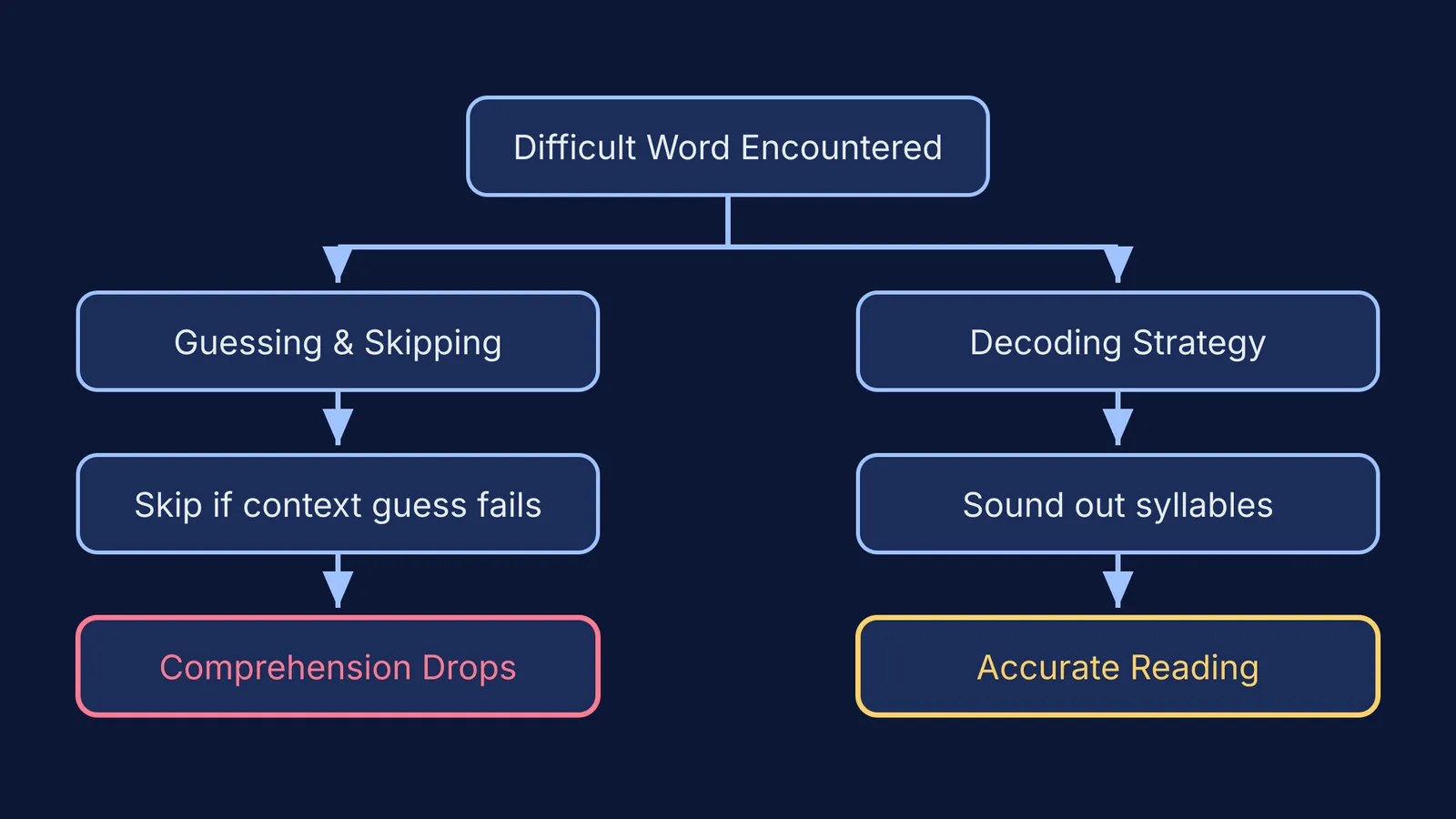
According to the National Institute of Child Health and Human Development, proficient reading requires a foundation of accurate word identification rather than reliance on surrounding text. This means that to build true literacy, children must be taught to pause and break a hard word apart.
Why do children skip difficult words?
For decades, many early literacy programs taught the "Three-Cueing System", which encouraged students to use pictures, syntax, or the first letter of a word to guess its meaning. While this approach keeps the reading moving, it trains children to treat reading like a visual guessing game rather than a reliable system of sounds.
When a child encounters a multi-syllable word they cannot quickly guess, their cognitive load spikes. To avoid the frustration of struggling, they often skip it entirely and push forward. This may not drastically alter the plot of a simple picture book, but as students reach the third and fourth grades, the pictures disappear and the vocabulary becomes specialized. Skipping essential nouns or verbs at this stage fundamentally breaks their understanding of the text. Proficient readers do not skip; they process every letter in a word rapidly and automatically. If you want to help your child read faster for exams, forcing them to speed read is counterproductive. If they are habitually skipping words or complaining that reading is "too hard", they likely need a stronger foundation in explicit phonics.
Is guessing from context a good strategy?
Context clues are excellent for building vocabulary, but they are poor tools for primary word identification. The National Reading Panel's 2000 report on teaching children to read reviewed decades of research and found that systematic phonics instruction is significantly more effective than whole-language approaches that encourage guessing from context [https://www.nichd.nih.gov/sites/default/files/publications/pubs/nrp/Documents/pnp-summary.pdf].
The critical distinction is knowing *when* to use context. Educational scientists recommend using context to determine the *meaning* of a word only after the child has accurately sounded it out. For example, if a child decodes the word "bark", they then use the surrounding sentence to decide if it means a tree covering or a dog's sound. If a child uses context to guess *what the word is* before decoding it (such as guessing "dog" because the story is about a pet), they fail to learn the new word and risk missing the author's precise meaning.
How can you help your child sound out hard words?
When you sit down for shared reading with young children, you have the perfect environment to gently correct the skipping habit. The goal is to move them away from rushing and toward careful, accurate decoding. Instead of simply supplying the word for them when they hesitate, you can guide them through the process.
Pause and point: Stop the reading the moment a word is skipped or mumbled. Point directly to the word and say, "Let's look at this one together."
Break into syllables: If a word feels overwhelming, cover part of it with your finger. Have your child sound out the first chunk, then the second, and finally blend them together. This morphological breakdown makes long words manageable.
Reread for meaning: The mental effort required to sound out a difficult word often causes the child to forget what the rest of the sentence was about. Once the word is successfully decoded, ask your child to reread the entire sentence from the beginning. This reconnects the newly sounded word to the broader story.
Log the vocabulary: Keep a small, dedicated notebook of the challenging words they encounter during the week. Reviewing these words occasionally helps transfer them into long-term memory.
Does decoding build accurate study habits?
The habit of breaking down complex information rather than skipping it extends far beyond early reading. As students progress to high school physics, biology and mathematics, similar avoidance strategies appear when they face dense, multi-step problems or unfamiliar terminology. A student who has learned to pause and decode is much more likely to apply that same patience to a challenging equation.
When your child tackles harder mathematical text, skipping steps inevitably leads to wrong answers. To help them work through these challenges, the Fermi Problem Library provides a step-by-step solver that explains the reasoning rather than simply printing an answer, preventing students from skipping over the hard parts of the calculation. If they are stuck on the underlying physical idea itself, Fermi's AI tutor holds a line of reasoning across a whole session, notices where a student is stuck and builds a plan for the session, ensuring they sit down to a clear next step.
Encouraging your child to tackle difficult words head-on not only improves their immediate literacy but also builds the resilience required for all future academic work. When they finally transition to independent reading for pleasure, they will do so with the confidence that no word—and no concept—is too difficult to break down and understand.


