

On this page
You have probably muttered a definition under your breath before a test. Memory researchers have a name for that habit, good evidence behind it, and one catch that changes how you should use it.
Does reading aloud actually help you remember?
Yes, for the lines you choose to say. The production effect is the memory advantage of saying something aloud over reading it silently, a name given by Colin MacLeod and colleagues at the University of Waterloo in a 2010 paper reporting eight experiments.
In their first experiment, run twice with 44 students in all, students studied a list of words, reading the blue ones aloud and the white ones silently. On a recognition test afterwards, they correctly picked out 76% of the words they had said aloud and 60% of the words they had read silently (MacLeod et al., 2010). Later experiments in the same paper found that mouthing the words without making a sound also helped. Saying the same word, “yes”, for each of those words instead did not.
One detail matters if you are short of time. In that first experiment, a silent word stayed on screen for two seconds, while a spoken word moved on as soon as the student said it. The spoken words got less study time and were still remembered better.
Why does saying it out loud work?
The main explanation is distinctiveness. Saying a line adds things silent reading does not have: the movement of your mouth and the sound of your own voice. Later, that extra record makes the line stand out, and you can use a rule of thumb like “if I recall saying it aloud, then it must have been studied”, as a 2017 review of the research by MacLeod and Glen Bodner puts it.
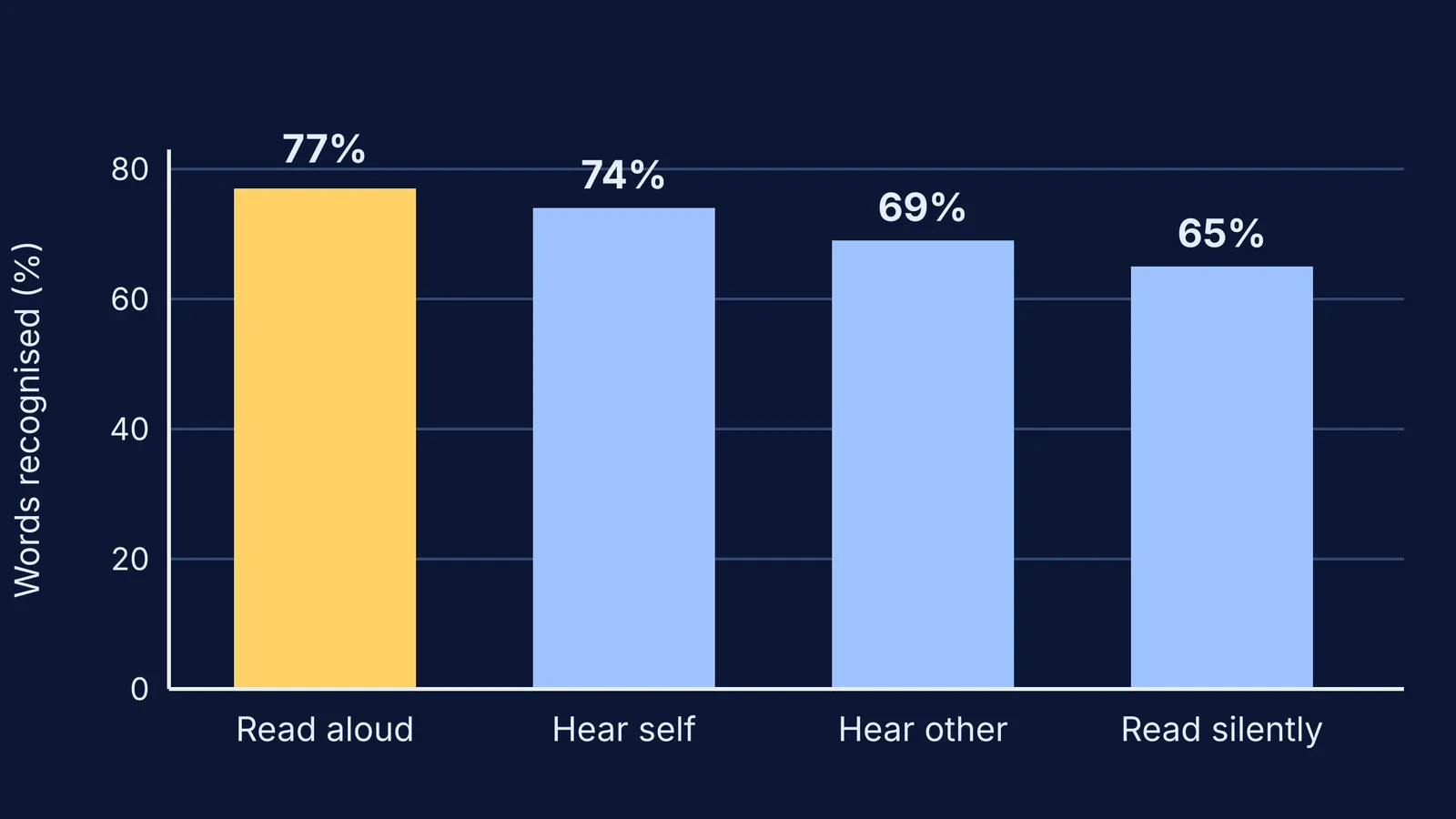
A 2018 study by Noah Forrin and Colin MacLeod pulled these parts apart. 95 students first recorded themselves reading words aloud. Two weeks later, the 75 who came back studied words in four ways: reading aloud, hearing their own recording, hearing someone else read, and reading silently. Recognition followed that order: 77%, 74%, 69% and 65%. Hearing your own voice reliably beat hearing someone else's. The extra gain from actually speaking, over hearing your own recording, was small and not statistically reliable.
Should you read the whole chapter aloud?
No. The same 2017 review sets out the limits:
It works by contrast. Most studies mix spoken and silent items in one list. When one group reads everything aloud and another reads everything silently, the recognition advantage is markedly smaller, and for free recall it disappears.
It improves recognition and cued recall, such as fill-in-the-blank questions, but not free recall, where you write down everything you remember. The authors call this one of the open puzzles in the research.
Writing and typing also help, but less than speaking.
The authors note that nobody yet knows whether reading all of a text aloud improves memory.
The good news is that the benefit lasts. The review describes work by Jason Ozubko and colleagues in which spoken words were still better recognised a week later, and textbook paragraphs read aloud a day earlier did better on a fill-in-the-blank test than paragraphs read silently.
How do you use it for definitions and key lines?
We suggest a three-step routine. It adds a few seconds per marked line, not minutes per page.
Mark. On your first pass, underline only the lines you must be able to reproduce closely: definitions, statements of laws and theorems, units, and lists of exceptions. Keep it to a handful per page.
Say. Read the rest silently at your normal speed. When you reach a marked line, say it once, clearly, at a normal pace. In a library or a shared hostel room, mouth it instead; mouthing also helped in the 2010 experiments.
Test. Later that day, cover the page and say the line from memory. Saying it at study time helps it stick; recalling it later is what tells you whether it did.
On a biology page about osmosis, that means reading the explanation and examples silently, then saying two marked lines once each: the definition of osmosis and the meaning of osmotic pressure. That evening, you cover the page, say both from memory and check the wording.
For parents: a teenager muttering short key lines at their desk is not necessarily distracted. An hour of reading the whole chapter aloud is a different thing.
What if the definition does not make sense?
Saying a line you do not understand gives you a well-remembered string of words, which will not help much in a numerical question. Understand the idea first, then pick the line to say. The Fermi Concept Library has every concept in physics, chemistry, biology, mathematics and computing, each with its own lesson, so you can sort out the idea before you choose what to memorise.
Reading aloud is one small tool. It works best alongside self-testing with flashcards and a spaced revision schedule, and it is a useful counter to the illusion of fluency that comes from rereading.


