

On this page
Your child is in Class 5. The homework isn't hard, yet you still sit beside them every evening, and some nights you do half of it. The real question is how much to help, what kind, and how to step back.
Should a Class 5 child do homework alone?
Mostly, yes. Class 5 homework is meant to be short. India's Policy on School Bag 2020, released by NCERT for the Ministry of Education, recommends no homework up to Class II and a maximum of two hours a week for Classes III to V. The policy doesn't say who should sit with the child, but that is a load many 10-year-olds can learn to manage, with an adult close by.
Research points the same way. In a 2015 study of 1,685 sixth-graders in Switzerland, how often parents helped with homework was negatively associated with how achievement developed. Help that students saw as supportive had positive effects on achievement, and help they saw as intrusive had negative effects.
A 2008 research synthesis by Patall, Cooper and Robinson found that training parents to get involved in homework led to higher completion and fewer homework problems among elementary school children. It also found that parents setting rules had a stronger link to achievement-related outcomes than other kinds of involvement.
So the goal is less sitting and better structure: a fixed time, a fixed place, and you as the person who checks at the end, not the person who works alongside.
How do you know your 10-year-old is ready?
If three or more of these fit, start the plan below.
They can tell you what the homework is without you opening the diary.
They start within a few minutes of sitting down, without reminders.
When stuck, they reread the question or look in the class notebook before calling you.
On most days they finish in about the time the teacher expects.
Their mistakes are mostly slips, not "I don't understand this at all".
If your child is lost on the content most days, talk to the class teacher first. That's a learning gap, and stepping back won't fix it.
How do you step back gradually?
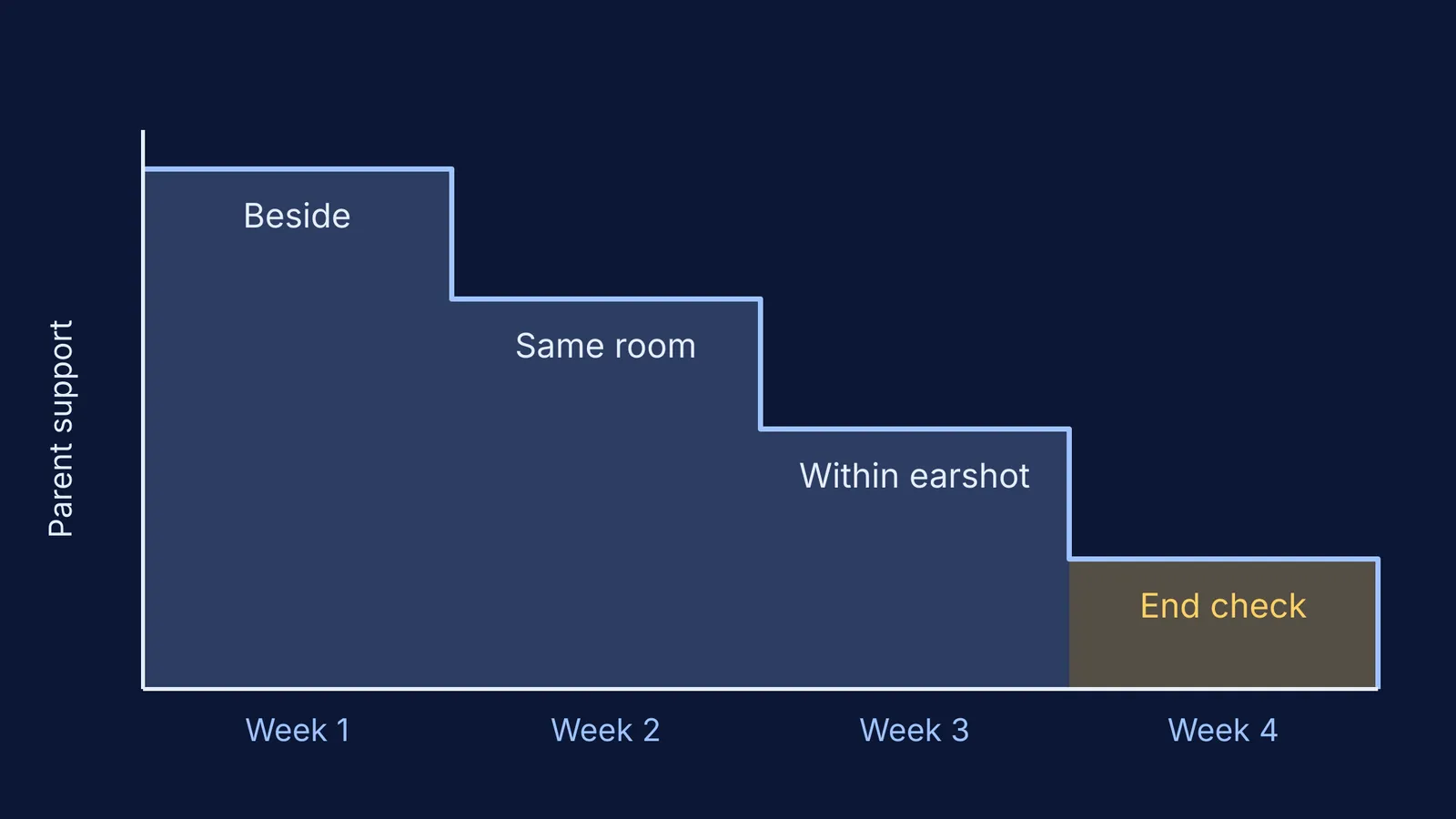
Move one step a week. If a week goes badly, repeat that week rather than starting over.
Week 1, beside them: sit at the table, but don't hold the pencil. Your child reads each question aloud and says how they'll start before writing.
Week 2, same room: do your own reading or work. Your child tries first and comes to you only with a specific question.
Week 3, within earshot: be in the next room. Check in once, halfway through, with "How's it going? Anything starred?"
Week 4, alone: your child works by themselves, and you do only the five-minute end check.
When they do ask for help, try this script: "Show me what you've tried." Then: "What is the question asking you to find?" Then: "Which example in your notebook looks like this one?" Then walk away.
A 2018 study of 336 ninth-graders in China found that autonomy-oriented support from parents (listening to the child's ideas) predicted higher later maths achievement. Content-oriented support (giving direct help whenever the child got stuck) predicted more effort later but lower later achievement. Those students were older, but the finding points the same way.
What should you check at the end without redoing the work?
The end check takes about five minutes. You are checking the process, not marking the answers.
Complete: every question attempted, and any stuck ones starred.
Explain two: pick any two answers and ask, "How did you get this?"
Check one another way: for a maths sum, multiply back or estimate. For a spelling list, cover and rewrite one word.
Point to the line, not the fix: "Something on this line is off. Can you find it?"
Pack up: books in the bag, diary signed.
What you don't do: erase, rewrite, or fix every error. The teacher needs to see real mistakes to know what to reteach. Read our guides on how to correct your child's homework mistakes without taking over and teaching your child to check their own answers.
When a starred question shows a gap in an idea, such as what a fraction of a fraction means, a short lesson beats a rushed explanation at 9 pm. The Fermi Concept Library covers concepts in mathematics, physics, chemistry, biology and computing, each with its own lesson, so your child can go back to the idea rather than copy an answer.
Our guide on why homework takes too long can help you find the cause. If evenings feel heavy for reasons beyond homework, Tele MANAS, the government's 24x7 tele-mental health service, is on the toll-free number 14416.
Start with Week 1 tonight. Sit beside them, keep your hands off the pencil, and let them do the talking.


