

On this page
Many ‘silly mistakes’ are answers nobody tested before handing them in. Checking is a skill you can teach at the kitchen table: four checks a child can run alone, a checklist for each subject, and words that make the habit theirs, not yours.
Why does checking their own work help children?
Monitoring accuracy is how closely a student’s judgement of an answer matches how they actually did (Oudman, van de Pol and van Gog, Metacognition and Learning). In that study, children aged 9 to 10 from 34 classes solved multiplication and division problems, judged how they had done, then scored their own answers. Self-scoring made their judgements more accurate, and on the division problems the gap between high- and low-performing students’ judgements disappeared after self-scoring.
A child who knows which answers are shaky knows where to look again.
How do you teach a child to estimate before calculating?
Estimating means rounding the numbers and working out a rough answer before the exact one. It is worth practising: psychologists Robert Siegler and Geetha Ramani write that proficiency at estimation is ‘substantially correlated’ with overall maths achievement test scores (APS Observer).
A worked example, 48 × 21:
Round: 48 is about 50, and 21 is about 20.
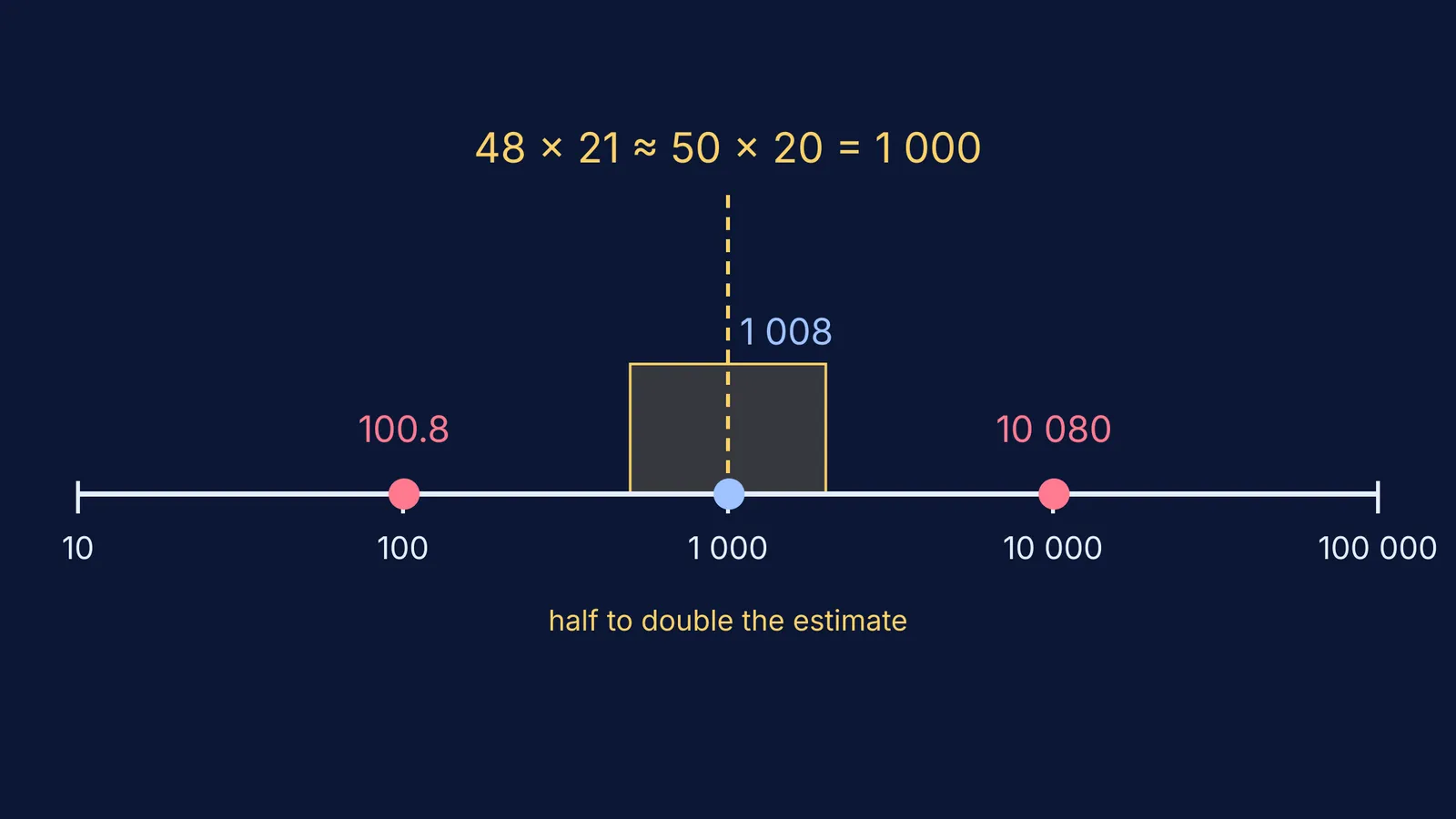
Estimate: 50 × 20 = 1,000. Write it in the margin before starting.
Calculate: 48 × 21 = 1,008.
Compare: 1,008 is close to 1,000, so it passes. An answer of 10,080 or 100.8 is ten times too big or too small, which usually means an extra zero or a slipped decimal point.
A simple rule for younger children: if the exact answer is less than half or more than double the estimate, work it again.
What does ‘reverse the operation’ mean?
Most calculations have an undo button. Your child does the opposite operation and checks they land back where they started:
Subtraction: 702 − 389 = 313. Check: 313 + 389 = 702.
Division: 864 ÷ 12 = 72. Check: 72 × 12 = 864.
Equations: if 3x + 7 = 25 gives x = 6, put it back in: 3 × 6 + 7 = 25.
In How to Solve It, first published in 1945 (Princeton University Press), George Pólya made looking back the last of four phases of solving a problem, with the questions ‘Can you check the result? Can you check the argument?’ (summary of Pólya’s steps). For long multiplication there is also a quick digit test: see our guide to casting out nines to check arithmetic.
How do you get a child to reread the question?
A correct calculation still loses marks if it answers a different question. Teach ‘read twice, underline once’:
Underline what is asked: ‘how many more’, ‘in metres’, ‘give two reasons’.
Circle the numbers and units.
After answering, read the question again and check the answer fits: the right quantity, the right unit, the right number of points.
For example: ‘Riya has 45 marbles and Arjun has 28. How many more does Riya have?’ A child who writes 73 has added. Rereading ‘how many more’ shows the question wants the difference, 17.
What should a checking checklist include for each subject?
Keep each list short enough for a sticky note inside the notebook cover.
Maths: estimate written in the margin and compared; operation reversed or answer substituted back; signs and decimal points looked at once more.
Physics: units match on both sides (our guide to checking units and dimensions shows how); the size makes sense, so a bicycle is not doing 300 m/s; signs and directions match the diagram.
Chemistry and biology: equations balanced, with the same number of each kind of atom on both sides; grams and moles not mixed up; diagram labels point to the exact part.
Languages and social science: every part of the question answered; length matches the marks; names, dates and spellings checked against notes.
What should you say when your child gets an answer wrong?
If you circle the mistake, you did the checking. Point them towards the check instead:
‘Two of these ten are wrong. Can you find them?’
‘What was your estimate? Does your answer match it?’
‘Put your answer back into the question. Does it work?’
Praise the catch as much as the right answer: ‘You found that yourself. That is the skill.’ Our post on correcting your child’s homework mistakes has more on keeping the tone calm.
Add one check a week: estimate in week 1, reverse in week 2, reread in week 3. By week 4, your child uses the sticky note alone and you only ask, ‘Did you check?’
Sometimes the checks show an answer is wrong but not why. Then the Fermi Problem Library has worked problems with a step-by-step solver that explains the reasoning rather than printing an answer, so your child can compare their method line by line.
Start tonight with one estimate in the margin.


