

On this page
Casting out nines is one of the oldest error-checking techniques in mathematics. When you multiply two large numbers by hand, a single wrong digit in the working makes the final answer wrong. Before calculators, accountants and students relied on this method to quickly test their results.
What is casting out nines?
The method is based on the mathematical property that any number leaves the same remainder when divided by 9 as the sum of its digits does. In modular arithmetic, we say that a number is congruent to the sum of its digits modulo 9 (Wolfram MathWorld).
This elegant property arises from our base-10 number system. Because 10 is exactly one more than 9, it leaves a remainder of 1 when divided by 9. Consequently, any power of 10—such as 100, 1,000, or 10,000—also leaves a remainder of 1. If you expand a number like 142 into its place values as (1 × 100) + (4 × 10) + 2, the remainders of the powers of 10 simplify to 1. This means the overall remainder is simply the sum of the individual digits: 1 + 4 + 2, which equals 7.
This single-digit sum is called the number's digital root. To find it, you add the digits of the number repeatedly until only one digit remains. For example, the digital root of 142 is 1 + 4 + 2 = 7. If the digit sum happens to be 9, the digital root is 9.
The shortcut that gives the method its name is that you can ignore—or "cast out"—any 9s, or any groups of digits that add up to 9, while summing. For instance, in the number 2943, you can cast out the 9, and the 2, 4 and 3 (which sum to 9), reaching a digital root of 9 much faster than adding all the digits together.
How to check multiplication using casting out nines?
The rule for multiplication is simple: the digital root of the two original numbers multiplied together must equal the digital root of your computed answer.
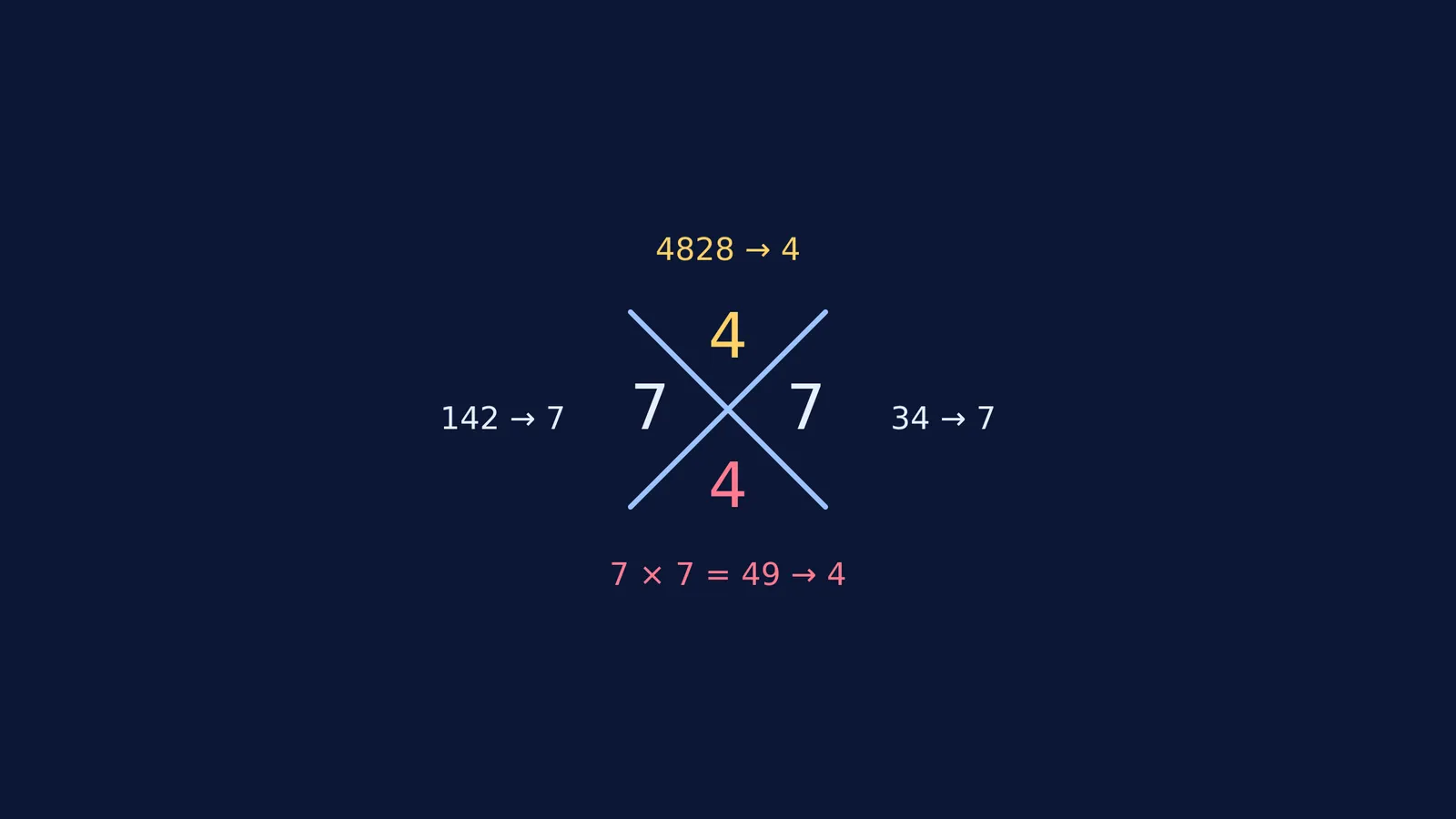
Here is the step-by-step check for 142 × 34 = 4828:
Find the digital root of the multiplicand (142): 1 + 4 + 2 = 7.
Find the digital root of the multiplier (34): 3 + 4 = 7.
Multiply those two roots: 7 × 7 = 49.
Find the digital root of that product: 4 + 9 = 13, and 1 + 3 = 4.
Find the digital root of your final answer (4828): 4 + 8 + 2 + 8 = 22, and 2 + 2 = 4.
Because the digital root of the product of the residues (4) matches the digital root of the computed answer (4), the calculation passes the check.
Traditionally, this is laid out in a cross. The roots of the two operands go on the left and right, the root of their product goes at the bottom, and the root of your answer goes at the top.
What errors does casting out nines miss?
While casting out nines is a fast sanity check, it is not foolproof. Because it relies only on the sum of the digits, it cannot catch errors that leave the sum unchanged (Wolfram MathWorld).
The most common blind spot is transposed digits. If you calculate the previous multiplication and accidentally write down 4882 instead of 4828, the check will still pass. The sum of 4 + 8 + 8 + 2 is 22, which reduces to 4, identically matching the correct answer.
The method will also fail to warn you if you:
Insert or drop a zero (for example, writing 48280 instead of 4828).
Insert or drop a nine.
Put a decimal point in the wrong place.
Make multiple errors that happen to offset each other.
These arithmetic slips are common, even for students who fully grasp the underlying concepts. When working through the Fermi Problem Library, the AI tutor holds a line of reasoning across the session, noticing when a student is stuck because they swapped a digit rather than misunderstood the method.
To catch transposed digits, mathematicians sometimes use a more robust check called "casting out elevens." This uses an alternating sum of digits—adding and subtracting each digit in turn—which changes if two adjacent digits are swapped.
If you are practising quadratic word problems in Class 10 or finding how adding to or scaling data changes the mean and variance, a quick digital root check can save you from losing marks to a careless multiplication error.


