On this page
You check the maths homework and see it at once: line two is wrong. The quick fix is to say so. The better fix is usually to help your child see it, or to let the teacher see it.
Should you correct mistakes in your child's homework?
Not by writing in the right answer. The Education Endowment Foundation's guidance for schools on working with parents advises caution about direct parental help with homework tasks, especially for older children. It notes that parents may not know the methods the school teaches, so it may be more effective to send a struggling pupil back to their teacher than to take on a teaching role yourself. Parents can more usefully support goal-setting, planning, and managing time, effort and emotions.
How you help matters more than how much. A review by Eva Pomerantz, Elizabeth Moorman and Scott Litwack is subtitled "More is not always better" and argues that the way parents get involved largely decides whether it works. A meta-analysis by Erika Patall, Harris Cooper and Jorgianne Civey Robinson found that across 14 studies, training parents to help with homework led to higher completion and fewer homework problems among elementary school children.
Why let your child find the mistake?
In a review titled Learning from Errors, Columbia University psychologist Janet Metcalfe reports that, in experiments, making errors and then getting corrective feedback helps learning, and that feedback which analyses the reasoning behind a mistake is crucial. She also notes that teachers gain useful information from students' errors.
Feedback can also backfire. A meta-analysis by Avraham Kluger and Angelo DeNisi found that feedback improved performance on average, but more than one third of feedback interventions made performance worse. John Hattie and Helen Timperley's review agrees that the type of feedback and the way it is given decide whether it helps.
A red cross that says "wrong" points attention at your child. A question that says "check line two" points attention at the work.
When should you point it out, and when should you leave it for the teacher?
Is it a slip or a misunderstanding? A copying error or a sign dropped once is a slip: prompt your child to check. The same mistake in every question is a misunderstanding, and the teacher needs to see it.
Will the teacher use this work to see what your child knows? A page you quietly fixed hides the gap the teacher is looking for. Leave it, and add a short note: "Got stuck on expanding brackets, tried for a while."
Would fixing it mean teaching a method? If you would have to explain it your way and the school teaches it differently, stop. Ask your child to take the question to class.
Point it out, with a prompt rather than the answer, for a one-off slip, when your child asks you to check, or when one small error will spoil a long project.
What can you say so your child finds the mistake themselves?
Start with the least help, pause after each prompt, and step up only if they are stuck.
"Read over this page once more before you call it done."
"One of these needs another look. Can you find which one?"
"Check your answer by putting it back into the question."
"Something changes between line one and line two. Talk me through it."
"What does the number outside the bracket multiply?"
If none works, say: "Let's mark this one to ask your teacher." That sends the question to the right person.
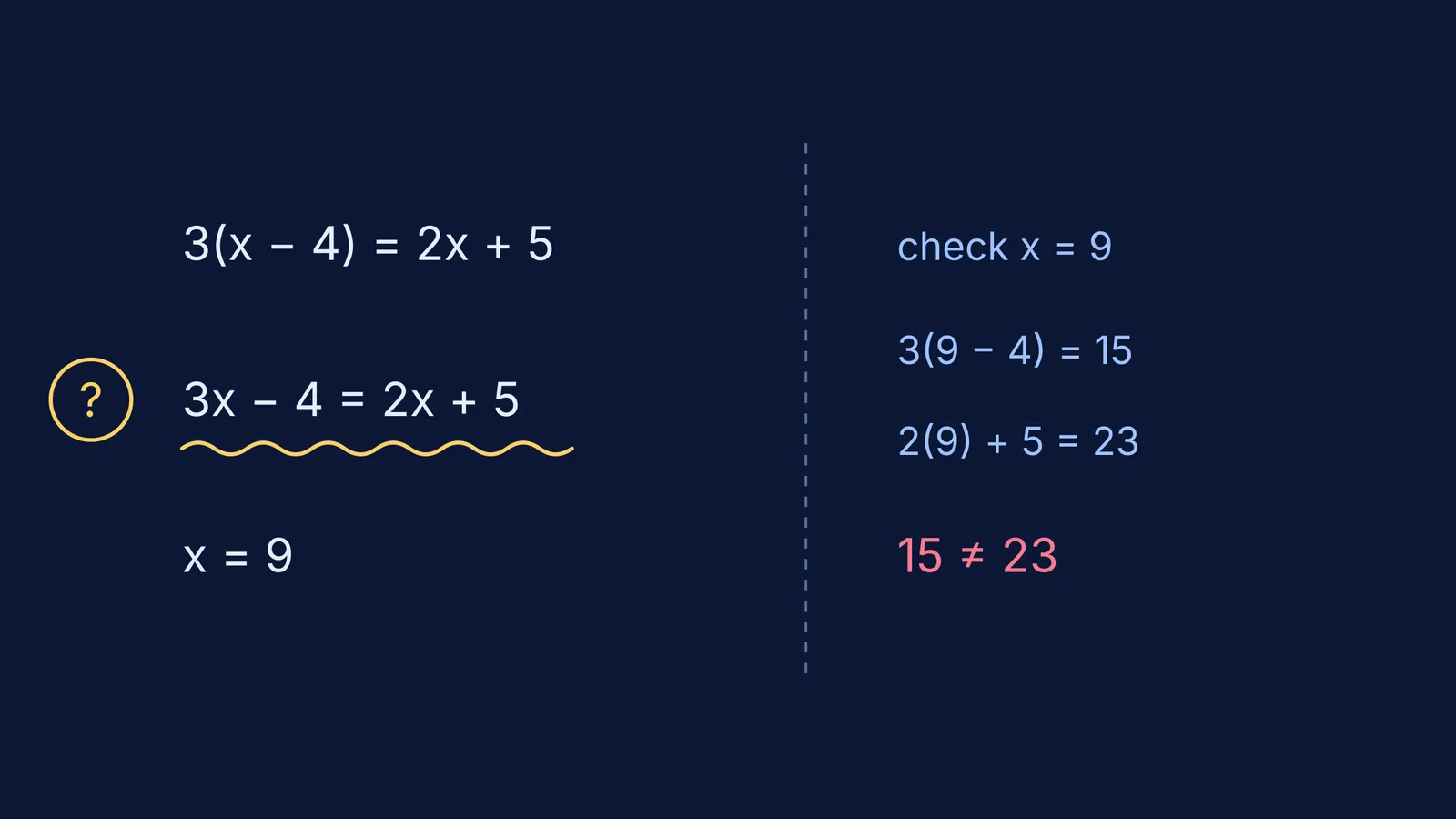
Worked example: 3(x − 4) = 2x + 5
Your Class 8 child has written:
3(x − 4) = 2x + 5
3x − 4 = 2x + 5
x = 9
Try phrase 3: "Put 9 back in." The left side gives 3 × 5 = 15; the right side gives 2 × 9 + 5 = 23. They do not match, so something is wrong. If needed, add phrase 4. Your child may then see that the 3 multiplied only the x. The fixed line, 3x − 12 = 2x + 5, gives x = 17, and the check works: 3 × 13 = 39 = 2 × 17 + 5.
If the same bracket slip turns up in the next few questions, it is a pattern. Stop prompting and write the note for the teacher.
For older students checking their own working, the Fermi Problem Library has a step-by-step solver that explains the reasoning rather than printing an answer.
What if your child gets upset about mistakes?
Keep your voice curious, as if the error is a puzzle. Praise the checking, not the cleverness; see praising effort and process instead of ability.
If every evening ends in a fight, read when to help with homework and when to step back and talk to the class teacher. If worry about schoolwork seems constant or affects sleep or eating, speak to the school counsellor or a doctor, or call the free, 24x7 Tele MANAS helpline on 14416.
Tonight, try just one thing: when you spot a mistake, ask a question instead of pointing.