

On this page
It is 9.30 pm, the maths worksheet had ten questions, and your child sat down "to start" at 6. The problem is rarely the amount of homework. It is usually how the evening is set up: a start that keeps slipping, work broken up by constant switching, and a phone within reach. All three can be fixed with a simple routine you can try for one week.
Why does a little homework take hours?
Watch one evening and you will usually see these leaks.
The start drifts. "After this episode" becomes "after dinner", and the start is negotiated again every few minutes.
Attention keeps switching. In a 2013 study, psychologist Larry Rosen and his colleagues asked middle school, high school and college students to study something very important for 15 minutes wherever they usually study. As Rosen describes the study, they spent only 9.65 of those minutes studying. When students were visibly off task, a communication activity such as messaging had distracted them more than half of the time (56%).
The phone drains focus even when silent. In experiments with nearly 800 smartphone users, people whose phones were in another room did better on tests of working memory and problem-solving than those whose phones sat face down on the desk, the researchers reported (Ward and colleagues, 2017). Whether the phone was on or off, face up or face down, made no difference.
The task feels bad. A question your child cannot do makes them want to avoid it, so they reorganise the pencil box instead. Delaying is often a way of dodging that feeling, not laziness; our piece on why procrastination is about feelings, not laziness explains this.
How do you set a fixed start time that sticks?
Pick the time together, once, and tie it to something that already happens every day. Psychologists call this kind of plan an implementation intention: an if-then plan that says exactly when, where and how you will act.
A meta-analysis of 94 tests by Peter Gollwitzer and Paschal Sheeran found that if-then plans had a medium-to-large effect on reaching goals (d = 0.65; published 200638002-1)).
A script you can try at the weekend, not in the middle of a fight:
"Homework has been eating our whole evening and neither of us enjoys it. Can we try something for one week?"
"When is a good time to start? After your snack, or after you change out of uniform?"
"So: when the snack plate goes in the sink, you sit at the table and open the first book. I'll set the timer."
Let your child choose the anchor and you agree to it, so the plan is theirs, not a rule handed down.
The timer-and-chunks routine: a worked example
Take a typical Class 8 evening: ten maths questions, a 150-word Hindi paragraph and a labelled science diagram.
Two minutes of planning. List the tasks with a time guess for each: maths 20 minutes, Hindi 20, science 15.
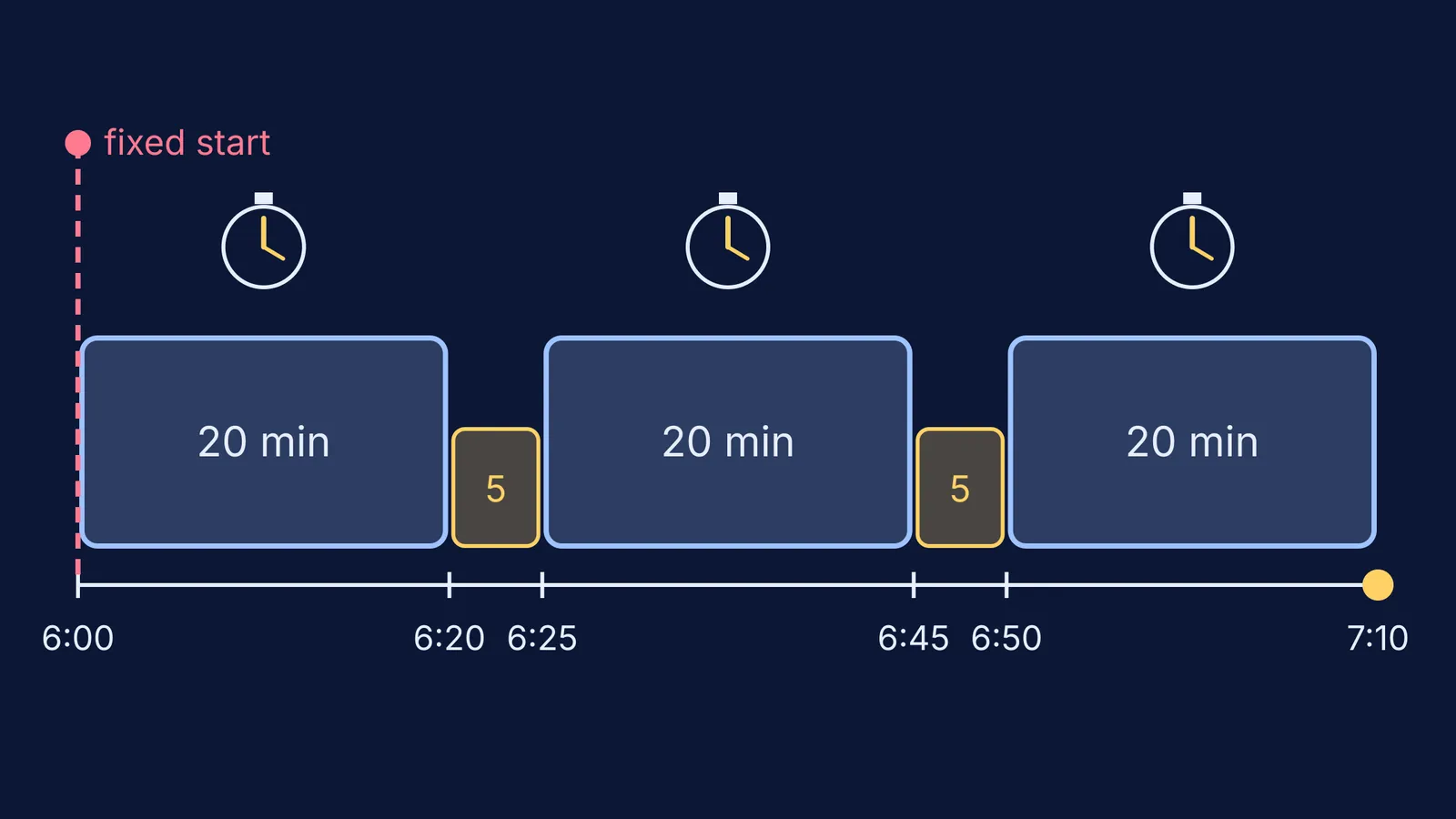
One task per chunk. Set a kitchen timer, not the phone, for 20 minutes. Only maths is on the table.
A short break that ends on time. Five minutes to stretch, drink water or check messages, then the next chunk. If 20 minutes is too long at first, Rosen suggests building up: an alarm for 15 minutes, one minute to check messages, then gaps of 20 and 25 minutes (Rosen in Kappan).
Stuck rule. If one question takes more than five minutes, mark it, move on, and come back to it in the last chunk.
Compare the guess with the clock. Each night, note how long each task really took. After a week you both know what "a little homework" actually costs.
Done this way, three 20-minute chunks and two 5-minute breaks take 70 minutes: start at 6.00, finish at 7.10.
How do you cut distractions without a fight?
The phone goes in another room for the chunk, not face down beside the book. Apply the same rule to yourself if you sit nearby.
One tab, one book, one task. Close the TV and the family group chat in that room.
Agree the rules once and write them down; our guide to phone and homework rules for families goes further.
What if homework still takes hours?
After two weeks of the routine, look at your notes. If the time is spent on one subject, the cause is probably a gap in understanding, not focus. Talk to the teacher. Our piece on how much homework is right for each age can help you judge whether the load itself is the issue.
If the sticking point is maths or physics problems, the Fermi Problem Library has worked problems with a step-by-step solver that explains the reasoning rather than printing an answer, so a stuck child sees the next step instead of a blank page.
If homework brings tears, panic or a refusal that keeps getting worse, talk to the school counsellor or a doctor. In India you can also call Tele MANAS, the free 24x7 government mental health helpline, on 14416.
Tonight, agree the start time; tomorrow, set the timer.


