On this page
On 1 January 2024 at 09:10 IST, ISRO's PSLV-C58 rocket launched XPoSat, the X-ray Polarimeter Satellite, into a low-inclination orbit (ISRO, PSLV-C58 mission page). ISRO describes it as its first dedicated scientific satellite for measuring the polarisation of X-rays from celestial sources. It adds a question that imaging, timing and spectra alone cannot answer: in which direction do the X-rays' electric fields point?
What is XPoSat and what does it carry?
XPoSat carries two instruments, according to ISRO's XPoSat mission page:
POLIX (Polarimeter Instrument in X-rays), built by the Raman Research Institute (RRI), Bengaluru, measures the degree and angle of polarisation of X-rays between 8 and 30 keV.
XSPECT, built by ISRO's U R Rao Satellite Centre, records spectra and fast timing in soft X-rays between 0.8 and 15 keV.
The satellite flies at about 650 km with an inclination of about 6 degrees, and ISRO expects a mission life of about five years (ISRO). The same page notes that XPoSat's 8-30 keV band complements NASA's IXPE, launched on 9 December 2021, which works at 2-8 keV. For India's earlier multi-wavelength observatory, read our explainer on AstroSat, India's space telescope.
What does X-ray polarisation tell us about black holes and neutron stars?
Light is polarised when its electric field oscillates mostly along one direction. You meet this in Class 12 wave optics: sunlight scattered at 90 degrees is plane polarised, as our post on why scattered sunlight is polarised shows. X-rays obey the same physics. ISRO's mission page names two ways cosmic X-rays become polarised: charged particles spiralling in a magnetic field give off synchrotron radiation polarised at right angles to the field, and electrons that scatter X-rays emit strongly polarised radiation (ISRO).
Black holes. ISRO says X-ray polarisation signatures enable measurements of the mass and spin of accreting black holes: the polarisation depends on how the disc is tilted, and strong gravity rotates its plane (ISRO).
Neutron stars. Accreting neutron stars, magnetars with ultra-strong magnetic fields, and rotation-powered pulsars can produce strongly polarised X-rays (ISRO). NASA's IXPE team lists finding the magnetic field configuration in magnetars as a goal (IXPE, NASA Marshall).
Polarisation has mapped pulsars before, in radio waves: see Radhakrishnan and Cooke's 1969 pulsar polarisation model.
How does POLIX measure X-ray polarisation?
POLIX has a collimator that limits its view to 3 degrees by 3 degrees, a scatterer of low atomic mass material, and four X-ray proportional counters around the scatterer (ISRO). ISRO's report on POLIX's first observations names the scatterer as beryllium (ISRO, POLIX first observations).
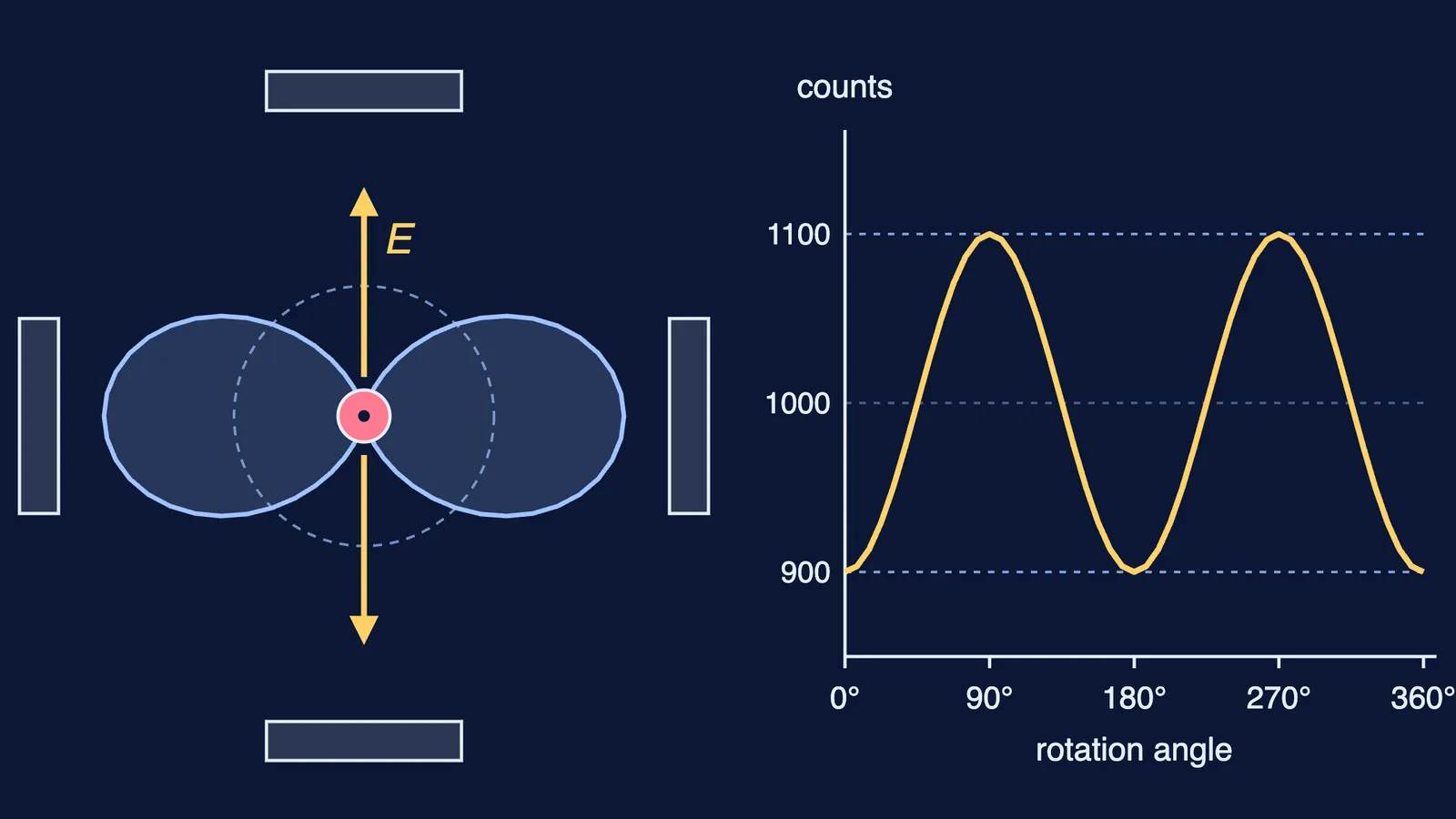
The physics is Thomson scattering. An incoming X-ray's electric field shakes an electron in the scatterer along that field, and the electron radiates most strongly perpendicular to its acceleration (Thomson scattering). So if the X-rays are polarised, the detectors facing perpendicular to the field collect more scattered photons than the detectors facing along it.
Then the instrument turns. A 2025 paper by the URSC team behind XSPECT says the spacecraft spins around its pointing axis at 0.2 rpm to remove POLIX's instrumental effects, and that POLIX needs long observations of 2-4 weeks per source (Radhakrishna et al., arXiv). As POLIX rotates, each detector's count rate rises and falls twice per turn. That ripple is the modulation curve. The ripple a fully polarised beam would produce is the instrument's modulation factor, a number below 1 that is measured in calibration.
Worked example: how do you read a modulation curve?
Suppose POLIX's counts, sorted by rotation angle, peak at 1,100 and dip to 900. These are practice numbers, not real data.
Modulation amplitude: a = (Nmax - Nmin) / (Nmax + Nmin) = 200 / 2,000 = 0.10.
Degree of polarisation: divide by the modulation factor. Taking 0.4 as a round practice value (a real analysis uses POLIX's calibrated value), P = 0.10 / 0.4 = 0.25, so the X-rays are about 25% polarised.
Angle: scattering peaks perpendicular to the electric field, so the polarisation angle sits 90 degrees from the angle of maximum counts. A peak at 90 degrees means the field points along 0 degrees.
Two sanity checks. If Nmax equals Nmin, a is zero and the beam looks unpolarised. If a ever came out larger than the modulation factor, P would exceed 100%, which signals noise or a calibration error, not a real source.
How can you use XPoSat in your own physics revision?
Try this short plan, built on Class 12 wave optics:
Draw an oscillating charge and shade where it radiates most and least. Explain why nothing is radiated along the line of oscillation.
Redo the worked example with peak 1,050 and dip 950. With the same practice modulation factor of 0.4, you should get a = 0.05 and P = 0.125, about 12.5%.
If polarisation is hard to picture, the Fermi Simulation Lab has interactive simulations for ideas that are easier to see than read. For a gap in the basics, the Fermi Concept Library covers every concept in physics, chemistry, biology, mathematics and computing.
When XPoSat results appear, look first for the degree and angle of polarisation.