On this page
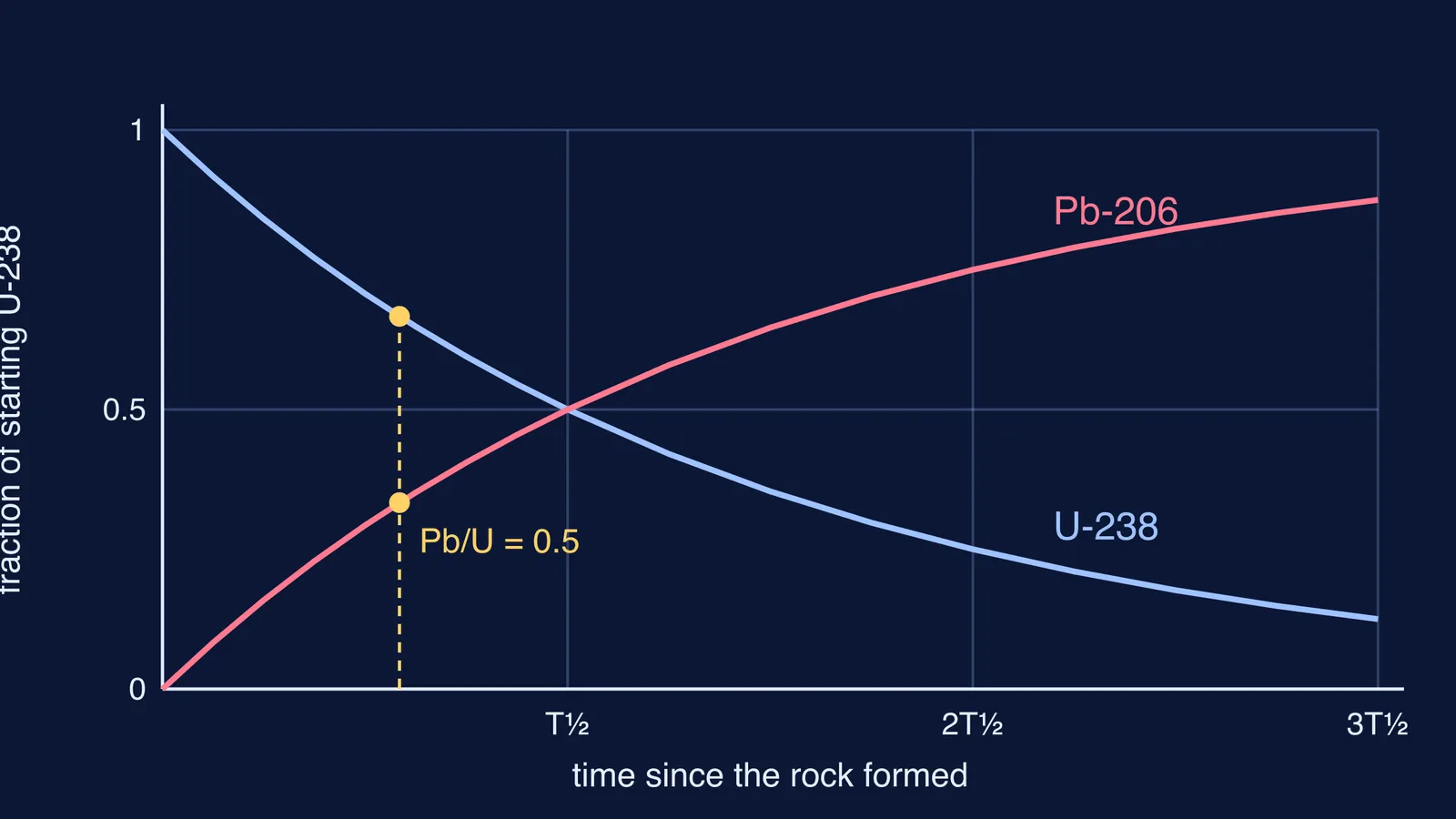
A rock that formed with uranium locked inside it works like a slow clock. Every U-238 nucleus that decays ends up, after a chain of short-lived steps, as a stable Pb-206 nucleus. Count how much lead has built up compared with the uranium still left, and you can work out how long the clock has been running.
Below: the derivation, a worked ratio, the mass-ratio trap, and the assumptions to state in a board answer.
How do you derive the uranium-lead age formula?
Start from the decay law. If the rock began with N₀ atoms of U-238, the number left after time t is N = N₀e^(−λt), where λ is the decay constant. Our explainer on radioactive decay and half-life builds this law from scratch.
Every U-238 atom that has decayed is now one Pb-206 atom, so Pb = N₀ − N, which means N₀ = U + Pb (writing U for the uranium atoms left).
Put this into the decay law: U = (U + Pb)e^(−λt).
Rearrange: e^(λt) = (U + Pb)/U = 1 + Pb/U.
Take natural logs and use λ = ln 2/T½: t = (1/λ) ln(1 + Pb/U) = (T½/ln 2) ln(1 + Pb/U).
The same result, written with the decay constant, appears in University of Colorado geology course notes on radiometric dates, where the lead counted is only the radiogenic lead, the part made by decay inside the rock.
How old is a rock with a lead-to-uranium ratio of 0.5?
The half-life of U-238 is 4.468 × 10⁹ years, according to the NuDat decay data from the US National Nuclear Data Center. Suppose a mineral contains 1 atom of Pb-206 for every 2 atoms of U-238, so Pb/U = 0.5.
Write the formula: t = (T½/ln 2) ln(1 + 0.5).
Work out T½/ln 2: 4.468 × 10⁹ ÷ 0.6931 = 6.446 × 10⁹ years. This is the mean life.
Work out ln 1.5 = 0.4055.
Multiply: t = 6.446 × 10⁹ × 0.4055 = 2.61 × 10⁹ years.
So the rock is about 2.6 billion years old. That is less than one half-life, which makes sense: two-thirds of the original uranium is still there.
The Colorado notes give λ = 1.55125 × 10⁻¹⁰ per year for this decay (course notes); using 1/λ in step 2 gives the same 2.61 billion years.
What if the question gives a mass ratio instead?
This is a common slip. The formula needs a ratio of atoms. If the question says the rock holds 0.5 g of Pb-206 for every 1 g of U-238, convert first:
Atoms of Pb-206 per atom of U-238 = (0.5/206) ÷ (1/238) = 0.5 × 238/206 = 0.578.
Then t = 6.446 × 10⁹ × ln 1.578 = 6.446 × 10⁹ × 0.456 = 2.94 × 10⁹ years.
Treating the mass ratio as an atom ratio would give 2.61 billion years, an error of more than 300 million years. For more practice, our guide to carbon-14 dating calculations uses the same logarithm steps with a much shorter half-life.
What assumptions should you state in a board answer?
State the conditions under which the formula holds, one line each:
No Pb-206 at the start. All the Pb-206 measured was made by uranium decay inside the rock. If some lead was there at the start, only the radiogenic part goes into the formula (Colorado course notes).
A closed system. No uranium or lead has entered or left the rock since it formed; the same notes measure t from the moment the system was closed to loss or gain of lead or uranium.
Intermediate steps can be ignored. U-238 decays through a chain of intermediate nuclei; the same notes put the half-lives of these intermediate products in the tens to low hundreds of thousands of years, which is tiny next to billions of years, so you treat the chain as one direct decay.
A constant decay rate. The half-life has stayed the same over the rock's lifetime.
The ratio is an atom ratio, converted from masses if needed.
The method has a real history: Bertram Boltwood first dated rocks with uranium and lead using this same idea of lead building up over time.
How do you practise this until it is automatic?
Try Pb/U = 0.25, 1 and 3 by hand (the last two should give exactly T½ and 2T½), then redo one as a mass ratio. If a step goes wrong, the Fermi Problem Library has worked problems with a step-by-step solver that explains the reasoning rather than printing an answer. If ln and e^x still feel shaky, the logarithm and exponential lessons in the Fermi Concept Library are a good place to fill that gap first.