

On this page
In February 1907, the Yale chemist Bertram Boltwood published a paper in the American Journal of Science that put ages on ten minerals, and several came out at more than a billion years (the 1907 paper; its Table VI, reproduced in NIST Special Publication 1298, p. 12). At the time, Lord Kelvin's estimate for the age of the whole Earth was about 100 million years, according to the same NIST report. His method needs only a calculator and the half-life idea from Class 12 physics.
Who was Bertram Boltwood?
Bertram Borden Boltwood (1870 to 1927) was an American radiochemist at Yale who, in 1910, was appointed chair of the first academic department of radiochemistry (Wikipedia biography). He swapped data on uranium minerals by letter with Ernest Rutherford at McGill University (NIST Special Publication 1298).
How did Boltwood date rocks with uranium and lead?
Boltwood established that lead is the final product of uranium's decay, and that the lead-to-uranium ratio is greater in older rocks (Wikipedia biography). Writing to Rutherford in 1905 about the idea that all lead came from uranium, he said "the deductions that can be made from this assumption will make even the metaphysicians dizzy" (NIST Special Publication 1298, p. 11).
The logic works like a sand timer: if a mineral started with no lead and kept every lead atom it made, more lead means an older rock.
Boltwood looked at 20 mineral samples from around the world and was confident enough to calculate ages for 10 of them (Linda Hall Library). His Table VI runs from 410 million years for uraninite from Glastonbury, Connecticut, to 2,200 million years for a thorianite from Sabaragamuwa Province in Ceylon, now Sri Lanka; only four of the ten ages fall below 600 million years (Table VI reproduced in NIST SP 1298, p. 12). He credited the idea openly: "The general plan of calculating the ages of the minerals in this manner was first suggested to the writer by Prof. Rutherford."
Where did Boltwood's 10 billion years come from?
He needed a rate of lead production. Boltwood and Rutherford had measured 3.8 × 10^-7 gram of radium for every gram of uranium in a mineral, and Rutherford's value for the half-life of radium was 2,600 years (NIST Special Publication 1298, p. 11). From these he worked out that about 10^-10 of the uranium decays each year, so a gram of uranium makes about 10^-10 gram of lead a year.
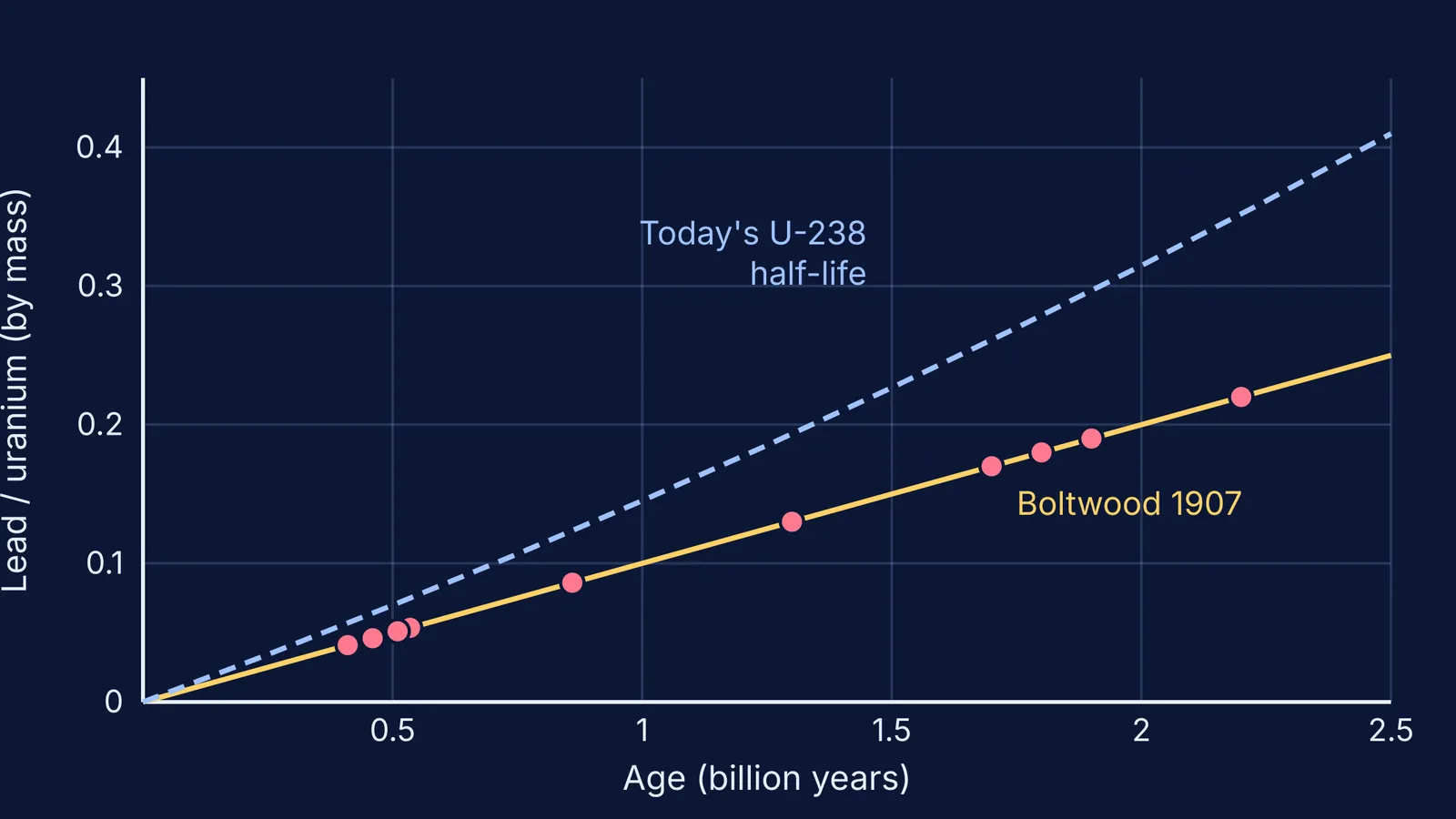
Boltwood's rule was: age = (lead ÷ uranium) × 10^10 years.
In the language of radioactive decay and half-life, a fraction of 10^-10 per year is a decay constant λ = 10^-10 per year. Since half-life = ln 2 ÷ λ, Boltwood's rate is the same as giving uranium a half-life of about 6.9 billion years. Today's value for uranium-238 is 4.47 billion years (Wikipedia: uranium–lead dating). A slower clock makes every rock look older.
Work it out: Boltwood's sum and today's sum
Take the Glastonbury uraninite, which Boltwood dated at 410 million years.
His age implies a lead-to-uranium mass ratio of 0.041 (410 million ÷ 10 billion).
Boltwood's way: 0.041 × 10^10 years = 410 million years.
Turn mass into atoms (lead-206 versus uranium-238): the atom ratio is 0.041 × 238 ÷ 206 ≈ 0.0474.
Today's way: lead atoms ÷ uranium atoms = e^(λt) − 1, so t = (half-life ÷ ln 2) × ln(1 + 0.0474) = 6.45 billion × 0.0463 ≈ 300 million years.
Repeat for the Ceylon thorianite (ratio 0.22): atom ratio ≈ 0.254, so t ≈ 6.45 billion × 0.226 ≈ 1.46 billion years.
This classroom version treats all the lead as coming from uranium-238, so it checks the half-life maths; it is not a modern date for those rocks.
Why were Boltwood's ages wrong, and why did they still matter?
Boltwood saw the weak point himself. His paper warns that "the actual values obtained for these ages are, of course, dependent on the value taken for the rate of disintegration of radium" (NIST Special Publication 1298, p. 12). The same report notes that the paper was not immediately accepted more widely; later work by R.J. Strutt and the geologist Arthur Holmes led to general acceptance of lead-uranium dating. The report gives the current estimate for the age of the Earth as 4.543 billion years.
The story ends with Clair Patterson and how lead isotopes dated the Earth, and the isotope idea behind lead-206 starts with Frederick Soddy, isotopes and the displacement law.
If exponential decay still feels abstract, the Fermi Simulation Lab has interactive simulations for ideas that are easier to see than to read. If logarithms or decay constants are the real gap, the Fermi Concept Library gives each concept its own lesson.
Next, rerun the worked example with a ratio of 0.1 and watch the two methods drift apart.


