On this page
The democratic rights chapter in Class 9 civics rests on one part of the Constitution of India: Part III, Fundamental Rights. Every rule below comes from the official text of the Constitution of India (as on 1 May 2024) published by the Ministry of Law and Justice.
What are democratic rights in Class 9?
Fundamental Rights are the rights listed in Part III of the Constitution, and Article 13 makes any law that takes them away void to that extent (Constitution of India, Part III).
Article 12 defines the State to include the central and state governments and legislatures and all local or other authorities, so these rights protect you against all of them.
What are the six Fundamental Rights, with an example of each?
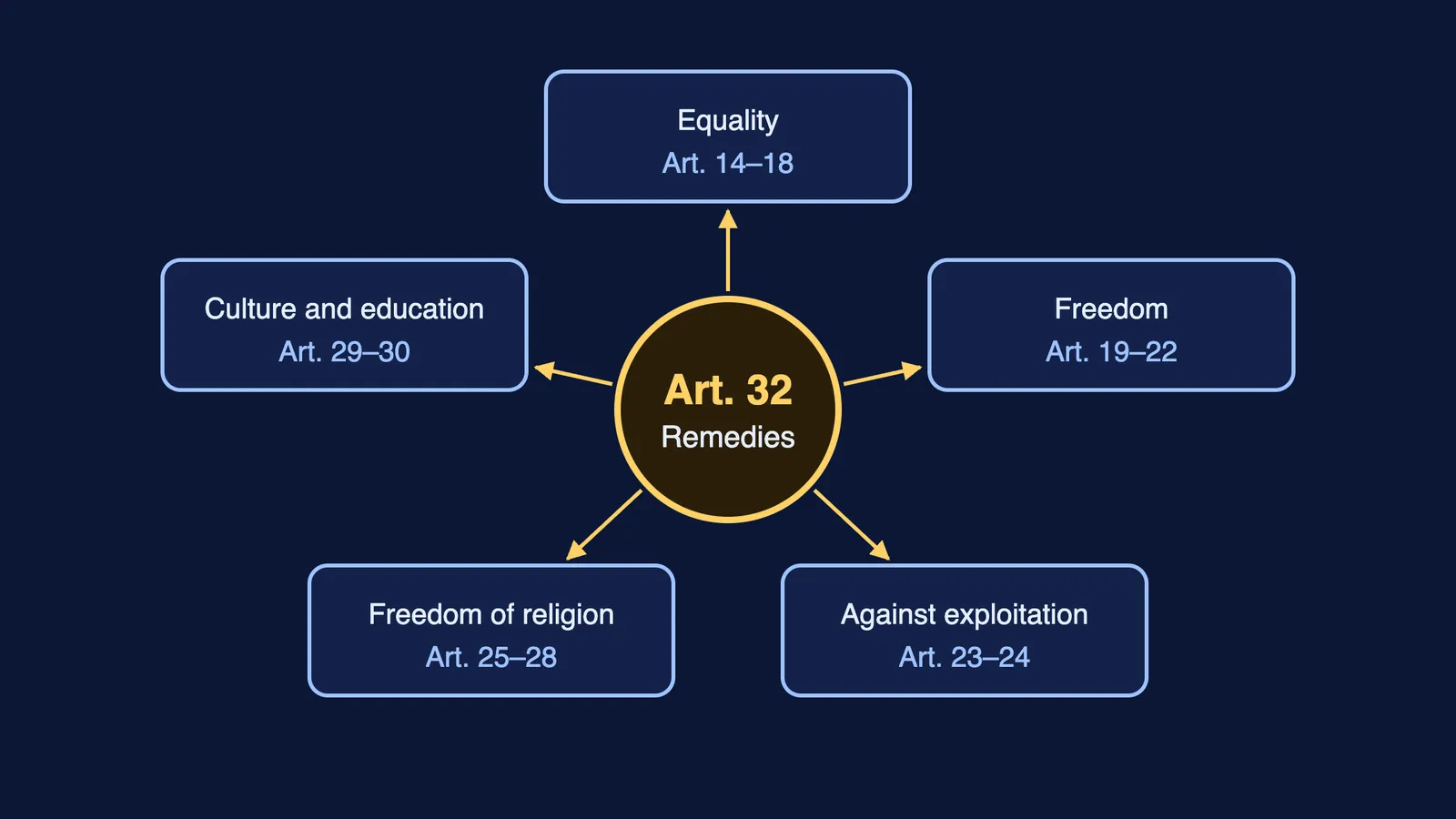
The Constitution groups Articles 14 to 32 under six headings.
Right to Equality (Articles 14–18). Article 14 guarantees every person equality before the law and equal protection of the laws. Article 15 bars discrimination on grounds only of religion, race, caste, sex or place of birth, including at shops, public restaurants, public wells and roads; Article 17 abolishes untouchability. Example: a public restaurant cannot turn a family away because of their caste.
Right to Freedom (Articles 19–22). Article 19 gives citizens six freedoms: speech and expression; assembling peaceably without arms; forming associations, unions or co-operative societies; moving freely throughout India; settling anywhere in India; and practising any profession, trade or business. Article 21 protects life and personal liberty, Article 21A promises free and compulsory education to children aged six to fourteen, and Article 22 says an arrested person must be produced before a magistrate within 24 hours, not counting travel time. Example: a student from Guwahati moves to Pune and takes a part-time job.
Right against Exploitation (Articles 23–24). Article 23 prohibits human trafficking, begar (forced work without pay) and other forced labour. Article 24 says no child below fourteen may work in a factory, mine or other hazardous employment. Example: a 12-year-old cannot be hired to pack firecrackers in a factory.
Right to Freedom of Religion (Articles 25–28). Article 25 gives all persons freedom of conscience and the right to profess, practise and propagate religion, subject to public order, morality and health. Article 28 bans religious instruction in institutions wholly funded by the State. Example: a student in a government-aided school cannot be made to attend a religious service without a guardian's consent.
Cultural and Educational Rights (Articles 29–30). Article 29 lets any group with a distinct language, script or culture conserve it, and bars State-run or State-aided institutions from refusing admission on grounds only of religion, race, caste or language. Article 30 lets religious and linguistic minorities set up and run educational institutions. Example: a Malayalam-speaking community in Mumbai runs its own school.
Right to Constitutional Remedies (Article 32). Article 32 guarantees the right to move the Supreme Court to enforce the rights above, through writs such as habeas corpus, mandamus, prohibition, quo warranto and certiorari. Example: if police hold someone without producing them before a magistrate, the court can be asked for habeas corpus.
Why are there six Fundamental Rights and not seven?
The Constitution once protected property in Article 19(1)(f) and Article 31, under the sub-heading Right to Property. The Forty-fourth Amendment Act, 1978 omitted all three with effect from 20 June 1979, which is why you learn six groups today (Constitution of India, notes under Articles 19 and 31).
How do you tell which right a case is about?
For a case-based question, ask these in order and stop at the first yes:
Is someone treated worse because of religion, race, caste, sex or place of birth? Equality.
Is someone stopped from speaking, meeting, moving, settling or working, or held without seeing a magistrate? Freedom.
Is someone forced to work, trafficked, or a child under fourteen in hazardous work? Exploitation.
Is it about belief, worship or religious instruction? Religion.
Is it about a group's language, script, culture or own schools? Cultural and educational.
Is the question how to get a denied right enforced? Constitutional remedies.
Try three cases:
A panchayat stops one caste from using the public well. Answer: Equality (Articles 15 and 17).
A brick kiln owner makes workers labour unpaid to clear a loan. Answer: Exploitation (Article 23).
A State-aided college refuses a student because of her language. Answer: Cultural and educational (Article 29).
If a chatbot quotes an Article, check the Article number against the Constitution first. To see rights meet real offices, read who runs a government school and where to raise a problem. The same idea runs through this year's history, as our French Revolution Class 9 notes on causes and timeline show.
When the science and maths side of your week feels like a blank page, Fermi's AI tutor works out what you already know and builds a plan for the session, leaving time for chapters like this one.