On this page
The French Revolution is easiest to learn as a chain: France ran short of money, the king called back an old assembly, the commoners broke away, and ten years of change followed. Here are the causes, the three estates, the dates, what changed and a revision plan.
What were the causes of the French Revolution?
The figures below come from a summary of the causes of the French Revolution.
War debt. The American War of Independence cost France 1.3 billion livres and the Seven Years' War 1.8 billion livres.
Unfair taxes. The Third Estate paid the taxes, while clergy and nobles kept tax immunities and feudal privileges.
Bread. Harvests were poor in 1788 and 1789. In 1789 the price of bread rose 88% while real wages fell 25%.
New ideas. Rousseau and Voltaire discussed liberty and equality, and Locke's Treatises were published in French in 1724.
What were the three estates in France?
The First Estate was the clergy, the Second Estate the nobility and the Third Estate the commoners (Estates General of 1789).
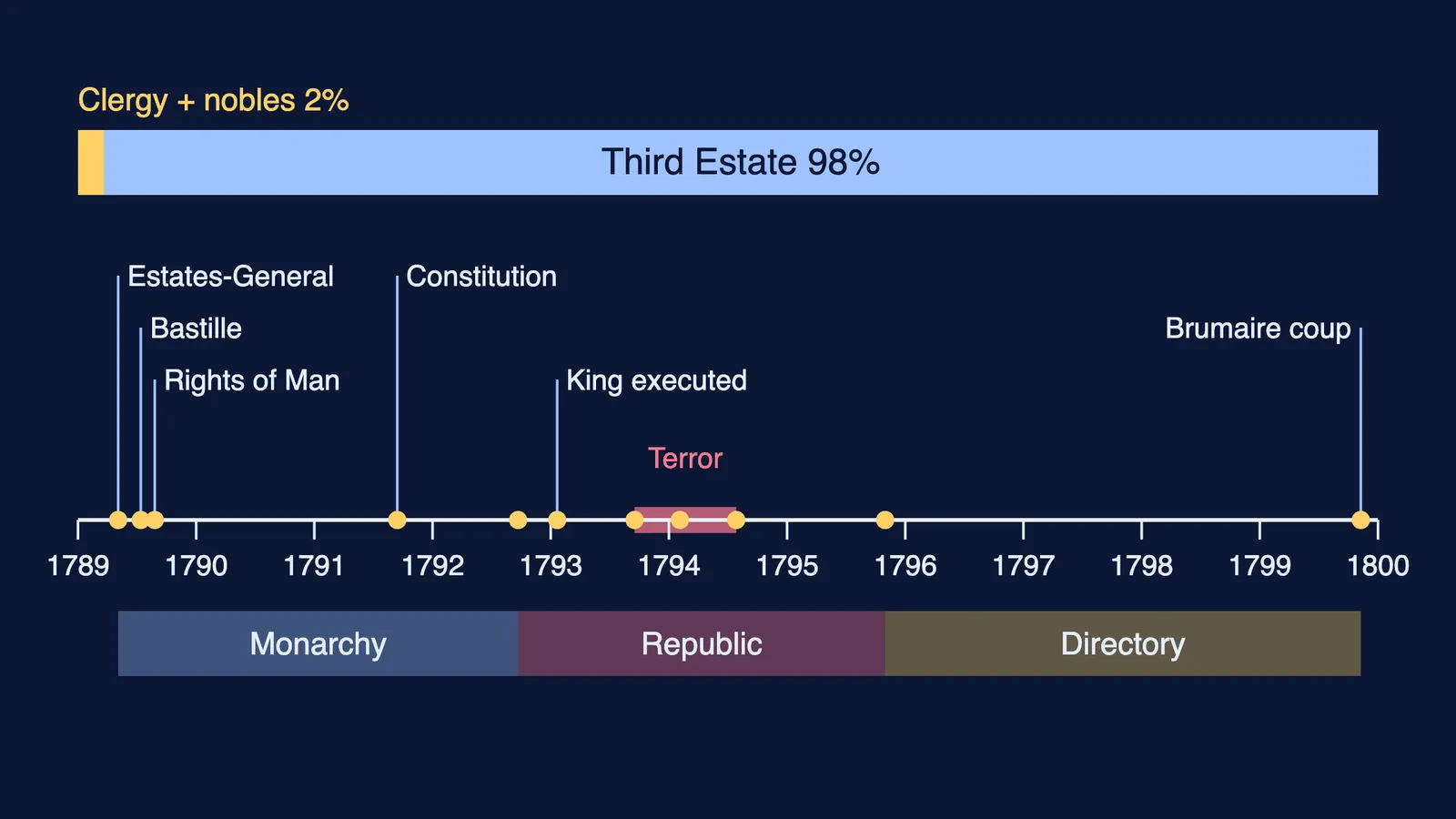
The first two estates together were about 2% of the population and the Third Estate the other 98% (causes of the French Revolution).
The nobility was exempt from the taille, France's oldest direct tax (Estates of the realm).
Voting caused the split. Clergy and nobles wanted each estate to vote as one block, which protected their tax exemptions; the Third Estate demanded one vote per member (Estates General of 1789). Voting by estate meant two votes against one, however many people each estate spoke for.
French Revolution timeline: which dates from 1789 to 1799 matter?
Dates are from the Timeline of the French Revolution unless another source is named.
5 May 1789: the Estates-General, which had not met since 1614, opens at Versailles.
17 June 1789: the Third Estate's deputies declare themselves the National Assembly.
20 June 1789: locked out of their hall, they meet in an indoor tennis court and swear not to separate until France has a new constitution.
14 July 1789: an armed crowd storms the Bastille.
4 August 1789: the August Decrees abolish the nobles' privileges and feudal rights.
26 August 1789: the Declaration of the Rights of Man and of the Citizen is approved (Avalon Project text).
5 October 1789: thousands of women march on Versailles.
September 1791: Louis XVI accepts the new constitution.
22 September 1792: the Convention abolishes royalty and proclaims the First Republic.
21 January 1793: Louis XVI is executed.
17 September 1793: the Reign of Terror begins.
28 July 1794: Robespierre is guillotined and the Terror ends.
1795: a new constitution creates a five-member Directory.
9 to 10 November 1799: the coup of 18 Brumaire brings Napoleon Bonaparte to power.
If an AI tool gave you a different date, here is how to check a history date against your NCERT book.
What changed after the French Revolution?
Rights were written down. Article 1 of the Declaration says: "Men are born and remain free and equal in rights" (Avalon Project).
Privilege by birth was abolished by the August Decrees, and the monarchy gave way to a republic.
Slavery was abolished, then restored. A law of 4 February 1794 abolished it in all French colonies, Napoleon reintroduced it in sugarcane-growing colonies in 1802, and a decree of 27 April 1848 abolished it again (End of slavery in France).
Women were left out. Women marched on Versailles in 1789, yet women's suffrage was introduced in France only in 1944 (Women's suffrage by country).
How should you revise the French Revolution for a Class 9 exam?
Try this 20-minute routine.
Write the four causes from memory, one line each, then check.
Draw the date chain 1789, 1791, 1792, 1793, 1794, 1795, 1799 with one event under each year, and tell it aloud as a story.
Close the book and answer one question as cause, event, result.
Redo only what you got wrong, two days later.
A worked 3-mark answer:
Q: Why did the Third Estate form the National Assembly?
It was about 98% of the population (causes of the French Revolution), but voting by estate gave it one vote against two.
Clergy and nobles wanted to keep voting by estate to protect their tax exemptions.
So on 17 June 1789 its deputies declared themselves the National Assembly, and on 20 June swore the Tennis Court Oath.
To lay out causes and results on one page, try this cause-and-effect chart for a history chapter. Wondering how much this year counts? Read where Class 9 marks matter and where they don't.
History isn't one of our subjects, but if science or maths is where you get stuck this year, Fermi's AI tutor can work out what you already know and build a plan for the session.
Start with the date chain tonight: seven years, seven events, ten minutes.