On this page
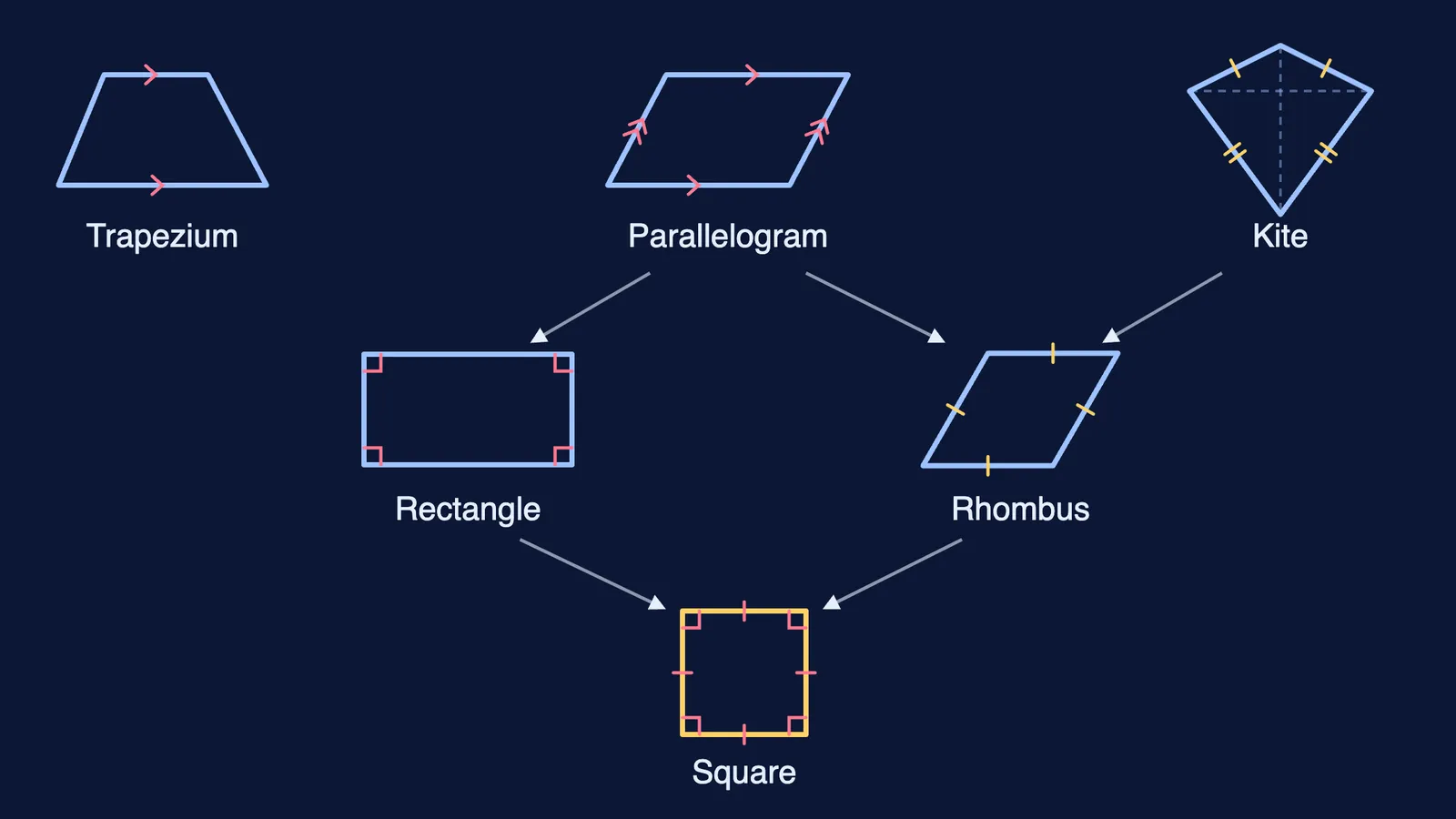
Six four-sided shapes keep turning up in school geometry from Class 6 to Class 8: the trapezium, kite, parallelogram, rhombus, rectangle and square. They are one family, and once you see which shape sits inside which, the properties stop being something to cram.
Everything below follows NCERT's Class 8 chapter Understanding Quadrilaterals (reprint 2024-25).
What are the types of quadrilaterals?
A quadrilateral is a closed figure made of four straight sides. Its four interior angles always add up to 360°, which you can see by cutting it along a diagonal into two triangles (why the angle sum of a polygon is (n − 2) × 180°).
These are the six definitions given in the NCERT Class 8 chapter:
Trapezium: a quadrilateral with a pair of parallel sides. If its non-parallel sides are equal, it is an isosceles trapezium.
Kite: a quadrilateral with exactly two distinct consecutive pairs of sides of equal length.
Parallelogram: a quadrilateral whose opposite sides are parallel.
Rhombus: a parallelogram with sides of equal length.
Rectangle: a parallelogram with equal angles (the chapter's summary says "with a right angle"). Since 4x° = 360°, each angle is 90°.
Square: a rectangle with sides of equal length.
Each of the last three is a parallelogram with one extra condition.
What are the properties of each quadrilateral?
Because a rhombus, rectangle and square are parallelograms, each inherits everything a parallelogram has. Here is the property checklist, following sections 3.3 and 3.4 and the summary table of the NCERT chapter:
Parallelogram: opposite sides equal, opposite angles equal, adjacent angles supplementary (they add to 180°), diagonals bisect each other.
Rhombus: every parallelogram property, plus all four sides equal and diagonals perpendicular to each other.
Rectangle: every parallelogram property, plus each angle 90° and diagonals equal in length.
Square: every property of a parallelogram, a rhombus and a rectangle, so its diagonals are equal and are perpendicular bisectors of each other.
Kite: diagonals perpendicular, one diagonal bisects the other, and one pair of opposite angles equal (the two angles where unequal sides meet).
Trapezium: one pair of parallel sides, so the two angles along each non-parallel side add to 180° as co-interior angles. NCERT lists no special property of its diagonals.
To see why the diagonals bisect each other, read the parallelogram diagonals proof with congruent triangles.
How do you identify a quadrilateral?
Ask three questions, in this order. They use only the definitions in the NCERT chapter.
Are both pairs of opposite sides parallel? If not, look for exactly one parallel pair (trapezium) or two pairs of equal adjacent sides (kite). If neither, it is a general quadrilateral and you stop. If yes, it is a parallelogram; go on.
Are all four sides equal? Note yes or no.
Is one angle a right angle? Note yes or no.
Then read off the name: no and no is a parallelogram, yes and no is a rhombus, no and yes is a rectangle, yes and yes is a square.
How do you name a quadrilateral and find its angles?
In quadrilateral PQRS, PQ ∥ SR and PS ∥ QR, PQ = QR = 8 cm and ∠P = 70°. Name it and find every angle.
Both pairs of opposite sides are parallel, so PQRS is a parallelogram.
Opposite sides are equal, so RS = PS = 8 cm too. All four sides are equal.
∠P is 70°, not 90°.
So PQRS is a rhombus, not a square. Opposite angles are equal, so ∠R = 70°. Adjacent angles are supplementary, so ∠Q = ∠S = 180° − 70° = 110°. Check: 70° + 110° + 70° + 110° = 360°. Its diagonals are perpendicular but not equal, which separates it from a square. Next, try finding the side of a rhombus from its diagonals, which puts the perpendicular diagonals to work.
Which statements about quadrilaterals are true?
Exercise 3.4 in the NCERT chapter has true-or-false questions that the family settles:
All rectangles are squares: false, because a rectangle's sides need not all be equal.
All rhombuses are parallelograms: true, by definition.
All squares are rhombuses and also rectangles: true.
All kites are rhombuses: false, because a kite's two equal pairs can have different lengths.
Whether "all parallelograms are trapeziums" is true depends on whether "a pair of parallel sides" means at least one pair or exactly one, so ask your teacher which reading your school uses.
For ideas that are easier to see than to read, the Fermi Simulation Lab has interactive simulations, and the Fermi Concept Library gives every mathematics concept its own lesson, so you can return to a definition when a property stops making sense.