

On this page
You can work out the angles inside any polygon in seconds if you remember one picture: triangles fanning out from a single corner.
Why is the angle sum of a polygon (n − 2) × 180°?
Everything rests on one fact. Euclid's Elements, Book I, Proposition 32, states that the three interior angles of any triangle add up to two right angles, that is 180° (Euclid I.32, David E. Joyce's online edition). For a refresher, see our post on finding x in triangle angle sum problems.
Now take a convex quadrilateral ABCD and draw the diagonal AC. You get two triangles, ABC and ACD. The angles at B and D sit whole inside one triangle; the angles at A and C are split cleanly between the two. Nothing is lost or double-counted, so the quadrilateral holds 2 × 180° = 360°.
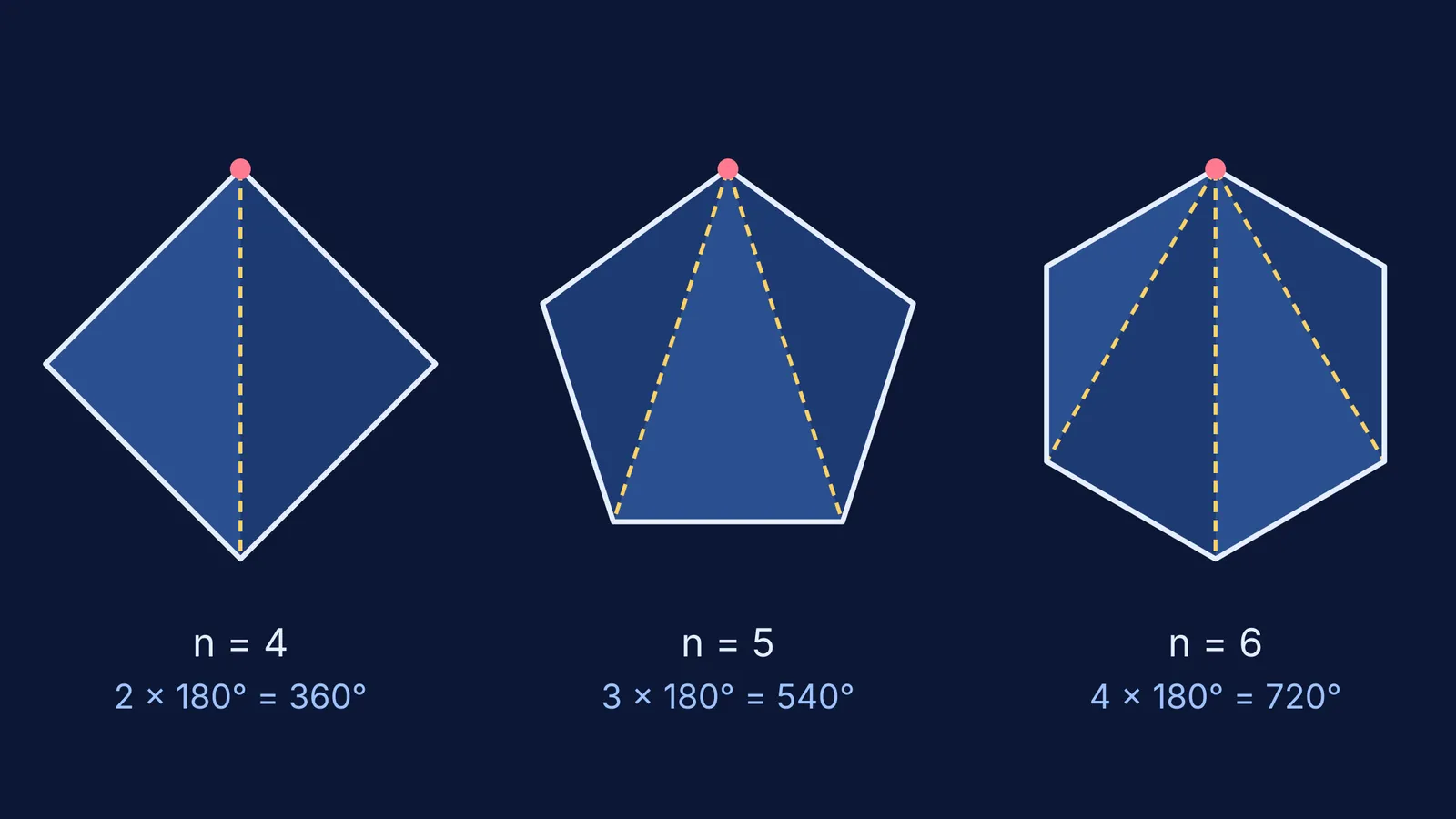
The same move works for any convex polygon. Pick one vertex and draw every diagonal you can from it:
A vertex cannot make a diagonal with itself or its two neighbours, so from one vertex of an n-sided polygon you get n − 3 diagonals.
Those n − 3 diagonals cut the polygon into n − 2 triangles.
Each triangle holds 180°, so the interior angles add up to (n − 2) × 180°.
Any convex polygon can be split this way, with diagonals from one vertex, and any triangulation of a simple polygon with n vertices, without adding new points, has exactly n − 2 triangles (Polygon triangulation). That is why the rule also holds for concave, arrow-shaped polygons: the interior angles of any simple polygon add up to 180(n − 2) degrees (Internal and external angles). Counting all the diagonals of a polygon is a different question; see why the number of diagonals is nC2 minus n.
How do you find the missing angle of a quadrilateral?
Worked example: three angles of a quadrilateral are 85°, 110° and 95°. Find the fourth. The angle sum of any simple polygon is 180(n − 2) degrees (Internal and external angles), so:
Angle sum: (4 − 2) × 180° = 360°.
Known angles: 85° + 110° + 95° = 290°.
Missing angle: 360° − 290° = 70°.
How do you find each angle of a regular polygon?
NCERT's Class 8 chapter defines a regular polygon as one that is both equiangular and equilateral, like a square (NCERT Class 8, Understanding Quadrilaterals). All n angles are equal, so you share the total evenly.
Each interior angle of a regular n-gon = (n − 2) × 180° ÷ n.
Regular pentagon: 3 × 180° = 540°, and 540° ÷ 5 = 108°.
Regular hexagon: 4 × 180° = 720°, and 720° ÷ 6 = 120°.
Regular octagon: 6 × 180° = 1080°, and 1080° ÷ 8 = 135°.
There is a fast cross-check. The same NCERT chapter shows that the exterior angles of any polygon add up to 360°, and that a regular polygon whose exterior angle is 45° has 360 ÷ 45 = 8 sides (NCERT Class 8). An interior and exterior angle at the same vertex make a straight line, so each interior angle is also 180° − 360° ÷ n. For the octagon: 180° − 45° = 135°, which matches.
How do you work backwards to the number of sides?
Both patterns use the same two facts: interior angles total (n − 2) × 180° (Internal and external angles) and exterior angles total 360° (NCERT Class 8).
Given the angle sum: if the interior angles add up to 1260°, then n − 2 = 1260 ÷ 180 = 7, so n = 9.
Given each angle of a regular polygon: if each interior angle is 165°, each exterior angle is 15°, so n = 360 ÷ 15 = 24.
If the division does not give a whole number, no such polygon exists. Can a regular polygon have interior angles of 100°? The exterior angle would be 80°, and 360 ÷ 80 = 4.5, so no. More practice of this kind is in our post on interior and exterior angle formulas.
What should you practise next?
A plan for one sitting:
Draw a quadrilateral, a pentagon and a hexagon. Fan triangles from one corner of each and write the total beside it.
Redo the hexagon with a point in the middle joined to every vertex. That gives 6 × 180° = 1080°, but the 360° around the centre is not a polygon angle. Subtract it: 720°, the same answer.
Solve three regular-polygon questions both ways: total ÷ n, and 180° − 360° ÷ n.
Do two working-backwards questions, including one with no answer.
If a step trips you up, the Fermi Problem Library has worked problems with a step-by-step solver that explains the reasoning rather than printing an answer. To rebuild triangles or exterior angles from the start, each idea has its own lesson in the Fermi Concept Library.


