

On this page
If you are solving geometry problems, you will frequently need to find missing angles inside or outside a shape. Understanding the relationship between the interior and exterior angles of polygons is a fundamental skill in geometry. These rules form the foundation for more advanced topics in mathematics and physics, such as calculating the areas of complex shapes or understanding crystal structures in chemistry. Whether you are dealing with a simple triangle or a 12-sided dodecagon, the rules for these angles follow a predictable pattern based on the number of sides.
What is the sum of interior angles of a polygon formula?
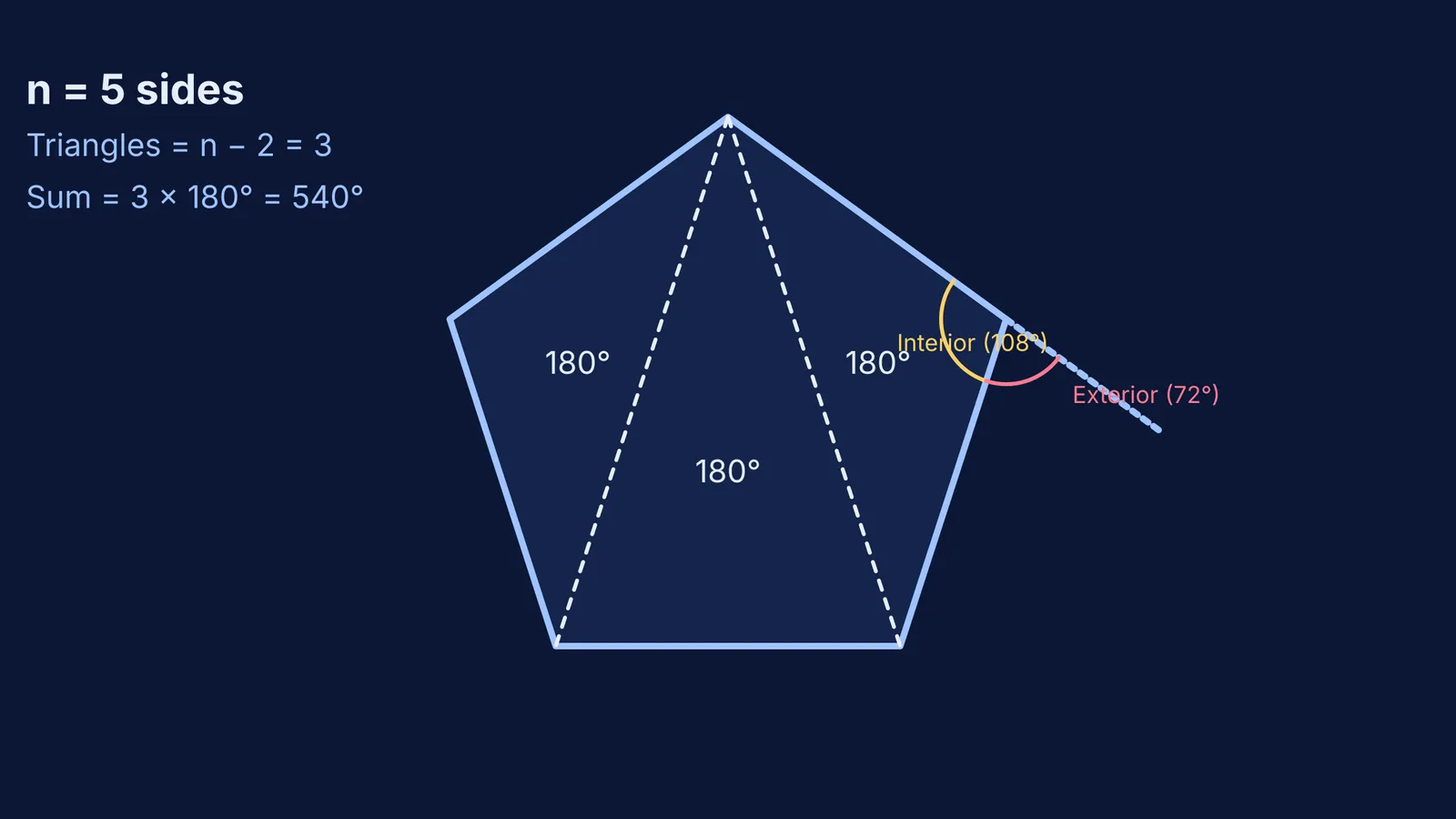
The interior angles of a polygon are the angles inside the closed shape at each vertex. For any simple polygon with *n* sides, the formula for the sum of its interior angles is (n − 2) × 180° (Wikipedia).
This works because any polygon can be partitioned into exactly *n* − 2 triangles by drawing diagonals from a single vertex to all other non-adjacent vertices. Since the angles in a single triangle always add up to 180°, multiplying the number of triangles by 180° gives the total sum of the polygon's interior angles.
For example:
Triangle (3 sides): (3 − 2) × 180° = 180°
Quadrilateral (4 sides): (4 − 2) × 180° = 360°
Pentagon (5 sides): (5 − 2) × 180° = 540°
If the polygon is "regular" (meaning all its sides and angles are equal), you can find the measure of a single interior angle by dividing the total sum by the number of sides: (n − 2) × 180° / n.
Why do exterior angles sum to 360°?
An exterior angle is formed by extending one side of the polygon outwards. At any given vertex, the interior angle and its adjacent exterior angle sit on a straight line, meaning they are supplementary and add up to 180° (Wikipedia).
While the sum of the interior angles grows larger as you add more sides, the sum of the exterior angles of any convex polygon is always exactly 360° (Wikipedia). Imagine walking along the perimeter of the polygon: at each corner, you turn by the exterior angle. By the time you return to your starting point and face the original direction, you have made one complete rotation, which is 360°.
For a regular polygon with *n* sides, each exterior angle is simply 360° / n. For example, a regular hexagon has 6 sides. The sum of its interior angles is (6 − 2) × 180° = 720°. Each individual interior angle is 720° / 6 = 120°. Its corresponding exterior angle is 180° − 120° = 60°, and indeed, 360° / 60° gives us the 6 sides back.
How to find the number of sides from one angle?
Exam questions often give you the measure of a single interior angle of a regular polygon and ask you to find the number of sides (*n*).
Worked Example: A regular polygon has an interior angle of 144°. How many sides does it have?
While you could set up the equation 144 = (n − 2) × 180 / n and solve for *n* using algebra, using the exterior angle is much faster (Wikipedia).
Find the exterior angle: Since the interior and exterior angles add up to 180°, the exterior angle is 180° − 144° = 36°.
Divide 360° by the exterior angle: Because all the exterior angles must sum to 360°, you divide 360 by 36 to get 10.
The polygon has 10 sides (a decagon). If you get stuck on a geometry question and are not sure where to start, the Fermi Problem Library has worked problems with a step-by-step solver that explains the reasoning rather than printing an answer.
A plan for polygon angle problems
When tackling polygon questions on an exam, follow this checklist to avoid common traps:
Identify the shape: Count the sides carefully if a diagram is given.
Check for regularity: Does the problem state the polygon is "regular"? If not, you can use the sum formula, but you cannot assume all individual angles are equal.
Know the vocabulary: Terms like "convex" (all interior angles are less than 180°) and "concave" (at least one interior angle is greater than 180°) can change how you draw the shape, even though the sum formula still applies to simple concave polygons.
Use the 360° rule: If you need to find the number of sides, converting to the exterior angle is usually the most efficient route.
Geometry often relies on bringing multiple concepts together. If you are also working on coordinate geometry, you might need to know how to find the circle through three given points or how to calculate latus rectum lengths for conic sections. If you want to review the properties of different shapes, the Fermi Concept Library covers every concept in mathematics, each with its own lesson and its place in the map.


