On this page
Ask a Class 3 child to name India's seasons and you may hear five: summer, monsoon, autumn, winter and spring. What makes the chapter stick is linking each season to things the child can see outside, and to one simple reason: sunlight reaches India at a different angle as the year goes on.
What are the seasons in India?
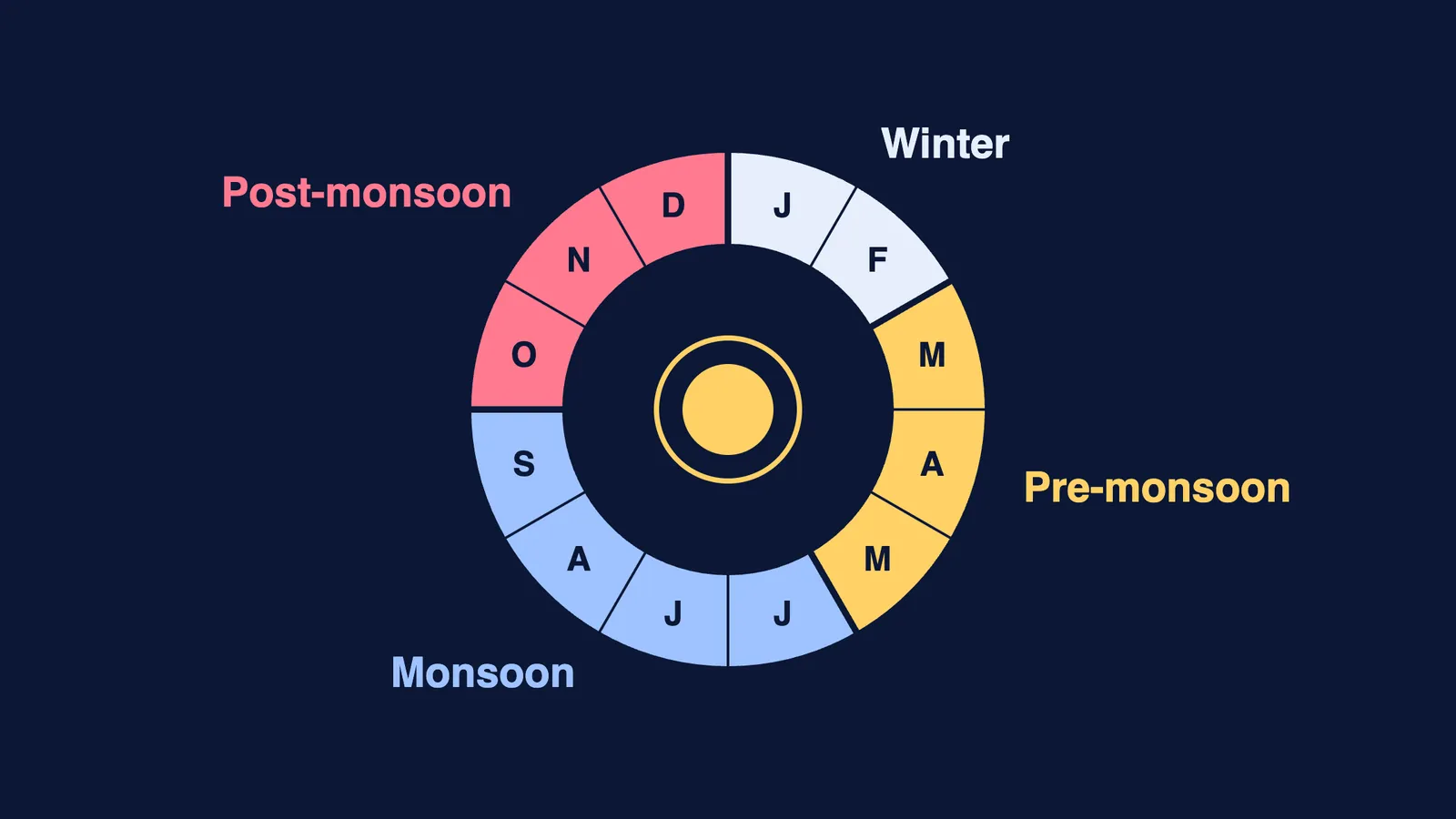
The India Meteorological Department (IMD), the country's official weather office, uses four seasons. Its statement on the climate of India during 2025 names them as winter (January–February), pre-monsoon (March–May), southwest monsoon (June–September) and post-monsoon (October–December).
Many primary-school books and worksheets use friendlier names and add spring as a short in-between time. A simple way to match the two lists:
Winter: about December to February. Cold mornings, woollens, short days.
Spring: about February and March. New leaves and flowers, pleasant days.
Summer: the IMD's pre-monsoon, March to May. Hot afternoons, cotton clothes, long days.
Monsoon: June to September. Heavy rain, puddles, green fields.
Autumn: the IMD's post-monsoon, about October and November. Clear skies after the rains, cooler nights.
The edges blur, and they shift across the country: a winter in Delhi feels very different from a winter in Chennai. Tell your child that seasons are patterns in the weather, not fixed dates on a calendar.
What changes in each season?
Here is what to look for together.
Clothes and food: woollens and hot drinks in winter, cotton clothes and cool drinks in summer, umbrellas and raincoats in the monsoon.
Trees: many Indian trees drop their leaves in the dry, hot months, which surprises children who were told leaves fall in autumn. Our post on why many Indian trees drop their leaves in summer explains why.
Rain: the southwest monsoon normally sets in over Kerala around 1 June, according to IMD's monsoon onset page, and then spreads across the rest of the country over the following weeks.
Sky and air: clear skies after the rains and, in north India, dense fog on winter mornings.
Animals: frogs calling after the first rains, birds building nests, street dogs hunting for shade on summer afternoons.
Why do seasons change in India?
NASA Space Place gives the short answer: Earth's tilted axis causes the seasons. Earth's axis is tilted by 23.5°, as the textbook OpenStax Astronomy explains.
As Earth travels round the Sun, our half of the planet leans towards the Sun for part of the year and away from it for the rest. When it leans towards the Sun, sunlight hits the ground more directly and days are longer, so the land heats up: summer. When it leans away, the Sun stays lower in the sky, its light spreads over a wider area, and days are shorter: winter. Our explainer on why the noon sun feels hottest shows the same idea within a single day.
Distance from the Sun is not the reason, as NASA Space Place says. OpenStax adds a surprising fact: Earth is closest to the Sun in January, which is the middle of winter in India.
The monsoon adds a second story on top of the heat, about winds that bring rain from the sea. For Class 3, “the hot months come first, then the rains” is enough; the winds can wait for higher classes.
How can you teach seasons to a Class 3 child at home?
Try this two-part plan over one week. It needs a torch, a sheet of paper and a notebook.
Part 1: the torch test (10 minutes).
In a dark room, shine a torch straight down on a sheet of paper. Trace the bright circle with a pencil.
Keep the torch at the same distance but tilt it, so the light hits the paper at a slant. Trace the new patch.
Ask: “Which patch is brighter? Which one would warm your hand faster?”
The slanting light spreads over a bigger patch, so each bit of paper gets less of it. That is winter sunlight; the straight-down beam is summer sunlight.
Part 2: a seven-day season diary. Each evening, your child writes or draws four things:
what they wore that day
whether it was sunny, cloudy or rainy
one plant or animal they noticed
whether it got dark before or after dinner
At the end of the week, ask three questions. Which season are we in? Which clue told you? What will be different in three months? Keep the diary and repeat the week when the season changes, so your child can compare the two pages.
When an older brother or sister reaches the physics of light and angles, the Fermi Simulation Lab has interactive simulations for ideas that are easier to see than read.
Start the diary this week, and by the next change of season your child will be able to tell you what is coming and why.