On this page
The Sun at 9 am and the Sun at midday are the same star. What changes is the angle of its light, and that angle controls two things: how widely the light is spread over the ground, and how much air it crosses first.
Why does the sun feel hottest around noon?
Around solar noon, the moment the Sun is highest in your sky, its rays arrive most directly. Michael Ritter's online textbook The Physical Environment calls this the "noon sun angle" and explains that the most intense sunlight at any place arrives then, because "as the sun angle decreases, light is spread over a larger area and decreases in intensity" (Ritter, The Physical Environment).
Intensity means energy per square metre each second, and that is what your skin feels.
How does the angle of the Sun's rays change the energy you get?
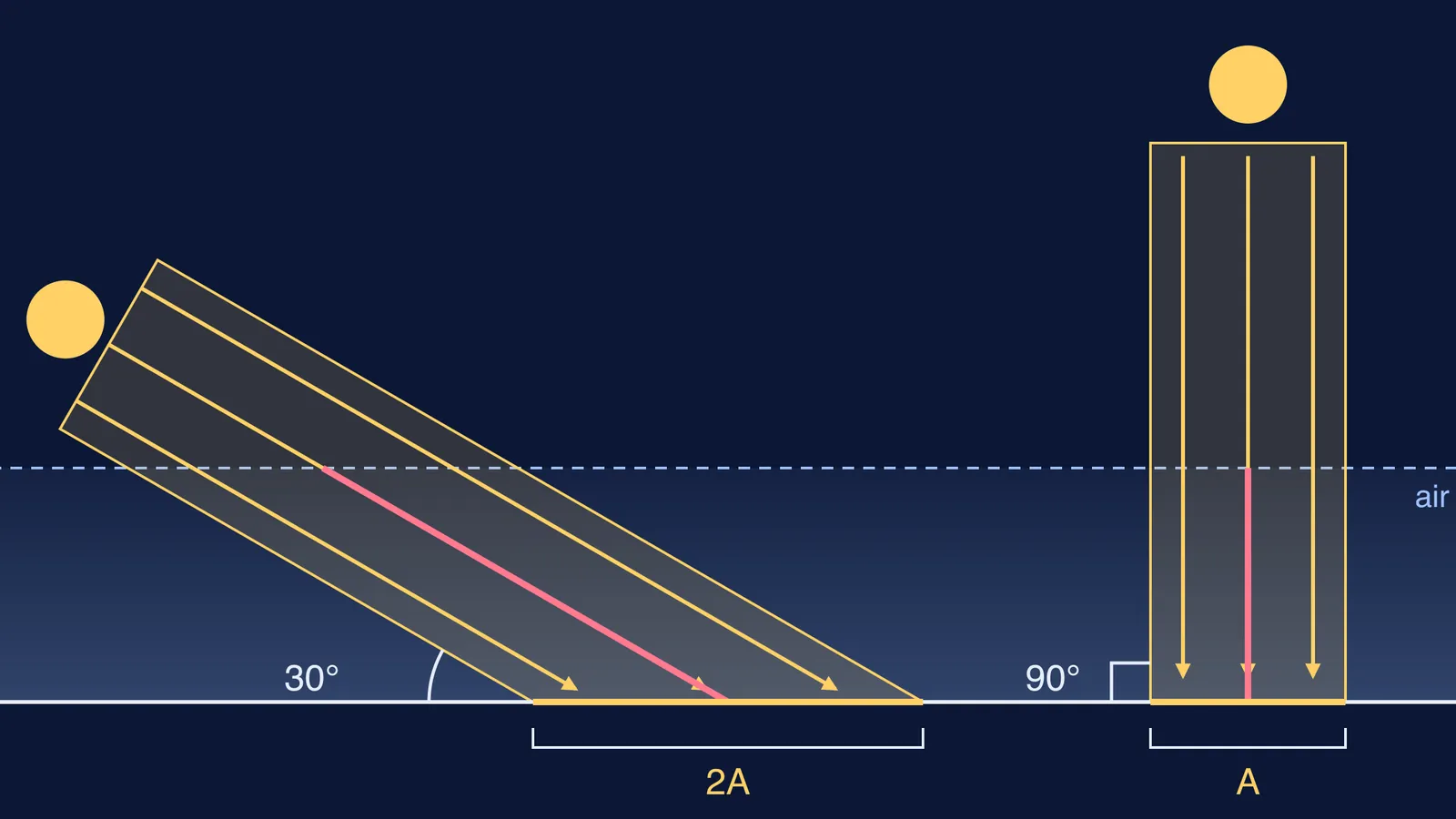
Picture a beam of sunlight one square metre across. If it comes straight down, it lights one square metre of ground. If it comes in at a slant, the same beam is smeared over a longer patch, so each square metre gets only a share of it.
The rule is short: sunlight on flat ground equals the sunlight in the beam multiplied by the sine of the Sun's elevation angle, S_horizontal = S_incident × sin α (PVEducation).
Now a worked example. Above the atmosphere, sunlight carries about 1361 watts per square metre, the value established by NASA's SORCE satellite mission (NASA Goddard). Ignore the air for a moment and lay a flat square metre under that beam:
Sun overhead (90°): sin 90° = 1, so about 1361 W lands on each square metre.
Sun at 60°: sin 60° ≈ 0.87, so about 1180 W.
Sun at 30°: sin 30° = 0.5, so about 680 W, half the overhead value.
At 30° the same beam covers twice the ground. That is the A and 2A in the diagram at the top of this post.
Why does sunlight lose more energy when the Sun is low?
The second effect is the air. Sunlight is partly scattered and absorbed on its way down, and a low Sun's light takes a longer, slanting route. Solar engineers call this the air mass: the path through the atmosphere compared with the shortest path, when the Sun is directly overhead. They calculate it as AM = 1/cos θ, where θ is the angle from the vertical (PVEducation).
With the Sun 30° above the horizon, θ is 60° and cos 60° = 0.5, so the light crosses twice as much air as it would from overhead. That is the pink path in the diagram. More air means more scattering and absorption, so less of the already-spread beam reaches you.
Both effects favour a high Sun. The same geometry explains why seasons come from Earth's tilt, not its distance from the Sun and how the tilt of a solar panel changes its output.
If the noon Sun is strongest, why is the afternoon often hotter?
Direct sunlight peaks around noon, but air temperature usually does not. The University of Georgia's climate extension blog notes that "the hottest temperature in an average sunny day is not at noon but several hours later, in mid- to late afternoon" (UGA Extension). The ground and air keep warming as long as the Sun delivers more energy than they lose, so the thermometer keeps climbing after the Sun has started to sink.
So the noon Sun is strongest on your skin, while the air in the shade is often warmest in mid- to late afternoon.
How can you measure the Sun's angle with your shadow?
You do not need an instrument. Your shadow gives you the angle, and the angle gives you the energy share from the sin α rule (PVEducation). For anything of height h, the shadow length is h divided by tan α, so:
Shadow twice your height: the Sun is about 27° up, and flat ground gets about 45% of the overhead value.
Shadow equal to your height: the Sun is 45° up, about 71%.
Shadow half your height: the Sun is about 63° up, about 89%.
Try it on a sunny weekend. Stand a 30 cm ruler upright, measure its shadow at 9 am, noon and 3 pm, and work out the angle from tan α = 30 ÷ shadow length. The noon reading gives the largest of the three angles. On a zero shadow day, the noon Sun is directly overhead and the shadow vanishes under the ruler.
The same shadow works as a safety cue. The US Environmental Protection Agency's shadow rule says that if your shadow is shorter than you are, around midday, you are being exposed to higher levels of UV radiation (US EPA). In those hours, choose shade and cover up.
If a spreading beam is easier to see than to read about, the Fermi Simulation Lab has interactive simulations for ideas that are easier to see than read.