

On this page
If your family is putting solar panels on the roof, someone will ask what angle to tilt them at. Turn a panel through one day and one year in a simulation, guess the best tilt before you run it, then check the result against a single rule from Class 11 vectors.
Why does the tilt of a solar panel matter?
A panel only collects the part of the sunlight that hits it head-on. PVEducation gives the direct light on a tilted module as the incoming beam times a factor set by the sun's position, the tilt and the direction the panel faces (PVEducation, arbitrary orientation and tilt). That factor is the cosine of the angle of incidence θ, the angle between the sun's rays and the panel's normal.
This is the cosine rule, the same idea as vector projection as a shadow. A panel 60° off the sun catches half the beam (cos 60° = 0.5). A panel 10° off still catches about 98.5% (cos 10° ≈ 0.985), so a few degrees barely matter.
What is the best tilt angle for a solar panel in India?
PVEducation states that "for a fixed tilt angle, the maximum power over the course of a year is obtained when the tilt angle is equal to the latitude of the location" (PVEducation, solar radiation on a tilted surface). The same page notes that steeper tilts favour winter and flatter tilts favour summer.
The reason for that rule: the sun's declination swings between +23.45° in June and −23.45° in December (PVEducation, declination angle). Tilt a south-facing panel at your latitude and the noon sun is never more than 23.45° off its normal, whatever the season.
Real weather shifts the answer slightly. Jacobson and Jadhav used NREL's PVWatts program, with historical weather data, to find the optimal tilt of south-facing panels for sites in every country (Solar Energy, 2018). For India their table gives:
Chennai (latitude 13.07° N): optimal tilt 13°.
Rajkot (latitude 22.31° N): optimal tilt 24°.
Their fitted curve for the Northern Hemisphere gives about 25.5° at 28° N, a little below that latitude. They also found that heavy cloud lowers the optimum, because cloud-scattered light arrives from the whole sky and a flatter panel sees more of it. Their example is Calgary (51.12° N, optimum 45°) compared with cloudier, hazier Beek in the Netherlands (50.92° N, optimum 34°) (Jacobson and Jadhav, full paper).
How do you find the best tilt in a simulation?
Use any sun-and-panel simulation that lets you set latitude, date, time and tilt. The Fermi Simulation Lab has interactive simulations for ideas that are easier to see than to read. Predict before you press play:
Set your latitude and an equinox date (around 21 March). Predict the tilt that makes the noon sun hit the panel square on.
Keep that tilt and move the clock to four hours after noon. Predict the direct light compared with a panel facing the sun directly. On an equinox it is exactly half: the sun has moved 60° and cos 60° = 0.5.
Move to late June, then late December. Predict when a flat panel wins and when a steep one wins.
Sweep the tilt from 0° to 50° over a whole year, find the peak and compare it with your latitude.
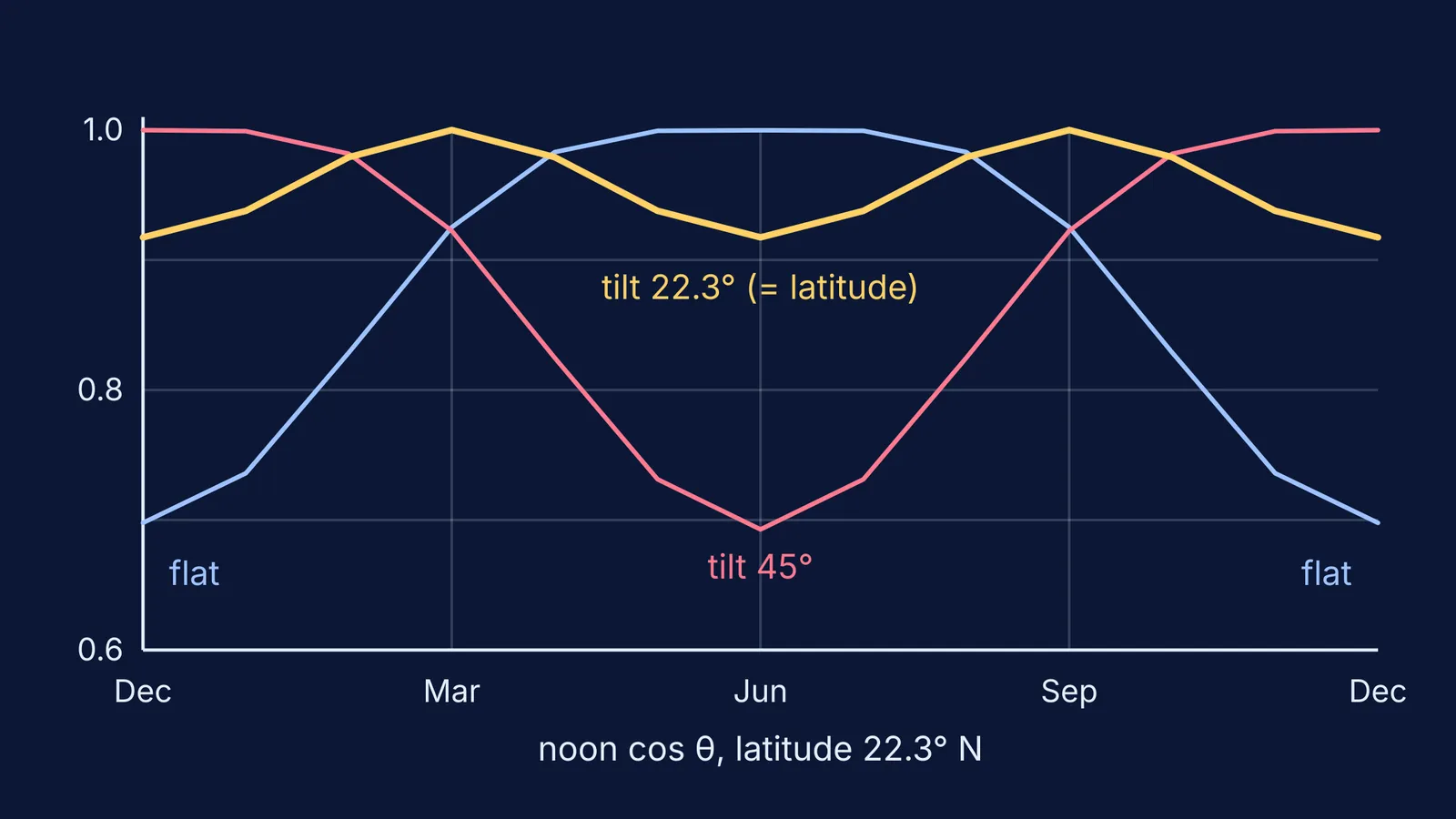
Here is a worked check for Rajkot (22.3° N) at solar noon, where θ = |latitude − tilt − declination| with PVEducation's declination values (PVEducation, declination angle):
Flat panel (0°): cos θ is 0.93 in March, 1.00 in June, 0.70 in December.
Tilted at the latitude (about 22°): 1.00 in March, 0.92 in June, 0.92 in December.
Steep panel (45°): 0.92 in March, 0.69 in June, 1.00 in December.
The latitude tilt never drops below 0.92 at noon; the other two each have a bad season. A full simulation also counts longer summer days and the weaker beam when the sun is low (PVEducation, air mass), so sweep the whole year rather than trusting three noons.
If you want to see how the sun's path changes with latitude first, try predicting day length across latitudes.
Why might your roof need a different angle?
A real rooftop adds things a simulation may leave out:
Local weather. Cloud and haze change the best angle, which is why weather-based results such as Rajkot's 24° at 22.3° N can differ from the latitude by a degree or two (Solar Energy, 2018).
Rain and dust. Jacobson and Jadhav note that panels whose optimum is within 10° of flat will likely be set at 10° in practice, so rain can wash them clean.
Heat. Hot panels lose output, which our post on why solar panels produce less power on very hot days explains.
Shade and roof shape. Check where a water tank or wall casts shadows. A 5° tilt error changes the noon cosine by less than 0.4% (cos 5° ≈ 0.996).
If a step surprises you, Fermi's AI tutor can run the simulation with you and check your understanding as it goes. Then go up to your roof with a protractor and your latitude.


