

On this page
If you have ever looked at a solar panel's output on a scorching 40°C summer afternoon, you might have noticed something strange: it is producing less power than it did on a crisp, bright 25°C spring day. It seems counter-intuitive that more heat leads to less electricity. But solar panels run on light, not heat, and the semiconductor physics inside them dictates a strict trade-off as temperatures rise.
How do solar panels react to heat?
Solar panels are rated for power at a Standard Test Condition (STC) of 25°C. But out on a real roof under the beating sun, they run much hotter. The Nominal Operating Cell Temperature (NOCT) for a typical module is 48°C.
When a silicon solar cell heats up above its STC, its maximum power output drops by approximately 0.4% to 0.5% per °C. That means a panel baking at 65°C on a roof in the summer is 40 degrees above its test condition, losing up to 20% of its rated power.
Why do solar panels produce less power on very hot days?
To understand the power drop, we have to look at the two numbers that make up power: current and voltage (P = V × I).
As the temperature of a semiconductor increases, the thermal energy of its crystal lattice increases. This causes the atoms to vibrate and reduces the bandgap—the energy required to knock an electron loose. A narrower bandgap means the cell can absorb a slightly wider spectrum of low-energy photons, which increases the short-circuit current (I_sc) by a tiny 0.06% per °C.
Why does open-circuit voltage drop?
While the current goes up slightly, the open-circuit voltage (V_oc) crashes.
Higher temperatures cause a massive surge in the number of intrinsic charge carriers. This leads to a higher dark saturation current (I_0), which represents electrons and holes recombining inside the cell before they can exit as useful electricity.
Mathematically, V_oc is inversely proportional to the logarithm of the saturation current. Because this recombination current rises exponentially with heat, the voltage drops sharply. For a standard silicon cell, V_oc falls by about 2.2 mV per °C.
When you multiply the slightly higher current by the significantly lower voltage, the net result is a smaller maximum power rectangle.
The I-V curve shift
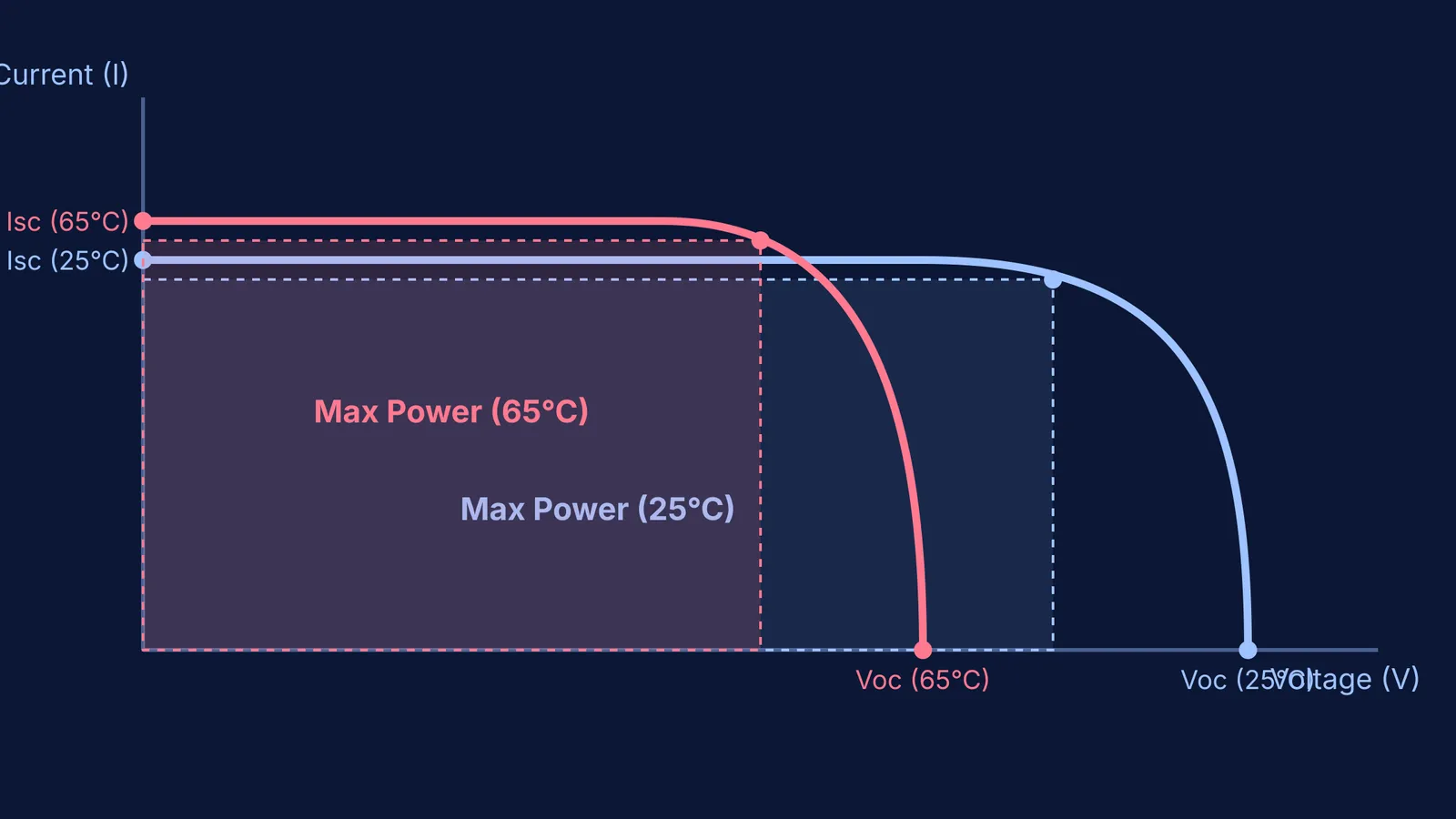
The relationship between current (I) and voltage (V) in a solar cell is plotted on an I-V curve. The maximum power the cell can produce is the largest rectangle that fits under this curve.
On a cool day at 25°C, the curve stretches far to the right, meaning the voltage is high. On a hot day at 65°C, the curve shifts slightly upward because of the extra current, but it is squashed heavily to the left. The resulting maximum power rectangle—the product of V and I at the optimal operating point—shrinks considerably. This squashing effect is why solar farms in cold, sunny climates often out-perform those in blistering deserts, even if the desert gets more direct sunlight.
If you are struggling to picture how heat changes carrier behaviour, the Fermi Simulation Lab has interactive simulations for the ideas that are easier to see than to read. You can change the temperature of a semiconductor lattice and watch the electron-hole recombination rate rise. And when it is time to calculate the exact power loss, the Fermi Problem Library has worked problems with a step-by-step solver that explains the reasoning rather than printing an answer.
For more on how charge carriers move in these materials, see our guides on Energy bands: conductors, semiconductors and insulators compared and n-type and p-type semiconductors: carrier concentration problems.
How do you calculate a solar panel's power loss?
If you are faced with a temperature coefficient problem on an exam or want to estimate your home's solar output, here is a quick framework:
Find the temperature difference (ΔT): Subtract 25°C (the standard test condition) from the panel's actual operating temperature.
Find the temperature coefficient: Most panels list a maximum power coefficient (e.g. −0.4%/°C) on their specification sheet.
Calculate the percentage loss: Multiply ΔT by the coefficient.
Subtract the loss: Reduce the panel's rated power by that percentage to find your real-world output.
By keeping panels cool—such as by leaving a gap between the panel and the roof for airflow—you can minimise the voltage drop and keep the power flowing.


