

On this page
Many students memorize the formula for the scalar projection of vector u onto vector v — which is (|u| × |v| × cos θ) / |v|, simplifying to |u| cos θ — but stumble when the angle changes. A formula alone makes it hard to predict what happens when the vectors are rotated.
A more intuitive way to understand vector projection is to visualize it as a shadow.
What is a vector projection?
Picture a vector u pointing diagonally upward, and a second vector v lying flat along the ground. To find the projection of u onto v, imagine a light source positioned far above.
According to Paul's Online Math Notes, the vector projection is the shadow cast onto a line when an imaginary light shines perpendicularly down on it. Because the light shines directly from above the vector's tip to the base vector, the invisible line connecting the tip of the original vector to the tip of its shadow always meets the ground vector at a 90° angle.
This shadow analogy is powerful because it gives you an immediate physical sense of the math. When you pull a heavy box across the floor using a rope tied at an angle, only the "shadow" of your pulling force on the ground actually contributes to moving the box forward.
What happens to the projection at 60° and 120°?
The shadow behaves differently depending on the angle (θ) between the two vectors. Let us look at two specific cases: 60° and 120°.
Assume your vector u has a length of 10 units.
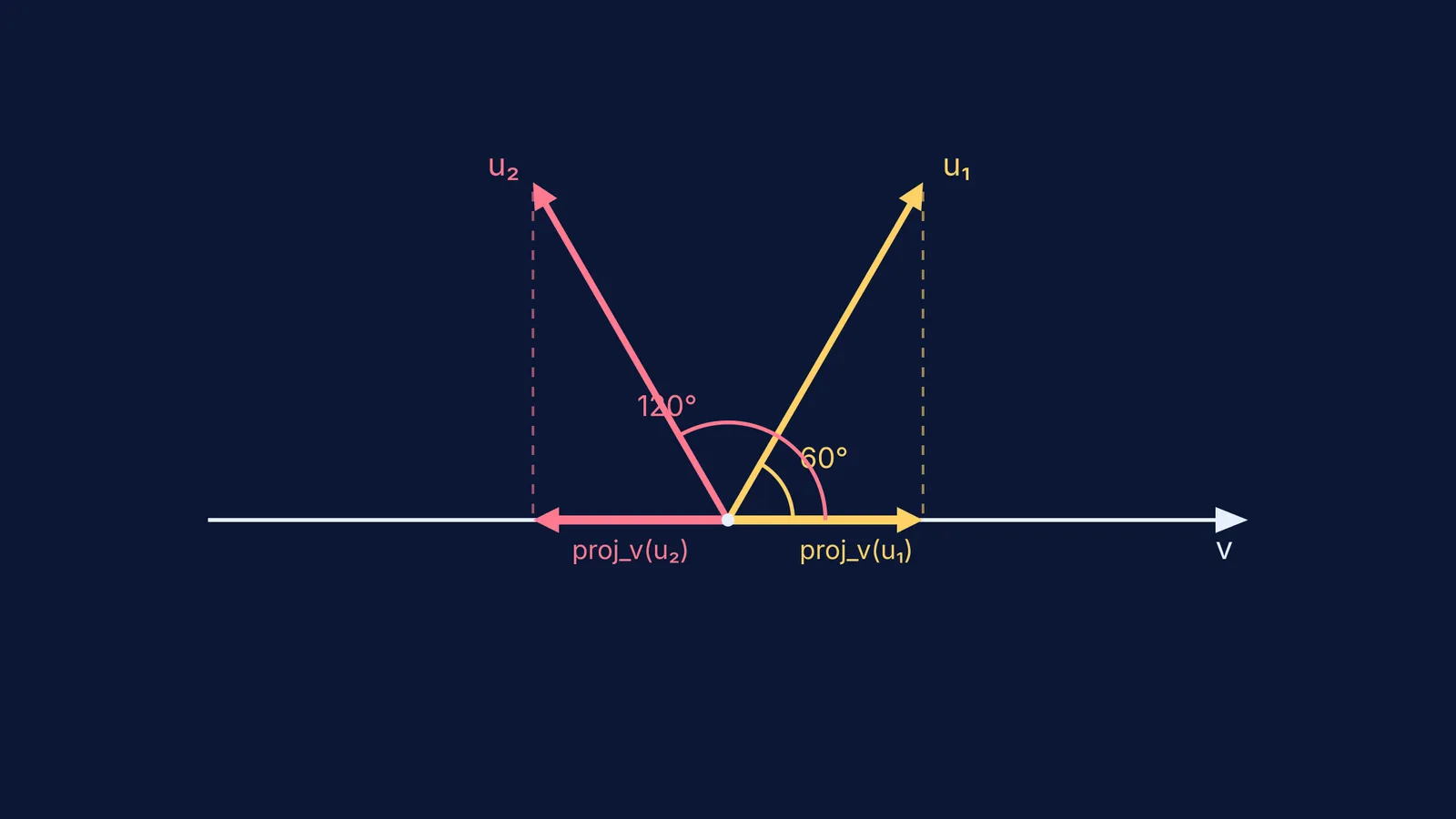
At 60°, the angle is acute (less than 90°). If you shine the perpendicular light, the shadow falls directly onto vector v, pointing in the same direction. The length of the shadow is calculated by multiplying the length by the cosine of the angle: 10 × cos 60°. Since cos 60° is 0.5, the shadow is exactly 5 units long.
Now, rotate vector u so the angle between them opens up to 120°. This is an obtuse angle (greater than 90°). If you apply the same formula, you find that cos 120° is −0.5. The length calculation gives you −5.
What does a negative shadow mean? It means the projection has flipped. The shadow no longer falls ahead on vector v; it falls on the line behind it, pointing in the exact opposite direction.
How do you calculate the vector projection?
Let us apply this to a coordinate geometry problem. Suppose you have a base vector v = 4i + 0j (lying along the x-axis, with a length of 4) and you want to project another vector onto it.
Case 1: The 60° angle Let vector u₁ = 2i + 2√3j. To find the angle, we can calculate its length: √(2² + (2√3)²) = √(4 + 12) = 4. The horizontal component is 2. The angle with the x-axis has a cosine of 2/4 = 0.5, which corresponds to 60°. Using the dot product formula for scalar projection: (u₁ · v) / |v|. The dot product is (2 × 4) + (2√3 × 0) = 8. The scalar projection is 8 / 4 = 2. The shadow points in the positive x-direction, just as we expect for an acute angle.
Case 2: The 120° angle Now let us rotate the vector to 120°. The new vector is u₂ = -2i + 2√3j. Its length is still 4. The dot product is (-2 × 4) + (2√3 × 0) = -8. The scalar projection is -8 / 4 = -2. The negative sign confirms our visual model: the shadow has flipped and now points in the negative x-direction, opposite to vector v.
How should you check exam problems?
When you face a vector projection problem, use this mental checklist before doing the algebra:
Check the angle's category: Is it acute, right, or obtuse?
Predict the direction: If it is acute, the projection shares the direction of the base vector. If it is 90°, the shadow is zero. If it is obtuse, the projection points backward.
Calculate and verify: Plug the values into the (u · v) / |v| formula and ensure the sign matches your prediction.
Memorizing algebraic formulas without a mental model often leads to sign errors during exams. When you can see the shadow shrink and flip, the negative sign for obtuse angles makes physical sense.
This is why interactive visual tools are highly effective for learning abstract concepts. A 2008 paper in Science by physicist Carl Wieman and colleagues found that interactive simulations enhance learning by allowing students to visualize invisible mechanisms. By dynamically rotating the vectors and seeing the shadow respond, your brain links the geometric shape to the algebraic formula.
If you struggle to picture how vectors change as they rotate, the Fermi Simulation Lab lets you drag the vectors on the screen and watch the shadow shrink, disappear at 90°, and flip to the other side. Fermi's AI tutor can also help you break down the dot product step by step when you get stuck.
If you are revising vectors for your upcoming exams, you might also want to review how to use Collinear points with vectors: the position vector test or how to find Motion in a plane from r(t): velocity and acceleration vectors.


