

On this page
Imagine you are at a Harvard University graduation. You ask random graduates, faculty and alumni what causes the seasons. Surely they know?
In 1987, filmmakers for the documentary *A Private Universe* did exactly this, and asked people what causes the seasons. Almost all of them gave the wrong answer. Most confidently explained that the Earth travels in a stretched-out oval, making it summer when we are close to the Sun and winter when we are far away.
It is one of the most common misconceptions in science. Let's look at why it happens, and how to test the real cause.
Does distance from the Sun cause seasons?
Most people assume that when we stand closer to a fire, we get hotter. So, summer must mean Earth is closer to the Sun. But distance does not explain the seasons.
If it did, the whole planet would experience summer at the same time. Instead, when it is winter in India or the UK, it is summer in Australia and South Africa.
In fact, the Earth's orbit is nearly a perfect circle, and we are closest to the Sun in January (perihelion, at 91.4 million miles) and farthest in July (aphelion, at 94.5 million miles). If distance mattered most, January would be our hottest month in the Northern Hemisphere.
Why do we have seasons?
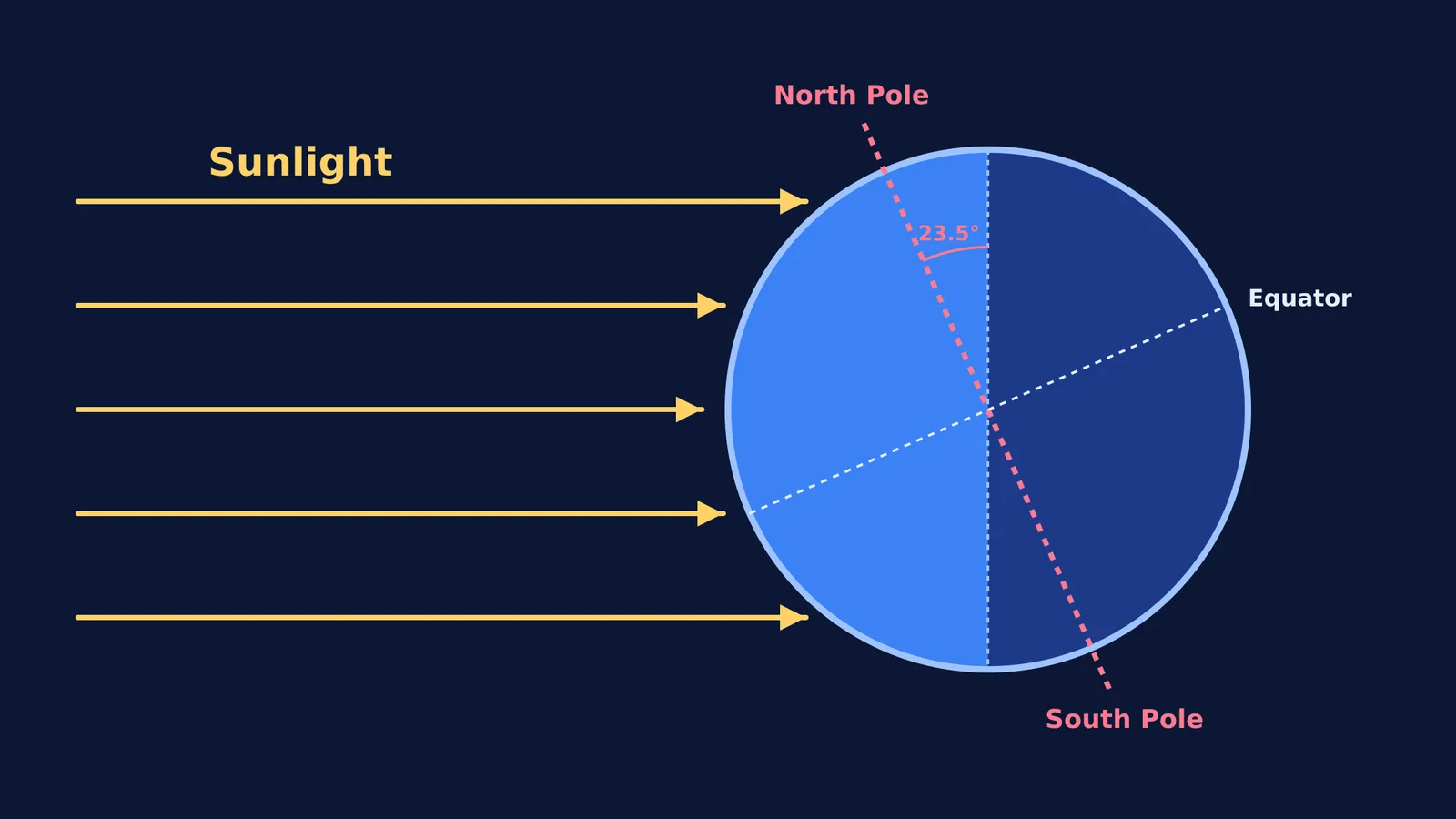
The real reason is that Earth's axis—the imaginary line running through the North and South poles—is tilted by 23.5 degrees.
As the Earth orbits the Sun, this tilt stays pointed in the same direction. When the North Pole is tilted toward the Sun, the Northern Hemisphere gets summer. When it is tilted away, it gets winter.
But why does tilt change the temperature? It comes down to two things:
The angle of sunlight: When a hemisphere tilts toward the Sun, the light hits the ground directly. When it tilts away, the light comes in at a shallow angle, spreading the same amount of solar energy over a much larger area.
Day length: The tilted-toward hemisphere spends more of its daily spin in the sunlight, giving it longer days to heat up.
Over long periods of time, these orbital properties slowly change, which is the mechanism behind Milutin Milankovic and the orbital cycles behind ice ages.
Can we test it with an axial tilt simulation?
The hardest part of learning this is trying to picture moving spheres and invisible angles in your head. When a textbook shows Why seasons and eclipses happen: Class 7 Earth, Moon and Sun, the orbit is usually squashed flat to fit on the page. This makes it look like a long, stretched-out oval, feeding the misconception.
Instead of reading about it, you can run the Fermi Simulation Lab and see it happen. You can look at the orbit from above to confirm it is almost perfectly circular. Then, you can turn on the sunlight rays and see exactly how the axial tilt makes the light spread out in winter and concentrate in summer.
How can we teach the seasons at home?
If you are explaining this to a child, start by asking for their prediction. "Why do you think it is cold in winter?"
When they say distance, do not just correct them. Test their idea.
Ask them: "If we are far away from the Sun in December, why is it hot in Australia right now?"
Use a globe and a flashlight to show them the tilt, or let them explore the simulation.
Seeing the light spread out on the tilted globe makes the science click. When a student builds their own understanding by predicting and testing, the knowledge sticks.


