

On this page
If a question gives you the two diagonals of a rhombus and asks for the side, you need only one idea and one theorem. The idea is that the diagonals cross at right angles and cut each other in half. The theorem is Pythagoras. Once you have the side, the area and perimeter take about two lines more.
Why do the diagonals give you the side?
A rhombus is a quadrilateral with both pairs of opposite sides parallel and all four sides the same length, as defined by Wolfram MathWorld. The same page states that the two diagonals of a rhombus are perpendicular.
Every rhombus is also a parallelogram, so its diagonals bisect each other, a property listed in the Wikipedia article on the rhombus.
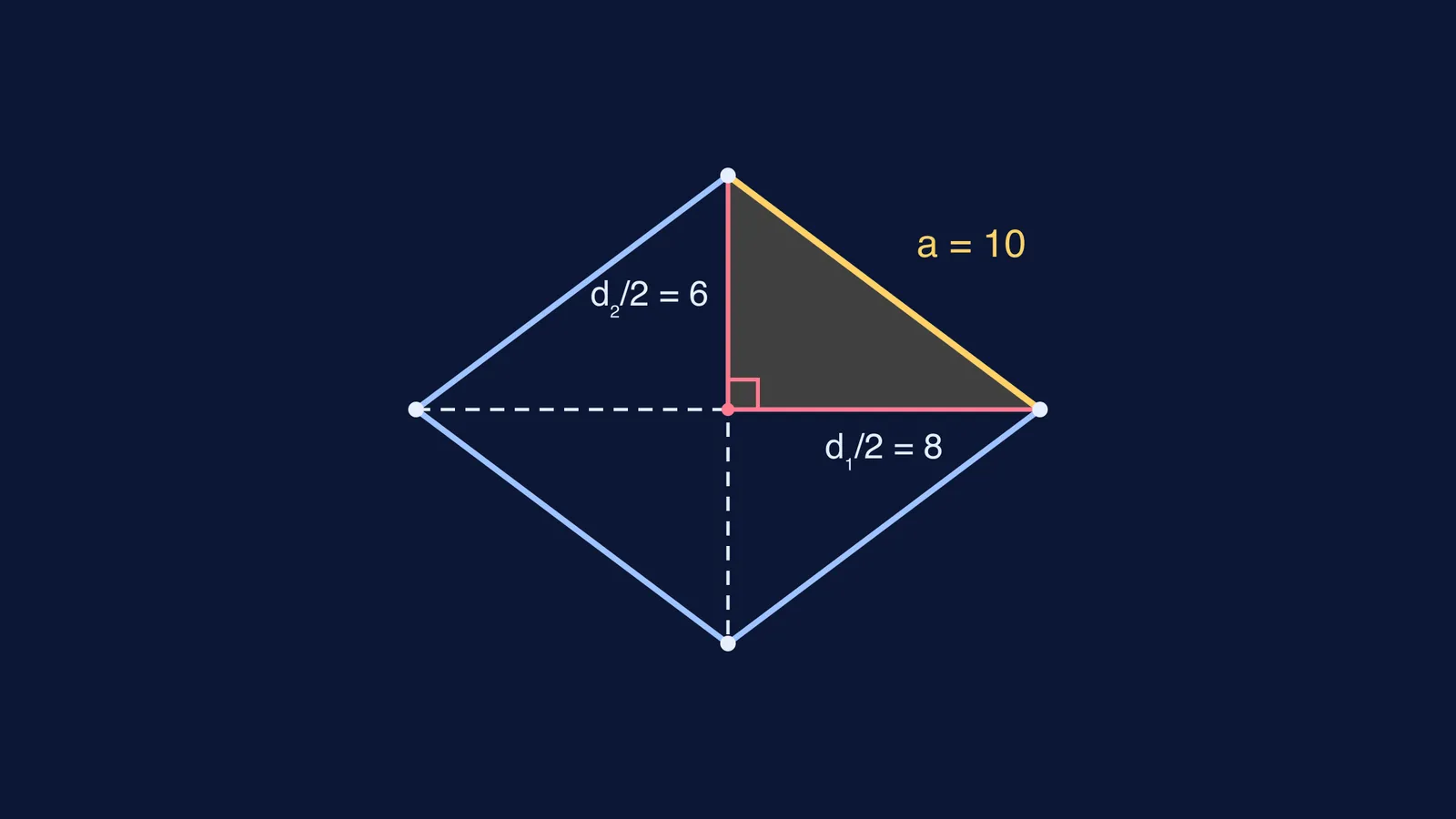
Put those two facts together and the diagonals cut the rhombus into four identical right triangles. Each triangle has legs of d₁/2 and d₂/2, and its hypotenuse is one side of the rhombus. Pythagoras then gives:
a² = (d₁/2)² + (d₂/2)²
a = √((d₁/2)² + (d₂/2)²)
Multiply the first line by 4 and you get 4a² = d₁² + d₂², the form of the relation given by MathWorld. Both versions say the same thing. Use whichever one you're less likely to slip on.
How do you find the side of a rhombus from its diagonals?
Here is a worked example. A rhombus has diagonals of 16 cm and 12 cm. Find its side.
Halve each diagonal: 16/2 = 8 cm and 12/2 = 6 cm.
Square and add: 8² + 6² = 64 + 36 = 100.
Take the square root: a = √100 = 10 cm.
Check with the other form: 4a² = 4 × 100 = 400, and d₁² + d₂² = 256 + 144 = 400. They match.
The hero diagram above is drawn to scale for this rhombus. The shaded triangle is the 6-8-10 right triangle that holds the whole calculation.
How do you find the area and perimeter of a rhombus?
The area of a rhombus is half the product of its diagonals, A = d₁d₂/2, according to MathWorld and the Wikipedia article. For the example: A = (16 × 12)/2 = 96 cm². You can check it with the four triangles. Each one has area ½ × 8 × 6 = 24 cm², and 4 × 24 = 96 cm².
You don't need the side to find the area. You do need it for the perimeter. All four sides are equal, so the perimeter is 4a = 4 × 10 = 40 cm.
What if you know the side and one diagonal?
Exam setters like to run the same triangle backwards. Say a rhombus has a side of 13 cm and one diagonal of 10 cm.
Half the known diagonal is 5 cm.
Pythagoras: (d₂/2)² = 13² − 5² = 169 − 25 = 144, so d₂/2 = 12 cm.
Double it: d₂ = 24 cm.
Area = (10 × 24)/2 = 120 cm². Perimeter = 4 × 13 = 52 cm.
Notice the 5-12-13 triangle hiding in there. The usual Pythagorean triples (3-4-5, 5-12-13, 8-15-17 and their multiples) show up all the time in rhombus questions. If your half-diagonals look like part of one, you can often skip the square root.
Which mistakes cost marks on rhombus questions?
Squaring whole diagonals. √(16² + 12²) = 20 cm, twice the true side. A quick check: the side is always shorter than d₁/2 + d₂/2 (here 14 cm), so 20 cm can't be right.
Dropping the ½ in the area. d₁ × d₂ gives the area of the rectangle around the rhombus, which is double the right answer.
Giving the side when the question asks for the perimeter. Underline what's being asked before you start.
Wrong units. Side and perimeter are in cm. Area is in cm².
Assuming the diagonals are equal. That only happens when the rhombus is a square.
Try the three practice problems in the box before you look at the answers. If one comes out wrong, step through it again in the Fermi Problem Library. Its step-by-step solver explains the reasoning rather than printing an answer, so you can see which step went wrong. If the shakier part is the theory, such as why a parallelogram's diagonals bisect each other or where Pythagoras comes from, the Fermi Concept Library gives each concept its own lesson.
Next time a rhombus turns up, halve the diagonals first and draw one right triangle. The side, area and perimeter all follow from it.


