On this page
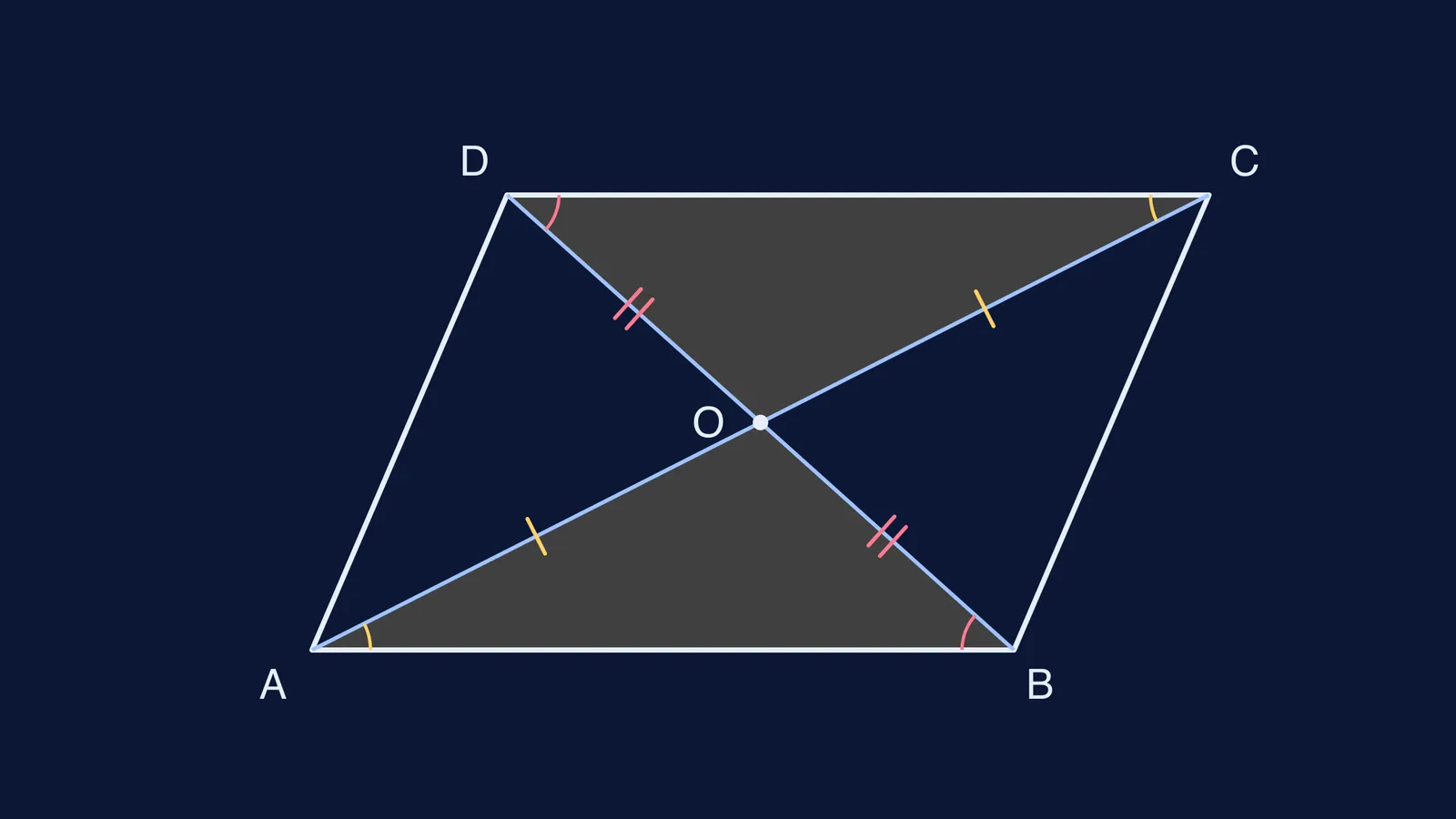
Draw a parallelogram ABCD and join both diagonals. They cross at a point, call it O. The claim is that O is the midpoint of both diagonals: OA = OC and OB = OD. Here is why it has to be true, in four steps.
In Euclid's *Elements*, Book I, Proposition 29 says a line crossing two parallel lines makes the alternate angles equal. Proposition 26 is the congruence rule: two triangles with two angles equal and one matching side equal have all their sides equal. Today we call the version with the side between the two angles ASA. Proposition 34 says the opposite sides of a parallelogram are equal.
How do you prove the diagonals of a parallelogram bisect each other?
Compare triangle AOB with triangle COD, which face each other across O (shaded in the diagram above).
∠OAB = ∠OCD. AB ∥ DC and AC is a transversal, so these are alternate angles (Proposition 29).
∠OBA = ∠ODC. Same reason, with BD as the transversal.
AB = CD, because opposite sides of a parallelogram are equal (Proposition 34).
AB lies between the two angles in step 1 and step 2, so triangle AOB ≅ triangle COD by ASA (Proposition 26).
By CPCT, OA = OC and OB = OD. So O is the midpoint of AC and of BD, and the diagonals bisect each other.
ASA needs the side to lie *between* the two angles. AB joins vertices A and B, where those angles sit, so the condition holds. If you have lost track of when CPCT is allowed, our explainer on what CPCT means in triangle proofs covers it. For a refresher on all four rules, see congruent triangles in Class 9: SAS, ASA, SSS and RHS.
How do you show a quadrilateral is a parallelogram using its diagonals?
The converse is the useful one in exams: if the diagonals of a quadrilateral bisect each other, the quadrilateral is a parallelogram. This time the proof runs on SAS, not ASA.
Given OA = OC and OB = OD.
∠AOB = ∠COD, because vertically opposite angles are equal (Proposition 15).
So triangle AOB ≅ triangle COD by SAS, and by CPCT ∠OAB = ∠OCD.
These are alternate angles on transversal AC, and equal alternate angles force the lines to be parallel (Proposition 27). So AB ∥ DC.
Repeat with triangles AOD and COB to get AD ∥ BC.
Both pairs of opposite sides are parallel, so ABCD is a parallelogram. A common slip is to stop after step 4. One pair of parallel sides only gives a trapezium, so you need step 5, or you need to show AB = DC as well.
What does this look like in a real question?
Algebra version. In parallelogram ABCD the diagonals meet at O, with OA = 2x + 1 and OC = 3x − 4. Find AC.
The diagonals bisect each other, so 2x + 1 = 3x − 4, which gives x = 5. Then OA = OC = 11, and AC = 22.
Coordinate version. Is A(1, 1), B(6, 2), C(8, 6), D(3, 5) a parallelogram? Use the converse and compare midpoints.
Midpoint of AC = ((1 + 8)/2, (1 + 6)/2) = (4.5, 3.5).
Midpoint of BD = ((6 + 3)/2, (2 + 5)/2) = (4.5, 3.5).
The midpoints are the same point, so the diagonals bisect each other and ABCD is a parallelogram.
Now try P(0, 0), Q(4, 0), R(5, 3), S(0, 3). The midpoint of PR is (2.5, 1.5) and the midpoint of QS is (2, 1.5). They differ, so PQRS is not a parallelogram. (PQ ∥ SR, so it is a trapezium.)
A four-point checklist before you write the proof
Name the two triangles that face each other across O, and use the same vertex order for both (AOB and COD).
Write the reason next to every equal angle: alternate angles, and say which line is the transversal.
Get the side from a property you have already proved (opposite sides equal), not from the diagram.
For the converse, prove both pairs of sides parallel, or one pair parallel and equal.
The result that gives you AB = CD is explained in how a diagonal divides a parallelogram into two congruent triangles. If your proof keeps getting stuck on the reason for a step, the Fermi Problem Library has worked problems with a step-by-step solver that explains the reasoning rather than printing an answer. If the gap is an earlier idea, such as alternate angles, the Fermi Concept Library gives each concept its own lesson.