

On this page
How does a diagonal divide a parallelogram into two congruent triangles?
According to the official NCERT Class 9 Mathematics curriculum, a diagonal of a parallelogram divides it into two congruent triangles. This statement, formally known as Theorem 8.1, forms the foundation for many other geometric properties. It is the starting point for proving why the opposite sides of a parallelogram are equal and why its opposite angles match.
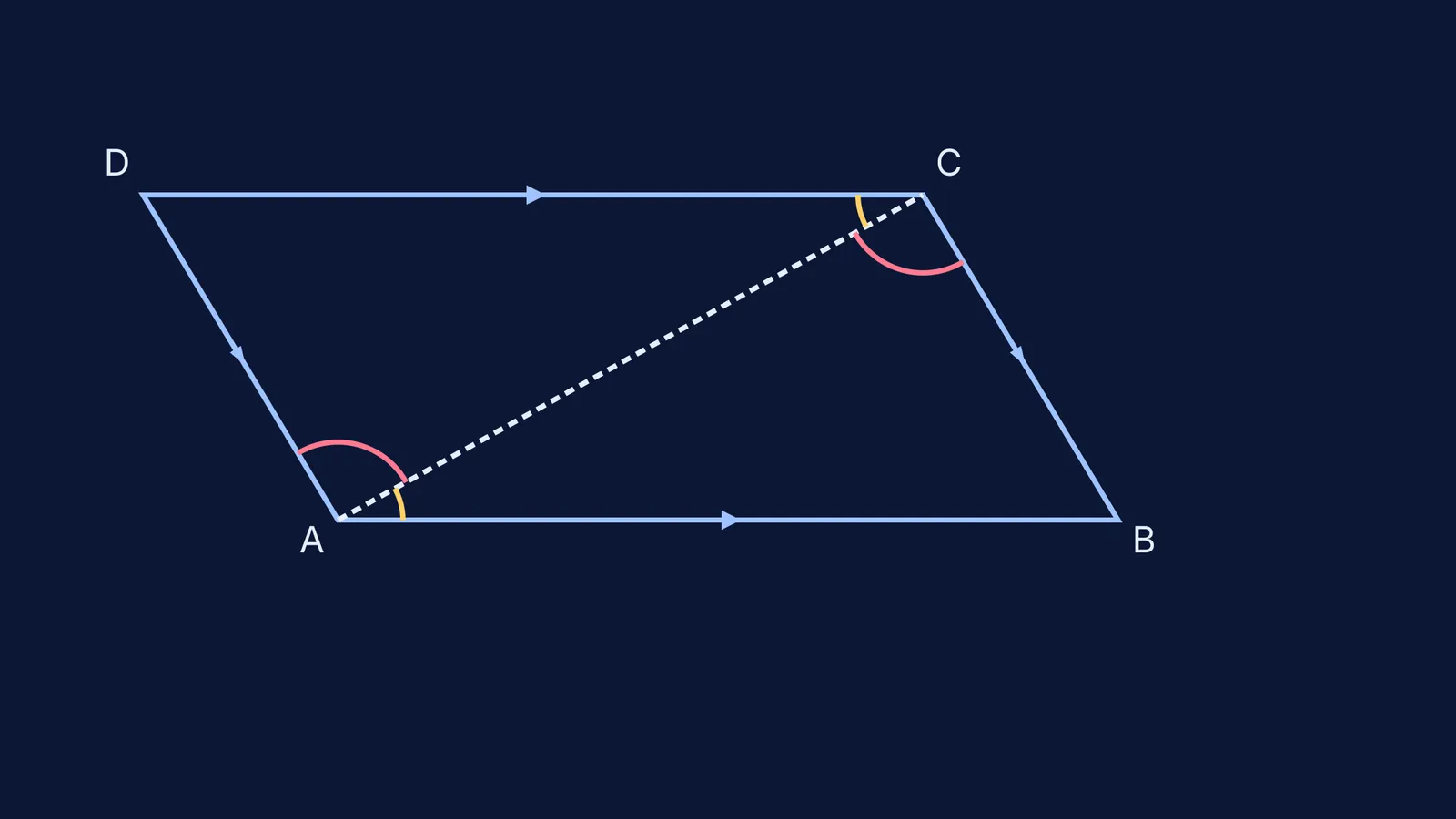
A parallelogram is a four-sided polygon where both pairs of opposite sides are perfectly parallel. When you draw a diagonal line connecting two opposite vertices (corners), you split the shape into two triangles. Because the outer edges are parallel, the diagonal acts as a transversal line cutting across them. This geometry creates pairs of equal alternate interior angles that lock the two resulting triangles into identical shapes and sizes.
The ASA proof step by step
To prove the theorem, we use the Angle-Side-Angle (ASA) congruence rule. For a complete look at how this compares to other rules, you can review our guide to Congruent triangles in Class 9: SAS, ASA, SSS and RHS. The ASA rule states that if two angles and the included side of one triangle are equal to two angles and the included side of another triangle, the two triangles are strictly congruent.
Let us take a parallelogram ABCD and draw the diagonal AC. This gives us two triangles: triangle ABC and triangle CDA. We can prove they are congruent by finding three matching parts:
The first pair of alternate interior angles: Because the bottom side AB is parallel to the top side DC, the diagonal AC acts as a transversal crossing these parallel lines. This makes the alternate interior angles equal. Therefore, angle BAC is equal to angle DCA.
The second pair of alternate interior angles: Similarly, because the left side AD is parallel to the right side BC, the same diagonal AC creates another pair of alternate interior angles. This means angle BCA is equal to angle DAC.
The common included side: Side AC is common to both triangles. It is a shared side, so AC = CA.
By the ASA congruence rule, triangle ABC is congruent to triangle CDA. The single diagonal has divided the original parallelogram into two identical halves.
Why does this theorem matter?
Once you know the two triangles are congruent, everything else about a parallelogram falls into place. In congruent triangles, all corresponding parts are equal. (This is a stricter condition than what you find in Similar triangles in Class 10: the basic proportionality theorem, where the triangles share angles but can have different side lengths).
Because triangle ABC is congruent to triangle CDA, their matching outer edges must be equal in length. Therefore, AB = DC and AD = BC. This proves the next major property: the opposite sides of a parallelogram are equal.
Their corresponding angles must also match exactly. Angle B in triangle ABC corresponds to angle D in triangle CDA. This proves that the opposite angles of a parallelogram are equal, which is another crucial rule you will use to solve textbook problems.
When a geometry problem asks you to find missing lengths or angles, getting stuck is a normal part of learning. If you struggle to visualise transversals and alternate interior angles, Fermi's Concept Library maps out every geometry concept step by step. Instead of just stating the theorem, Fermi's AI tutor works through the proof with you, drawing the angles on a board and checking your understanding of the ASA rule before moving forward.
Worked example: using congruent triangles to find angles
This congruence principle gives you a clear method for solving applied angle problems. By transferring known angles across the transversal, you can fill in the missing pieces.
Problem: In parallelogram ABCD, the diagonal AC makes an angle of 30° with side AB and 45° with side BC. Find the total measure of angle C and angle D.
Solution:
Transfer the first angle: Identify the alternate interior angles. Since side AB is parallel to side DC, angle ACD must equal angle BAC. The problem states the diagonal makes a 30° angle with AB, so angle BAC = 30°. Therefore, angle ACD = 30°.
Transfer the second angle: Since side AD is parallel to side BC, angle CAD must equal angle ACB. The diagonal makes a 45° angle with BC, so angle ACB = 45°. Therefore, angle CAD = 45°.
Calculate angle C: The total measure of angle C is the sum of its two parts: angle ACB (45°) and angle ACD (30°). Adding them gives angle C = 75°.
Calculate angle D: Look at the single triangle ADC. The sum of all angles in any triangle is exactly 180°. We just established that angle CAD = 45° and angle ACD = 30°, so angle D = 180° − (45° + 30°) = 105°.
By proving the triangles congruent first, you can transfer known angles across the shape. To try more geometry problems yourself, explore the Fermi Problem Library.


