On this page
Constitutional Design asks how people who distrust each other agree on rules, and what those rules should promise. Here are South Africa's story, the making of India's Constitution and the Preamble's key words, with dates checked against sources and a 20-minute revision plan.
Is Constitutional Design still in the Class 9 syllabus?
In the CBSE Social Science curriculum for 2025-26, Constitutional Design is Chapter 2 of the NCERT book Democratic Politics-I. Its learning outcomes ask you to describe what led to the Indian Constitution, list the features a constitution's drafters must keep in mind, examine its guiding values and understand your roles as a citizen.
The CBSE Class IX Social Science curriculum for 2026-27 prescribes new NCERT books, Social Science Part 1 and Part 2, organised in themes such as Democracy, Elections and Authority; none is called Constitutional Design. If your school still uses Democratic Politics-I, this guide matches your chapter. With the new books, the same facts may help with the Democracy and Authority themes. For how much this year counts, read where Class 9 marks matter and where they don't.
What happened in South Africa, and why does the chapter begin there?
Apartheid was South Africa's system of racial segregation under a white-minority government. Its end shows why a constitution matters when former opponents must share one country.
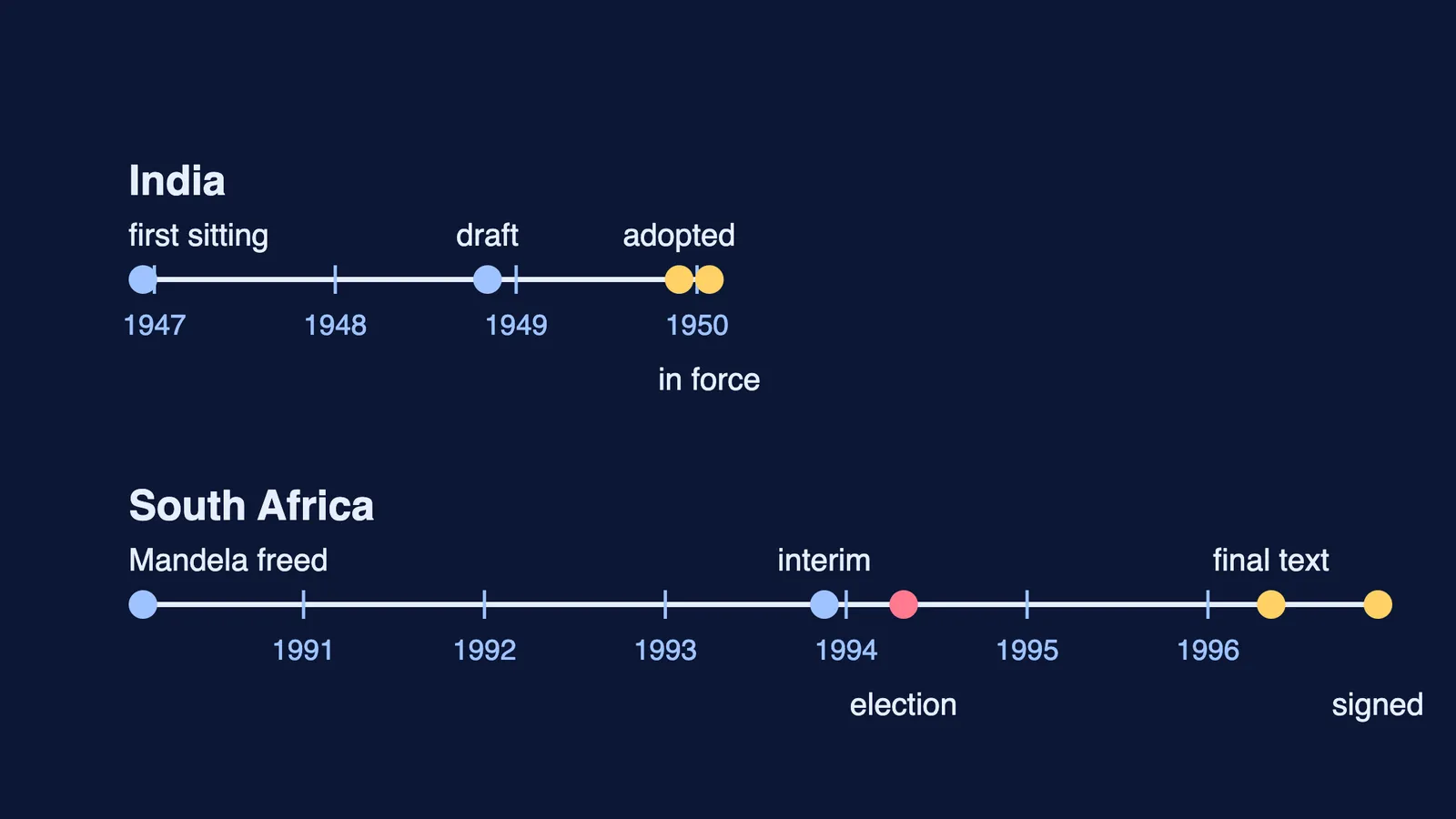
Nelson Mandela was sentenced to life imprisonment on 12 June 1964 and sent to Robben Island, says the Nelson Mandela Foundation's prison chronology. He was released on 11 February 1990 (Foundation timeline) after over 27 years in prison.
The Constitutional Court of South Africa records the country's first non-racial election on 27 April 1994 and Mandela's inauguration as president on 10 May. The final constitutional text was adopted on 8 May 1996. The Court refused to certify it on 6 September, certified the final text on 4 December, and Mandela signed the Constitution into law at Sharpeville on 10 December 1996.
For your answer: the Constitution gave the majority and the minority rules they could both trust, with an independent court to check them.
How was the Indian Constitution made?
India's Constitution was written by the Constituent Assembly, which sat for the first time on 9 December 1946 and met on 167 days over the next two years and eleven months, according to the Constituent Assembly debates archive.
Dr Rajendra Prasad served as President of the Constituent Assembly from 1946 to 1950 (member profile).
Dr B.R. Ambedkar chaired the Drafting Committee (member profile) and presented the Draft Constitution on 4 November 1948.
The Assembly adopted the Constitution on 26 November 1949, the date written into the Preamble.
Most of the Constitution came into force on 26 January 1950, under Article 394.
If you revise with an AI chatbot, check every Article number it gives you; our guide shows how to check an AI's Article number against the Constitution.
What do the key words of the Preamble mean?
The Preamble today describes India as a "SOVEREIGN SOCIALIST SECULAR DEMOCRATIC REPUBLIC" (Preamble text). The version adopted in 1949 read "SOVEREIGN DEMOCRATIC REPUBLIC". The Forty-second Amendment of 1976 added "socialist" and "secular" and changed "unity of the nation" to "unity and integrity of the nation".
Learn each word as one short meaning:
We, the people of India: power comes from citizens, not from a king or a foreign ruler.
Sovereign: India decides its own internal and external affairs.
Socialist: the state works to reduce inequality of wealth and opportunity.
Secular: citizens may follow any religion, and the state has no official religion.
Democratic: people elect their governments and can vote them out.
Republic: the head of state is elected, not hereditary.
Justice: social, economic and political.
Liberty: of thought, expression, belief, faith and worship.
Equality: of status and of opportunity.
Fraternity: brotherhood that assures each person's dignity and the nation's unity and integrity.
How do you revise Constitutional Design in 20 minutes?
Minutes 1-5, two timelines: from memory, draw India (1946 to 1950) and South Africa (1990 to 1996) as lines, mark the dates, then check them against this page.
Minutes 6-10, cover test: hide the Preamble meanings, say each one aloud and note the words you missed.
Minutes 11-15, one 3-mark answer: use situation, problem, solution. For "Why did South Africa need a constitution?": after apartheid, the Black majority and the white minority distrusted each other; each feared the other would misuse power; the Constitution set rules both accepted, with a court to check them. Our guide to a cause-and-effect chart for a history chapter gives you a template for this kind of answer.
Minutes 16-20, compare: write two lines answering one question: what did India and South Africa both need their constitutions to do?
When you switch from Social Science to science revision, the Fermi Concept Library has a lesson for every concept in physics, chemistry, biology, mathematics and computing.