On this page
India has had its own observatory in space for more than ten years. AstroSat sees ultraviolet and X-ray light that never reaches the ground. Here is what it carries, what it found, and a calculation you can check.
What is AstroSat?
AstroSat is India's first ultraviolet and X-ray astronomy observatory in space, as described in an overview chapter by astronomer Kulinder Pal Singh. ISRO launched it on PSLV-C30 from Satish Dhawan Space Centre, Sriharikota, on 28 September 2015, according to ISRO's AstroSat page.
The same ISRO page gives the key numbers. AstroSat had a lift-off mass of 1515 kg. It circles Earth in a 650 km orbit inclined at 6 degrees to the equator. ISRO expected a minimum useful life of 5 years, and NASA's HEASARC mission page, updated in February 2026, says the satellite continues to provide useful data.
Why put it in orbit? Ultraviolet and X-ray light from space is absorbed by Earth's atmosphere. Ground telescopes climb mountains to get above haze and turbulence, as we explain in why observatories are built on high mountains, but no mountain is high enough for X-rays. For the rocket that carried it, see PSLV vs GSLV.
What are AstroSat's five instruments?
AstroSat carries five science instruments and one auxiliary instrument, according to the AstroSat overview. Four are co-aligned on a common deck, so they look at the same star or galaxy at the same time. The fifth sits on a rotating platform, turned 90 degrees from the others, to scan the sky for X-ray sources that flare up suddenly.
The bands below come from ISRO's AstroSat payloads page:
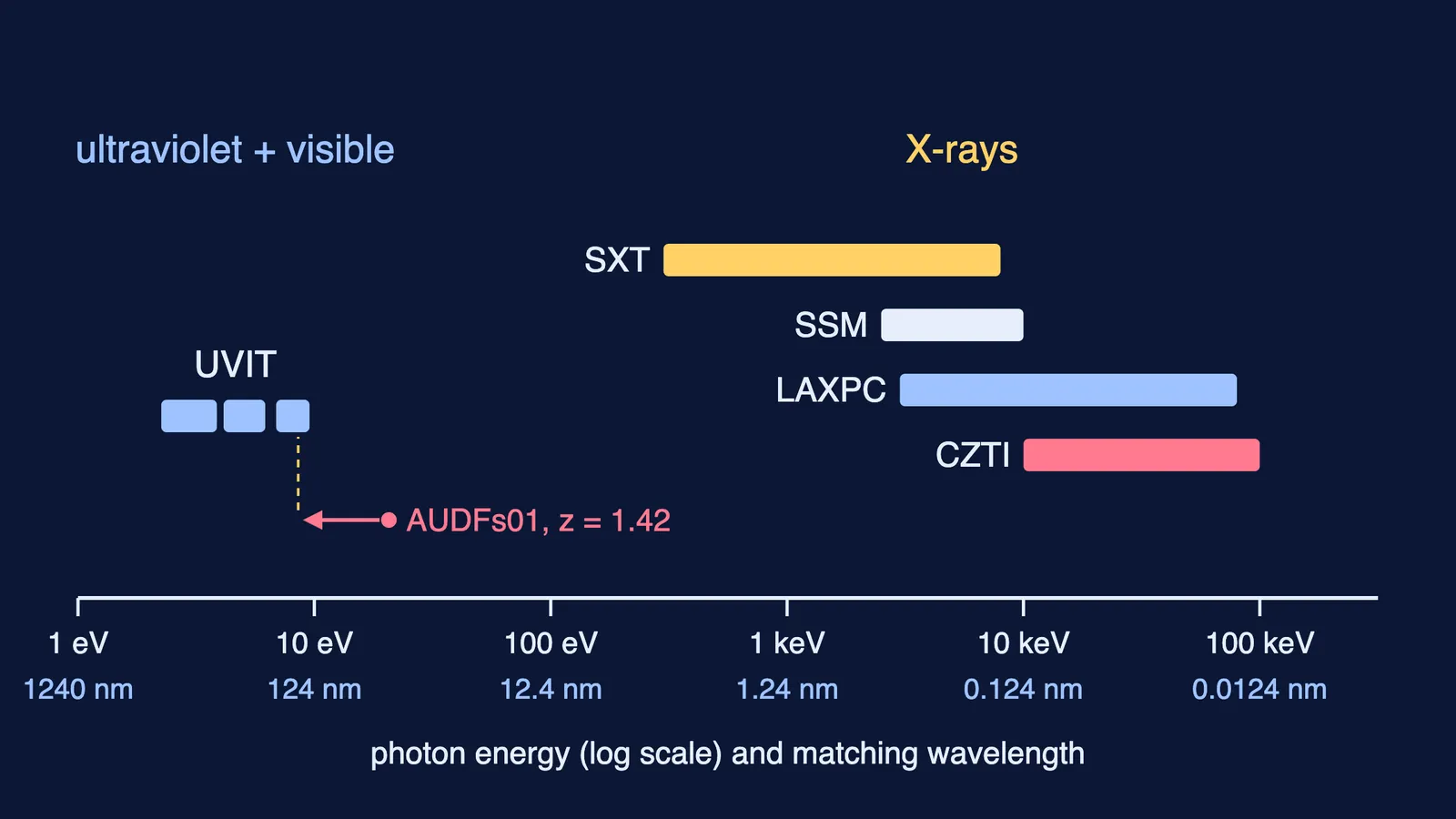
UVIT (Ultra Violet Imaging Telescope): far ultraviolet 130 to 180 nm, near ultraviolet 200 to 300 nm, and visible 320 to 550 nm.
SXT (Soft X-ray Telescope): a focusing X-ray telescope with a CCD camera, 0.3 to 8 keV.
LAXPC (Large Area X-ray Proportional Counters): three identical counters that track how a source's brightness changes over time, 3 to 80 keV.
CZTI (Cadmium-Zinc-Telluride Imager): a hard X-ray camera with a coded mask, 10 to 100 keV.
SSM (Scanning Sky Monitor): watches for new X-ray transients, 2.5 to 10 keV.
CPM (Charged Particle Monitor): the auxiliary instrument, which detects high-energy particles along the orbit.
NASA's HEASARC page lists somewhat different ranges for some instruments (for example 20 to 200 keV for CZTI), so treat the edges as approximate.
What has AstroSat discovered?
In 2020 an international team led by Kanak Saha of the Inter-University Centre for Astronomy and Astrophysics (IUCAA), Pune, reported extreme-ultraviolet light from a galaxy called AUDFs01, 9.3 billion light-years from Earth, according to ISRO's announcement. The paper in Nature Astronomy describes it as the first detection of extreme-ultraviolet radiation from a distant galaxy at an emitted wavelength of 600 angstrom (60 nm). The galaxy sits at redshift z = 1.42, and the paper estimates that more than 20% of its hydrogen-ionising light escapes.
This matters because, as the paper explains, astronomers are still working out which sources produced most of the ionising radiation after the Cosmic Dark Age. In ISRO's announcement, Saha credits the background noise in UVIT's detector, which is much lower than in the detectors on the Hubble Space Telescope.
The work has continued. In a follow-up study accepted by The Astrophysical Journal, Soumil Maulick, Kanak Saha and Michael Rutkowski reported 5 newly identified candidate galaxies leaking this ionising light, at redshifts 0.99 to 1.42, in the AstroSat UV Deep Field South.
How can a far-UV telescope see extreme-UV light?
You can check this with two formulas. Photon energy is E = hc/λ, from Class 12 physics, and light from a receding galaxy is stretched by redshift: the observed wavelength is the emitted wavelength times (1 + z).
UVIT's far-UV edges, from ISRO's payloads page: 1240/180 is about 6.9 eV and 1240/130 is about 9.5 eV.
X-ray edges: 1.24/0.3 keV is about 4.1 nm, and 1.24/100 keV is about 0.0124 nm. From 550 nm visible light down to 0.0124 nm, AstroSat spans a factor of more than 40,000 in wavelength.
AUDFs01: according to the Nature Astronomy paper, the light left the galaxy at 60 nm. Multiply by (1 + 1.42) = 2.42 and it arrives at about 145 nm, inside UVIT's 130 to 180 nm far-UV band.
So AstroSat never needed an extreme-UV camera. The expansion of the universe moved that light into a band UVIT already covers. The same hc shows up in the X-ray cutoff wavelength from tube voltage, a common JEE question.
If photon energy or redshift still feels shaky, the Fermi Concept Library gives each physics concept its own lesson and shows where it sits in the map. To practise the conversion, the Fermi Problem Library has worked problems with a step-by-step solver that explains the reasoning rather than printing an answer.
How can you follow AstroSat's science?
Read ISRO's AstroSat page, which notes that ISRO and IUCAA run an AstroSat Support Cell to help scientists propose observations and use the data.
Pick one result, such as the AUDFs01 paper, and redo its arithmetic yourself, as above.