On this page
Both are ISRO rockets and both names end in "Satellite Launch Vehicle". The first word is the clue. PSLV stands for Polar Satellite Launch Vehicle and GSLV for Geosynchronous Satellite Launch Vehicle: each name tells you the kind of orbit the rocket was designed to reach. Once you see the orbits, the rest of the difference follows.
What orbits do PSLV and GSLV aim for?
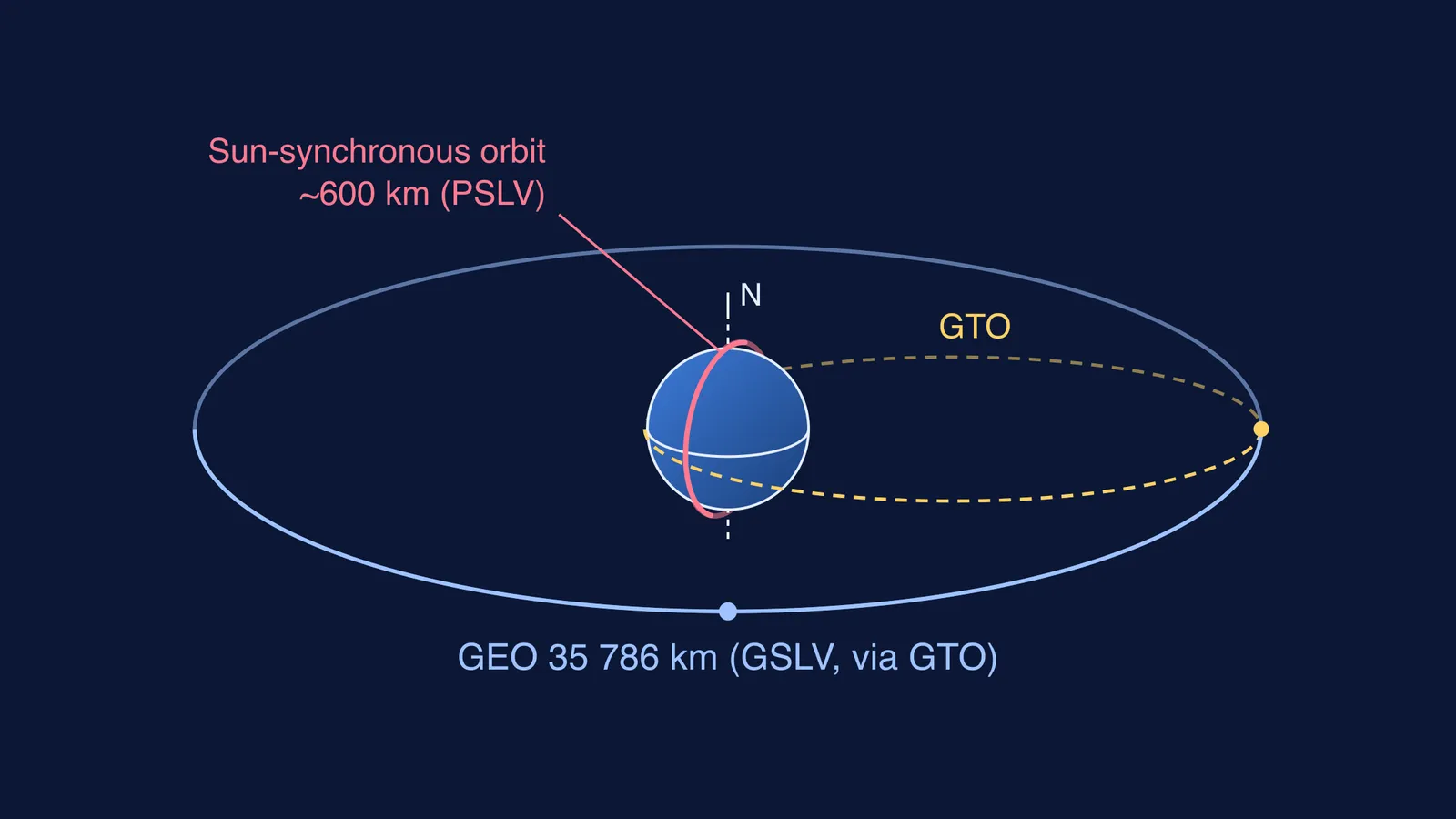
A polar orbit takes a satellite roughly from pole to pole, usually between 200 and 1,000 km up, so the Earth turns beneath it and the satellite eventually sees every part of the globe, according to the European Space Agency's guide to orbit types.
A Sun-synchronous orbit is a special polar orbit, typically 600 to 800 km up, in which a satellite passes over the same spot at the same local time every day, the same ESA guide explains. That steady lighting suits satellites that photograph the ground.
A geostationary orbit sits 35,786 km above the equator, where one lap takes 23 hours 56 minutes and 4 seconds, so the satellite appears fixed over one place (ESA). Rockets usually drop such satellites into a geostationary transfer orbit, a long ellipse whose far point reaches that height; the orbit is later made circular at that far point.
Do the arithmetic: 35,786 km is about 60 times the 600 km height of a typical Sun-synchronous orbit. Reaching that far needs much more energy per kilogram, and that is the job GSLV was built for.
How are the two rockets built differently?
ISRO's PSLV page lists the key facts:
Four stages that alternate solid and liquid fuel: solid HTPB, liquid UDMH with N2O4, solid HTPB again, then liquid MMH with MON.
Height of 44 m and a lift-off mass of 320 tonnes in its XL version, with six strap-on boosters.
Capacity of 1,750 kg to a 600 km Sun-synchronous polar orbit, or 1,425 kg to a sub-geosynchronous transfer orbit.
First launch on 20 September 1993.
ISRO's GSLV page describes a different machine:
Three stages: a 138 tonne solid motor with four liquid strap-ons, a liquid second stage driven by one Vikas engine, and a cryogenic third stage burning liquid oxygen and liquid hydrogen.
Height of 51.73 m and a lift-off mass of 420 tonnes.
Capacity of 2,250 kg to a geosynchronous transfer orbit, or 6,000 kg to low Earth orbit.
First flight on 18 April 2001, and first flight with an Indian-built cryogenic stage on 5 January 2014.
The cryogenic stage is the heart of the difference. ISRO's GSLV page describes the vehicle as designed to launch communication satellites into geosynchronous transfer orbit using that cryogenic third stage.
Which satellites go on which rocket?
ISRO calls PSLV "the workhorse of ISRO" on its PSLV page, which credits it with the Indian Remote Sensing satellites, Chandrayaan-1 in 2008, the Mars Orbiter Mission in 2013, and the PSLV-C37 flight that carried Cartosat-2 plus 103 co-passenger satellites.
GSLV's main payloads are INSAT-class communication satellites, according to its ISRO page. Such satellites stay fixed above one place, so antennas on the ground can stay pointed at them (ESA).
The names describe what each rocket was designed for, not a strict rule. On 30 July 2025, a GSLV carried the NASA-ISRO satellite NISAR, with a lift-off mass of about 2,400 kg, into a 747 km Sun-synchronous polar orbit, as ISRO's NISAR mission page records.
A worked example: pick the rocket
Use the capacities on ISRO's PSLV and GSLV pages to decide, the way an exam question might.
A 1,200 kg Earth-imaging satellite headed for a 600 km Sun-synchronous orbit. It is under PSLV's 1,750 kg rating for that orbit, so PSLV fits.
A 2,000 kg communication satellite that must end up geostationary. PSLV's 1,425 kg sub-GTO capacity is too small; GSLV's 2,250 kg to GTO covers it.
NISAR, about 2,400 kg, going to a 747 km Sun-synchronous orbit. The orbit says PSLV, but the mass is above PSLV's 1,750 kg rating for a 600 km orbit, and ISRO flew it on GSLV. Mass and orbit decide together.
The first two are made-up; NISAR is real. The rule: ask where the satellite must go, then check its mass against the rocket's rating for that orbit.
How can you picture these orbits?
The hard part is scale. A Sun-synchronous orbit hugs the Earth, while the geostationary ring sits 35,786 km up (ESA), about 60 times higher. To see how a satellite at that height keeps pace with the turning Earth, read how Arthur C. Clarke calculated the geostationary orbit. How satellites stay in orbit explains the balance between speed and gravity, and why ISRO launches rockets from Sriharikota covers where these launches begin.
Orbits are hard to picture from a flat diagram. The Fermi Simulation Lab has interactive simulations for the ideas that are easier to see than to read.