On this page
In October 1945, a 27-year-old RAF radar officer named Arthur C. Clarke published an article in *Wireless World* titled "Extra-Terrestrial Relays". His 1945 paper was the first to show how a geostationary orbit could be used for global communications.
At the time, long-distance radio communication was difficult because signals had to be bounced off the Earth's ionosphere. This method was unreliable, subject to solar interference, and completely unusable for the high-frequency microwaves needed for television broadcasts. Clarke realised that rather than relying on the unpredictable atmosphere, engineers could use artificial satellites as high-altitude repeater stations to relay VHF and UHF signals around the curvature of the Earth.
What is a geostationary orbit?
If a satellite orbits close to Earth, it moves much faster than the planet rotates. For example, the International Space Station orbits at an altitude of about 400 km and completes a revolution in just 90 minutes. As you move further away from Earth, the pull of gravity weakens, and the orbital period increases.
Clarke recognised that at a specific distance from Earth's centre, a satellite would take exactly one sidereal day to complete a single orbit. A satellite in this circular equatorial orbit takes exactly 24 hours to match the Earth's rotation. To an observer on the ground, the satellite appears completely stationary in the sky, never rising or setting. This means that a ground antenna can remain fixed, pointing at one spot in the sky without needing expensive tracking equipment.
How did Clarke calculate the orbit's height?
To find the exact height where this happens, we must balance the gravitational pull of the Earth with the centripetal force required to keep the satellite in a circular path.
The gravitational force is given by Newton's law of universal gravitation: F = GMm / r²
The centripetal force is: F = mv² / r
Equating the two forces, the mass of the satellite (m) cancels out: GM / r² = v² / r
Since the velocity (v) is the circumference of the orbit (2πr) divided by the time period (T), we can substitute v: GM / r² = (4π²r²) / (T²r)
Which simplifies to: GM / r² = 4π²r / T²
Solving for the orbital radius (r) gives the formula: r = ∛(GMT² / 4π²)
If you struggle to recall derivations like this during an exam, the Fermi Problem Library has worked problems with a step-by-step solver that explains the reasoning rather than printing an answer.
To find the Clarke Orbit, we use Earth's standard gravitational parameter and the length of a sidereal day in seconds. NASA records Earth's standard gravitational parameter as 3.986 × 10¹⁴ m³/s². A sidereal day is approximately 86,164 seconds long. Putting these numbers into the formula yields an orbital radius of approximately 42,164 km.
Why did Clarke propose three satellites?
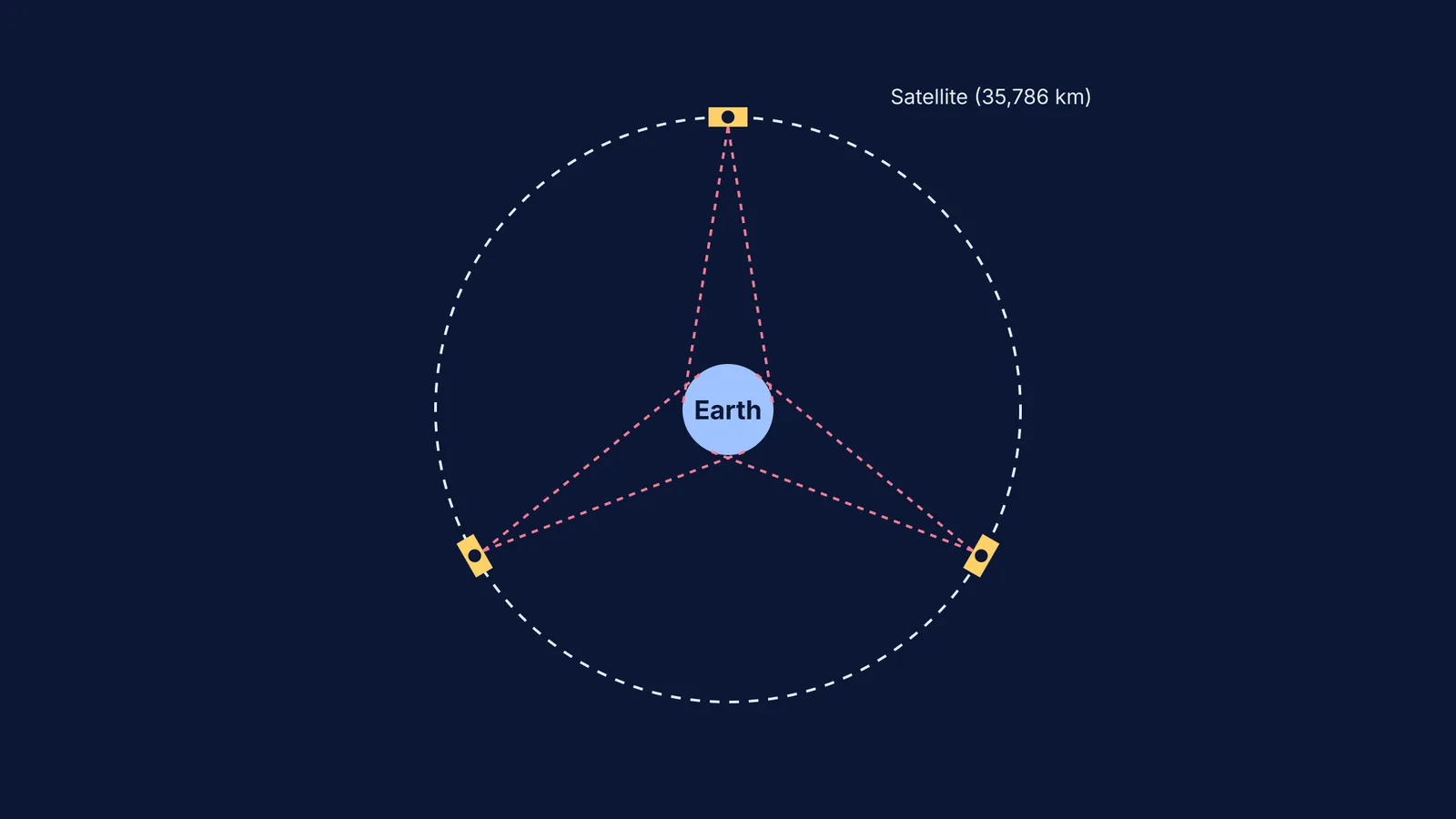
Because a geostationary satellite sits so high above the Earth, it has a direct line of sight to nearly half the planet's surface. Clarke calculated that a network of just three satellites spaced 120 degrees apart could cover the entire planet, except for the extreme polar regions.
He even suggested specific longitudes for them: 30°E to cover Africa and Europe, 150°E for China and Oceania, and 90°W for the Americas. By linking these three stations together, a signal could be broadcast from London, relayed through the satellite network, and received simultaneously in Sydney or Buenos Aires.
Visualising how fields and orbits overlap can be challenging from a textbook description alone. You can experiment with orbital mechanics yourself using interactive simulations for the ideas that are easier to see than to read in the Fermi Simulation Lab.
Nineteen years after Clarke published his idea, it became a reality with the launch of Syncom 3. Launched in 1964, Syncom 3 was the first true geostationary satellite and successfully broadcast the Tokyo Olympics across the Pacific. Today, hundreds of communications, weather, and military satellites occupy this unique region of space. Though he never patented the concept, the 35,786 km ring above our equator (the 42,164 km radius minus Earth's 6,378 km radius) is today officially known as the Clarke Orbit.