

On this page
Look at where the world's big telescopes sit and you see a pattern: Maunakea in Hawai'i, the Atacama Desert in Chile, Hanle in Ladakh. Starlight crosses space for years without trouble. Most of the damage happens in the last few kilometres, inside our atmosphere.
Why are telescopes built on high mountains?
Air does four things to starlight on the way down. It absorbs some of it, bends and blurs it, hides it behind cloud, and adds glow from city lights. Going higher reduces all four.
Less air overhead. Air pressure falls roughly exponentially with height. NASA's Earth fact sheet gives the atmosphere a scale height of 8.5 km, the height over which pressure drops by a factor of e.
Far less water vapour. Water vapour hugs the ground much more tightly than the rest of the air (more on this below).
Above the clouds. The IEEE milestone record_Mauna_Kea_Telescope,_1970) for the first big Maunakea telescope notes that the summit "stood above the clouds almost all of the time", while Haleakala, at 3,055 m, was "subject to clouds and occasional fog".
Darker skies. Remote peaks are far from towns, so there is less stray light. Our explainer on why city skies show so few stars covers skyglow in detail.
How does water vapour block starlight?
Water molecules absorb strongly at infrared and millimetre wavelengths. The European Southern Observatory says millimetre and submillimetre signals from space "are heavily absorbed by water vapour in the Earth's atmosphere", which is why ALMA was built on the 5,000 m Chajnantor plateau, in one of the driest places on Earth.
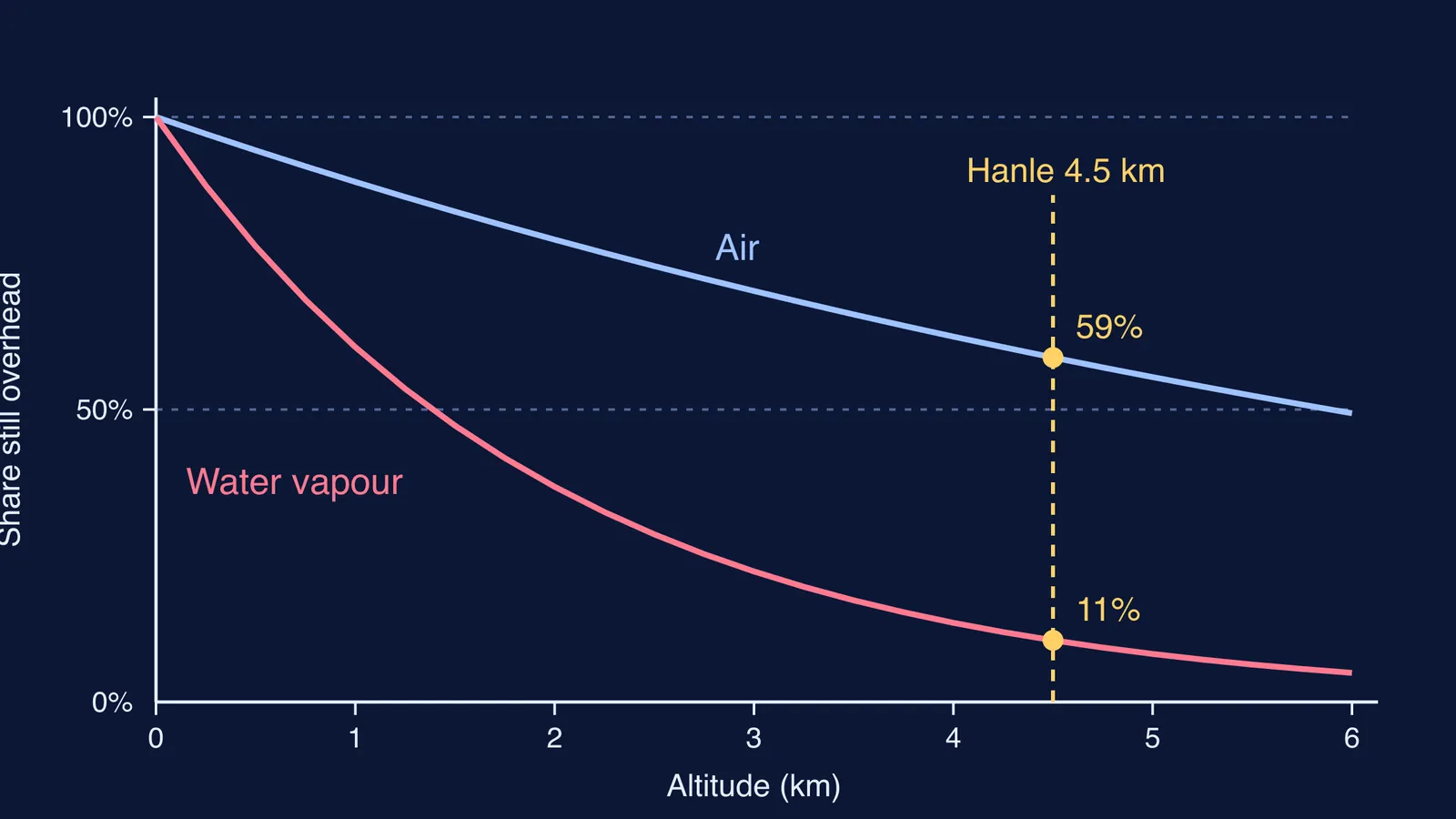
Height helps far more with water than with air. In lecture notes from the IRAM interferometry school, radio astronomer S. Guilloteau writes that the scale height of water vapour is typically 2 km, compared with 8.4 km for the atmosphere as a whole. So climbing a few kilometres leaves a good share of the air above you but most of the water below.
How much air and water vapour sits above Hanle?
You can estimate this with one formula, the simple barometric formula: the fraction of air still above height h is roughly e^(-h/H), where H is the scale height.
Hanle's observatory is at 4,500 m, according to the Indian Institute of Astrophysics.
Air: e^(-4.5/8.5) = e^(-0.53) ≈ 0.59. About 59% of the air is still overhead, so roughly 41% is below you. Pressure is about 0.59 × 10¹⁴ mb ≈ 600 mb.
Water vapour: e^(-4.5/2) = e^(-2.25) ≈ 0.11. Only about 11% is still overhead, so roughly 89% is below you.
Check against a real site: the same sums for Maunakea (4.2 km) give about 39% of the air and 88% of the water vapour below. The IEEE record_Mauna_Kea_Telescope,_1970) says 40% and 90%. A simple model gets close.
What does refraction have to do with it?
How much air bends light depends on its density and temperature. Our post on atmospheric refraction and twinkling shows how this makes stars twinkle: moving pockets of warmer and cooler air act like weak, shifting lenses.
For a telescope, that shimmer is a problem. ESO describes how turbulence makes stars twinkle in a way that "blurs the finest details of the cosmos", and how its telescopes use adaptive optics, mirrors reshaped by computer in real time, to undo some of it. Astronomers call this blurring "seeing" and measure it in arcseconds. Less air overhead generally means less air to bend and blur the light.
Refraction and falling air pressure are easier to see than to read about. The Fermi Simulation Lab has interactive simulations for ideas like these.
Why are India's observatories in Ladakh?
The Indian Astronomical Observatory at Hanle is a dry, cold desert site with about 260 spectroscopic nights a year. Its median seeing is under 1 arcsecond. Precipitable water vapour stays below 2 mm between October and April. That is the depth of water you would get if all the vapour above the telescope condensed into a puddle.
Darkness is protected too. In December 2022, a region of about 22 km radius around Hanle was declared the Hanle Dark Sky Reserve, with a light management plan to keep light pollution to a minimum.
How to answer this in an exam
If a school exam asks why observatories are built on mountains, cover four points in four lines:
Less air above, so less absorption and scattering of starlight.
Very little water vapour, which absorbs infrared and millimetre waves.
Above most clouds, with steadier air, so less blurring from refraction by turbulent air.
Far from cities, so little light pollution.
Add one number, such as Hanle's 4,500 m altitude, and you have a complete answer. If the word "scattering" feels shaky, our piece on why the sky glows before sunrise explains it, and the Fermi Concept Library has a lesson for every concept in physics, from refraction to pressure.


