On this page
Given an X-ray tube voltage, the shortest wavelength takes one line of energy conservation. The part examiners like to test is why the answer is the same for tungsten, copper or any other target.
What sets the shortest X-ray wavelength from a tube?
In an X-ray tube, electrons leave a hot cathode and are accelerated through a potential difference V towards a metal target. Each electron reaches the target with kinetic energy eV. There the nuclei's electric fields slow it down, and a decelerating charge radiates: bremsstrahlung, German for braking radiation.
Most electrons lose energy in many small steps, giving a continuous spread of wavelengths. The shortest wavelength comes from electrons that turn their entire kinetic energy into radiation in one step, as the PHYWE laboratory manual on the Duane-Hunt law explains. That gives the derivation:
Energy gained by the electron across the tube: K = eV.
The largest photon energy possible is all of it: hf(max) = eV.
For light, c = fλ, so the largest frequency means the smallest wavelength: hc/λmin = eV.
Rearranging: λmin = hc/eV.
William Duane and Franklin Hunt found experimentally that tube voltage multiplied by the shortest wavelength stays constant, in their 1915 Physical Review paper On X-Ray Wave-Lengths. This is the Duane-Hunt law, and the derivation shows why: Vλmin = hc/e.
Why does the cutoff wavelength not depend on the target?
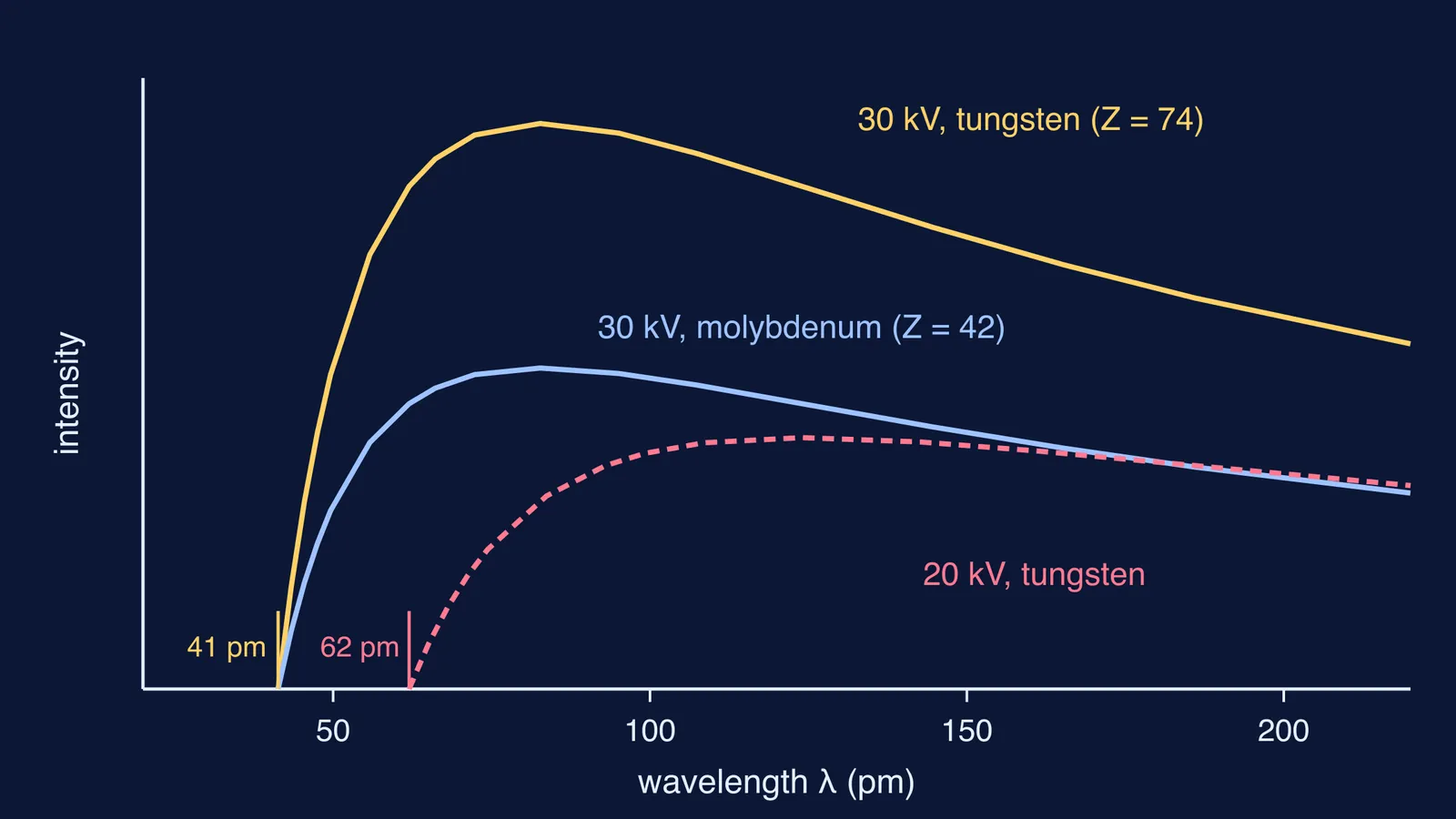
The four steps contain only the electron's charge, the voltage, Planck's constant and the speed of light. Nothing about the target appears. The target decides how the electron loses its energy, not how much it arrived with, so it cannot shift the cutoff. The Duane-Hunt law page states the same point: the limit comes from the limited energy of the incoming electrons.
The target does change two other things:
Intensity. In Kramers' law for the continuous spectrum, the constant in front is proportional to the target's atomic number Z, so a heavier target gives more X-rays at every wavelength.
Characteristic lines. The sharp peaks on top of the continuous curve come from the differences between atomic energy levels of the target atoms, as HyperPhysics notes on the X-ray spectrum, so they move when you change the metal. Moseley measured these lines across the periodic table, which we cover in X-rays and Moseley's law.
How do you calculate the cutoff wavelength for a 30 kV tube?
Use the constants from NIST, which are exact in the SI: Planck's constant h = 6.62607015 × 10^-34 J s, the speed of light c = 299 792 458 m/s and the elementary charge e = 1.602176634 × 10^-19 C.
Electron energy: eV = 1.602176634 × 10^-19 C × 30 000 V = 4.806 × 10^-15 J, which is 30 keV. If converting between joules and electron volts still feels shaky, read our electron volt to joules guide first.
Numerator: hc = 6.62607015 × 10^-34 × 299 792 458 = 1.9864 × 10^-25 J m.
Divide: λmin = 1.9864 × 10^-25 / 4.806 × 10^-15 = 4.133 × 10^-11 m.
Convert: λmin = 41.3 pm, or 0.0413 nm.
Check with frequency: f(max) = eV/h = 7.25 × 10^18 Hz, and c/f(max) gives the same 41.3 pm.
Faster: hc/e = 1.2398 × 10^-6 V m from the same NIST values, so λmin in nanometres is about 1.24 divided by kilovolts: 1.24/30 = 0.0413 nm.
In the PHYWE Duane-Hunt experiment, students record spectra from a copper anode at 13 kV to 25 kV, plot λmin against 1/V, and get a slope of (1.233 ± 0.007) × 10^-6 V m. From the same curves they obtain h = (6.59 ± 0.04) × 10^-34 J s, close to the NIST value.
What happens to λmin when you change the voltage or current?
Because λmin is inversely proportional to V, the Duane-Hunt law gives λmin ≈ 1239.8 pm divided by the voltage in kV:
20 kV: λmin = 62.0 pm
30 kV: λmin = 41.3 pm
60 kV: λmin = 20.7 pm, half the 30 kV value
Raising the tube current sends more electrons per second, so you get more X-rays, but each electron still arrives with eV, so the cutoff does not move. Our post on predicting and testing the X-ray cutoff against voltage walks through the same relation as an experiment.
When a problem mixes this with Bragg diffraction or Moseley's law, unit slips become the main risk. The Fermi Problem Library has worked problems with a step-by-step solver that explains the reasoning rather than printing an answer, so you can see where each unit goes. If the idea of photon energy itself feels unclear, the Fermi Concept Library gives each physics concept its own lesson.